

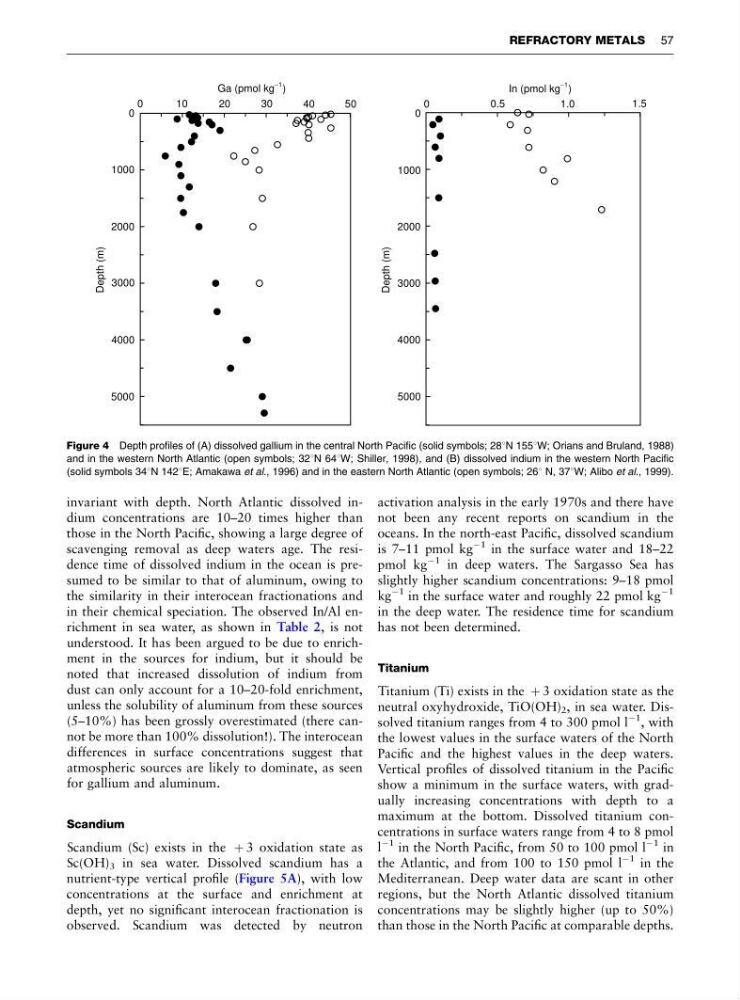
invariant with depth. North Atlantic dissolved indium concentrations are 10–20 times higher than
those in the North Pacific, showing a large degree of
scavenging removal as deep waters age. The residence time of dissolved indium in the ocean is presumed to be similar to that of aluminum, owing to
the similarity in their interocean fractionations and
in their chemical speciation. The observed In/Al enrichment in sea water, as shown in Table 2, is not
understood. It has been argued to be due to enrichment in the sources for indium, but it should be
noted that increased dissolution of indium from
dust can only account for a 10–20-fold enrichment,
unless the solubility of aluminum from these sources
(5–10%) has been grossly overestimated (there cannot be more than 100% dissolution!). The interocean
differences in surface concentrations suggest that
atmospheric sources are likely to dominate, as seen
for gallium and aluminum.
Scandium
Scandium (Sc) exists in the þ 3 oxidation state as
Sc(OH) 3 in sea water. Dissolved scandium has a
nutrient-type vertical profile (Figure 5A), with low
concentrations at the surface and enrichment at
depth, yet no significant interocean fractionation is
observed. Scandium was detected by neutron
activation analysis in the early 1970s and there have
not been any recent reports on scandium in the
oceans. In the north-east Pacific, dissolved scandium
is 7–11 pmol kg
À1 in the surface water and 18–22
pmol kg
À1 in deep waters. The Sargasso Sea has
slightly higher scandium concentrations: 9–18 pmol
kg
À1 in the surface water and roughly 22 pmol kg
À1
in the deep water. The residence time for scandium
has not been determined.
Titanium
Titanium (Ti) exists in the þ 3 oxidation state as the
neutral oxyhydroxide, TiO(OH) 2 , in sea water. Dissolved titanium ranges from 4 to 300 pmol l
À1
, with
the lowest values in the surface waters of the North
Pacific and the highest values in the deep waters.
Vertical profiles of dissolved titanium in the Pacific
show a minimum in the surface waters, with gradually increasing concentrations with depth to a
maximum at the bottom. Dissolved titanium concentrations in surface waters range from 4 to 8 pmol
l
À1 in the North Pacific, from 50 to 100 pmol l
À1 in
the Atlantic, and from 100 to 150 pmol l
À1 in the
Mediterranean. Deep water data are scant in other
regions, but the North Atlantic dissolved titanium
concentrations may be slightly higher (up to 50%)
than those in the North Pacific at comparable depths.
0
1000
2000
3000
4000
5000
0
10
20
30
40
Ga (pmol kg
_ 1 )
Depth (m)
0
1000
2000
3000
4000
5000
0
0.5
1.0
1.5
In (pmol kg
_ 1 )
Depth (m)
50
Figure 4 Depth profiles of (A) dissolved gallium in the central North Pacific (solid symbols; 281N 1551W; Orians and Bruland, 1988)
and in the western North Atlantic (open symbols; 321N 641W; Shiller, 1998), and (B) dissolved indium in the western North Pacific
(solid symbols 341N 1421E; Amakawa et al., 1996) and in the eastern North Atlantic (open symbols; 261 N, 371W; Alibo et al., 1999).
REFRACTORY METALS 57
those in the North Pacific, showing a large degree of
scavenging removal as deep waters age. The residence time of dissolved indium in the ocean is presumed to be similar to that of aluminum, owing to
the similarity in their interocean fractionations and
in their chemical speciation. The observed In/Al enrichment in sea water, as shown in Table 2, is not
understood. It has been argued to be due to enrichment in the sources for indium, but it should be
noted that increased dissolution of indium from
dust can only account for a 10–20-fold enrichment,
unless the solubility of aluminum from these sources
(5–10%) has been grossly overestimated (there cannot be more than 100% dissolution!). The interocean
differences in surface concentrations suggest that
atmospheric sources are likely to dominate, as seen
for gallium and aluminum.
Scandium
Scandium (Sc) exists in the þ 3 oxidation state as
Sc(OH) 3 in sea water. Dissolved scandium has a
nutrient-type vertical profile (Figure 5A), with low
concentrations at the surface and enrichment at
depth, yet no significant interocean fractionation is
observed. Scandium was detected by neutron
activation analysis in the early 1970s and there have
not been any recent reports on scandium in the
oceans. In the north-east Pacific, dissolved scandium
is 7–11 pmol kg
À1 in the surface water and 18–22
pmol kg
À1 in deep waters. The Sargasso Sea has
slightly higher scandium concentrations: 9–18 pmol
kg
À1 in the surface water and roughly 22 pmol kg
À1
in the deep water. The residence time for scandium
has not been determined.
Titanium
Titanium (Ti) exists in the þ 3 oxidation state as the
neutral oxyhydroxide, TiO(OH) 2 , in sea water. Dissolved titanium ranges from 4 to 300 pmol l
À1
, with
the lowest values in the surface waters of the North
Pacific and the highest values in the deep waters.
Vertical profiles of dissolved titanium in the Pacific
show a minimum in the surface waters, with gradually increasing concentrations with depth to a
maximum at the bottom. Dissolved titanium concentrations in surface waters range from 4 to 8 pmol
l
À1 in the North Pacific, from 50 to 100 pmol l
À1 in
the Atlantic, and from 100 to 150 pmol l
À1 in the
Mediterranean. Deep water data are scant in other
regions, but the North Atlantic dissolved titanium
concentrations may be slightly higher (up to 50%)
than those in the North Pacific at comparable depths.
0
1000
2000
3000
4000
5000
0
10
20
30
40
Ga (pmol kg
_ 1 )
Depth (m)
0
1000
2000
3000
4000
5000
0
0.5
1.0
1.5
In (pmol kg
_ 1 )
Depth (m)
50
Figure 4 Depth profiles of (A) dissolved gallium in the central North Pacific (solid symbols; 281N 1551W; Orians and Bruland, 1988)
and in the western North Atlantic (open symbols; 321N 641W; Shiller, 1998), and (B) dissolved indium in the western North Pacific
(solid symbols 341N 1421E; Amakawa et al., 1996) and in the eastern North Atlantic (open symbols; 261 N, 371W; Alibo et al., 1999).
REFRACTORY METALS 57