

diffusivity of gas in water), and varies widely between gases depending primarily on the molecular
cross-section. From moment to moment, the flux of
any particular gas is dependent on interfacial turbulence which is generated by shear between the
wind and the sea surface whereby higher wind speed
causes increasing turbulence and thus stimulating the
onset of waves and eventually the production of
bubbles and sea spray. There are considerable uncertainties relating gas exchange to wind speed.
These arise due to the various sea-state factors (wave
height, swell, breaking waves, bubble entrainment,
surfactants, and others) whose individual dependencies on actual wind speed and wind history are not
well quantified. The fluxes of gases across the air–sea
interface are usually calculated using a wind-speed
parameterization. These estimates are considered to
be accurate to within a factor of 2 or so.
This article summarizes the characteristics of
several important trace gases – dimethylsulfide, carbonyl sulfide, carbon disulfide, nonmethane hydrocarbons, ammonia and methylhalides – focusing on
their production and fate as it is determined by
biological and chemical processes.
Dimethylsulfide
Natural and anthropogenic sulfur aerosols play a
major role in atmospheric chemistry and potentially
in modulating global climate. One theory holds that
a negative feedback links the emission of volatile
organic sulfur (mostly as DMS) from the ocean with
the formation of cloud condensation nuclei, thereby
regulating, in a sense, the albedo and radiation balance of the earth. The direct (backscattering and
reflection of solar radiation by sulfate aerosols) and
indirect (cloud albedo) effects of sulfate aerosols may
reduce the climatic forcing of trace greenhouse gases
like CO 2 , N 2 O and CH 4 . The oxidation products of
DMS which also contribute to the acidity of rain,
particularly in marine areas, result from industrialized and/or well-populated land.
Dimethylsulfide (DMS) is the most abundant
volatile sulfur compound in sea water and constitutes
about half of the global biogenic sulfur flux to the
atmosphere. Studies of the concentration of DMS in
the ocean have shown that average surface water
concentrations may vary by up to a factor of 50
between summer and winter in mid and high latitudes. Furthermore, there are large-scale variations
in DMS concentration associated with phytoplankton biomass, although there are generally poor
correlations between local oceanic DMS concentrations and the biomass and productivity of phytoplankton (due to differences between plankton
species in ability to produce DMS).
The nature and rates of the processes involved in
the production and consumption of DMS in sea
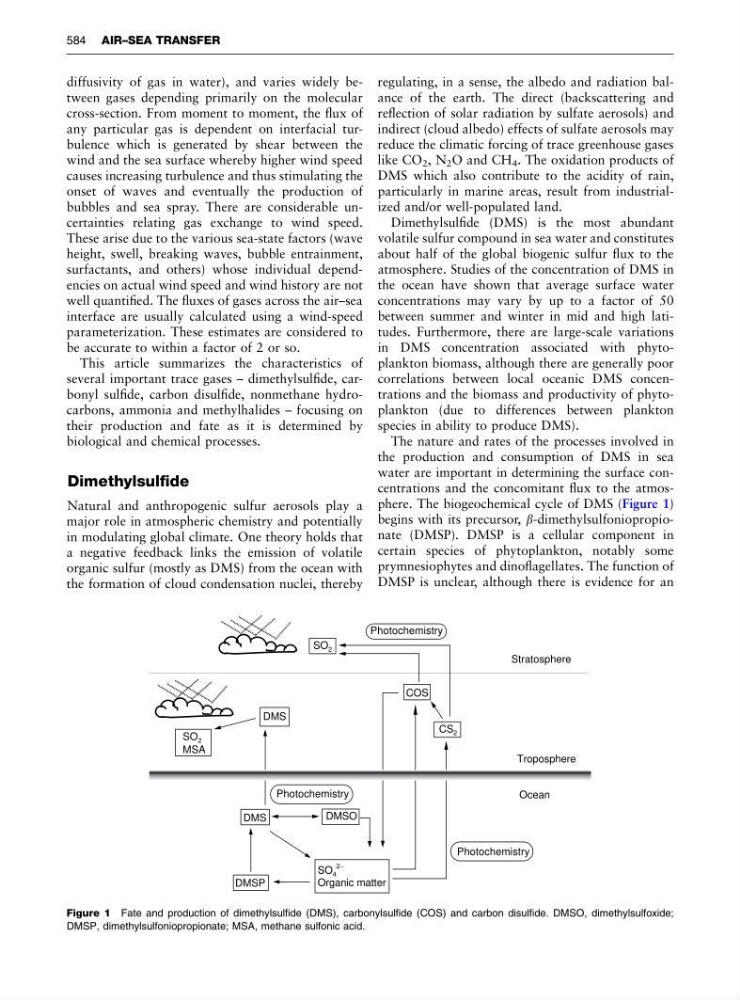
water are important in determining the surface concentrations and the concomitant flux to the atmosphere. The biogeochemical cycle of DMS (Figure 1)
begins with its precursor, b-dimethylsulfoniopropionate (DMSP). DMSP is a cellular component in
certain species of phytoplankton, notably some
prymnesiophytes and dinoflagellates. The function of
DMSP is unclear, although there is evidence for an
DMS
DMSP
DMSO
CS 2
COS
DMS
SO 2
Troposphere
Ocean
SO 2
MSA
Stratosphere
SO 4
2 _
Organic matter
Photochemistry
Photochemistry
Photochemistry
Figure 1 Fate and production of dimethylsulfide (DMS), carbonylsulfide (COS) and carbon disulfide. DMSO, dimethylsulfoxide;
DMSP, dimethylsulfoniopropionate; MSA, methane sulfonic acid.
584 AIR–SEA TRANSFER