

from the photic zone. Diatom skeletons are the primary form of biogenic silica in deposits associated
with coastal upwelling areas, high-latitude oceans
(predominantly in the Pacific and the Southern
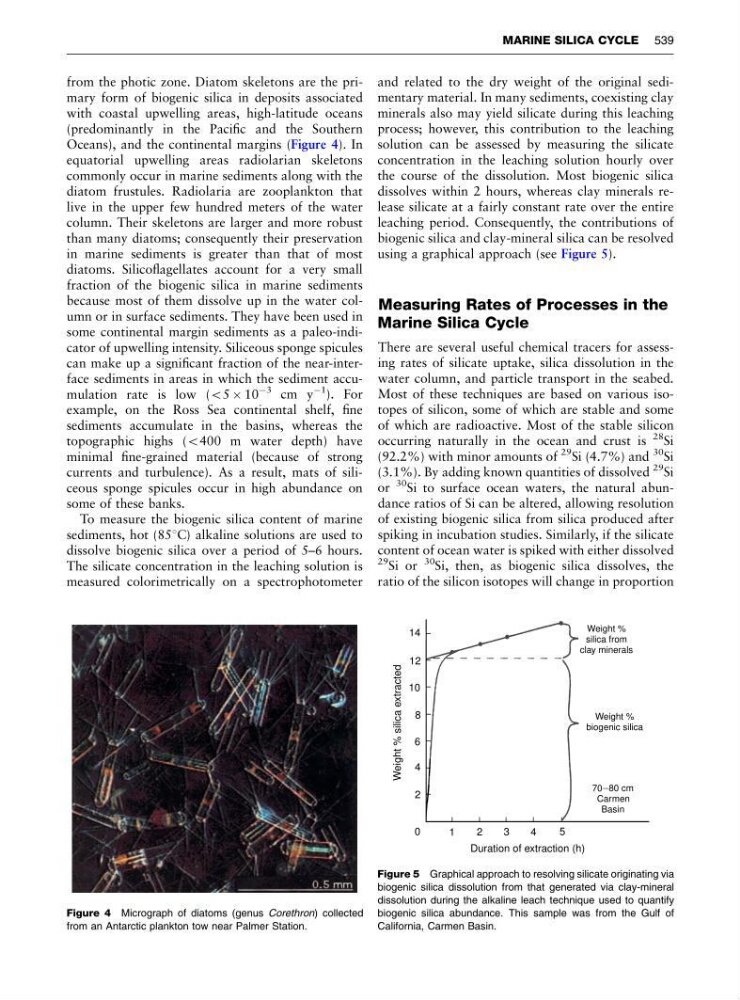
Oceans), and the continental margins (Figure 4). In
equatorial upwelling areas radiolarian skeletons
commonly occur in marine sediments along with the
diatom frustules. Radiolaria are zooplankton that
live in the upper few hundred meters of the water
column. Their skeletons are larger and more robust
than many diatoms; consequently their preservation
in marine sediments is greater than that of most
diatoms. Silicoflagellates account for a very small
fraction of the biogenic silica in marine sediments
because most of them dissolve up in the water column or in surface sediments. They have been used in
some continental margin sediments as a paleo-indicator of upwelling intensity. Siliceous sponge spicules
can make up a significant fraction of the near-interface sediments in areas in which the sediment accumulation rate is low (o5 Â 10
À3 cm y
À1
). For
example, on the Ross Sea continental shelf, fine
sediments accumulate in the basins, whereas the
topographic highs (o400 m water depth) have
minimal fine-grained material (because of strong
currents and turbulence). As a result, mats of siliceous sponge spicules occur in high abundance on
some of these banks.
To measure the biogenic silica content of marine
sediments, hot (851C) alkaline solutions are used to
dissolve biogenic silica over a period of 5–6 hours.
The silicate concentration in the leaching solution is
measured colorimetrically on a spectrophotometer
and related to the dry weight of the original sedimentary material. In many sediments, coexisting clay
minerals also may yield silicate during this leaching
process; however, this contribution to the leaching
solution can be assessed by measuring the silicate
concentration in the leaching solution hourly over
the course of the dissolution. Most biogenic silica
dissolves within 2 hours, whereas clay minerals release silicate at a fairly constant rate over the entire
leaching period. Consequently, the contributions of
biogenic silica and clay-mineral silica can be resolved
using a graphical approach (see Figure 5).
Measuring Rates of Processes in the
Marine Silica Cycle
There are several useful chemical tracers for assessing rates of silicate uptake, silica dissolution in the
water column, and particle transport in the seabed.
Most of these techniques are based on various isotopes of silicon, some of which are stable and some
of which are radioactive. Most of the stable silicon
occurring naturally in the ocean and crust is
28
Si
(92.2%) with minor amounts of
29 Si (4.7%) and
30
Si
(3.1%). By adding known quantities of dissolved
29
Si
or
30 Si to surface ocean waters, the natural abundance ratios of Si can be altered, allowing resolution
of existing biogenic silica from silica produced after
spiking in incubation studies. Similarly, if the silicate
content of ocean water is spiked with either dissolved
29 Si or
30
Si, then, as biogenic silica dissolves, the
ratio of the silicon isotopes will change in proportion
Figure 4 Micrograph of diatoms (genus Corethron) collected
from an Antarctic plankton tow near Palmer Station.
Weight %
silica from
clay minerals
Weight %
biogenic silica
70 _ 80 cm
Carmen
Basin
14
12
10
Weight % silica extracted
1
2
Duration of extraction (h)
3
4
5
8
6
4
2
0
Figure 5 Graphical approach to resolving silicate originating via
biogenic silica dissolution from that generated via clay-mineral
dissolution during the alkaline leach technique used to quantify
biogenic silica abundance. This sample was from the Gulf of
California, Carmen Basin.
MARINE SILICA CYCLE 539
with coastal upwelling areas, high-latitude oceans
(predominantly in the Pacific and the Southern
Oceans), and the continental margins (Figure 4). In
equatorial upwelling areas radiolarian skeletons
commonly occur in marine sediments along with the
diatom frustules. Radiolaria are zooplankton that
live in the upper few hundred meters of the water
column. Their skeletons are larger and more robust
than many diatoms; consequently their preservation
in marine sediments is greater than that of most
diatoms. Silicoflagellates account for a very small
fraction of the biogenic silica in marine sediments
because most of them dissolve up in the water column or in surface sediments. They have been used in
some continental margin sediments as a paleo-indicator of upwelling intensity. Siliceous sponge spicules
can make up a significant fraction of the near-interface sediments in areas in which the sediment accumulation rate is low (o5 Â 10
À3 cm y
À1
). For
example, on the Ross Sea continental shelf, fine
sediments accumulate in the basins, whereas the
topographic highs (o400 m water depth) have
minimal fine-grained material (because of strong
currents and turbulence). As a result, mats of siliceous sponge spicules occur in high abundance on
some of these banks.
To measure the biogenic silica content of marine
sediments, hot (851C) alkaline solutions are used to
dissolve biogenic silica over a period of 5–6 hours.
The silicate concentration in the leaching solution is
measured colorimetrically on a spectrophotometer
and related to the dry weight of the original sedimentary material. In many sediments, coexisting clay
minerals also may yield silicate during this leaching
process; however, this contribution to the leaching
solution can be assessed by measuring the silicate
concentration in the leaching solution hourly over
the course of the dissolution. Most biogenic silica
dissolves within 2 hours, whereas clay minerals release silicate at a fairly constant rate over the entire
leaching period. Consequently, the contributions of
biogenic silica and clay-mineral silica can be resolved
using a graphical approach (see Figure 5).
Measuring Rates of Processes in the
Marine Silica Cycle
There are several useful chemical tracers for assessing rates of silicate uptake, silica dissolution in the
water column, and particle transport in the seabed.
Most of these techniques are based on various isotopes of silicon, some of which are stable and some
of which are radioactive. Most of the stable silicon
occurring naturally in the ocean and crust is
28
Si
(92.2%) with minor amounts of
29 Si (4.7%) and
30
Si
(3.1%). By adding known quantities of dissolved
29
Si
or
30 Si to surface ocean waters, the natural abundance ratios of Si can be altered, allowing resolution
of existing biogenic silica from silica produced after
spiking in incubation studies. Similarly, if the silicate
content of ocean water is spiked with either dissolved
29 Si or
30
Si, then, as biogenic silica dissolves, the
ratio of the silicon isotopes will change in proportion
Figure 4 Micrograph of diatoms (genus Corethron) collected
from an Antarctic plankton tow near Palmer Station.
Weight %
silica from
clay minerals
Weight %
biogenic silica
70 _ 80 cm
Carmen
Basin
14
12
10
Weight % silica extracted
1
2
Duration of extraction (h)
3
4
5
8
6
4
2
0
Figure 5 Graphical approach to resolving silicate originating via
biogenic silica dissolution from that generated via clay-mineral
dissolution during the alkaline leach technique used to quantify
biogenic silica abundance. This sample was from the Gulf of
California, Carmen Basin.
MARINE SILICA CYCLE 539