

RARE EARTH ELEMENTS AND THEIR ISOTOPES
IN THE OCEAN
Y. Nozaki
w , University of Tokyo, Tokyo, Japan
Copyright & 2001 Elsevier Ltd.
Introduction
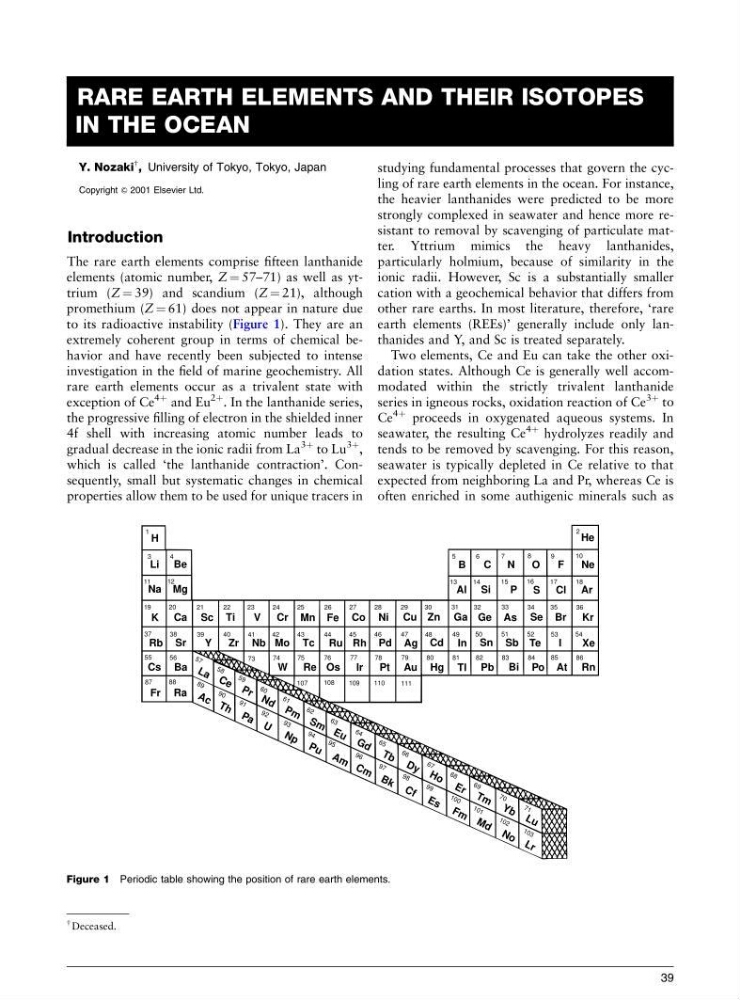
The rare earth elements comprise fifteen lanthanide
elements (atomic number, Z ¼ 57–71) as well as yttrium (Z ¼ 39) and scandium (Z ¼ 21), although
promethium (Z ¼ 61) does not appear in nature due
to its radioactive instability (Figure 1). They are an
extremely coherent group in terms of chemical behavior and have recently been subjected to intense
investigation in the field of marine geochemistry. All
rare earth elements occur as a trivalent state with
exception of Ce
4þ and Eu
2þ . In the lanthanide series,
the progressive filling of electron in the shielded inner
4f shell with increasing atomic number leads to
gradual decrease in the ionic radii from La
3þ to Lu
3þ
,
which is called ‘the lanthanide contraction’. Consequently, small but systematic changes in chemical
properties allow them to be used for unique tracers in
studying fundamental processes that govern the cycling of rare earth elements in the ocean. For instance,
the heavier lanthanides were predicted to be more
strongly complexed in seawater and hence more resistant to removal by scavenging of particulate matter. Yttrium mimics the heavy lanthanides,
particularly holmium, because of similarity in the
ionic radii. However, Sc is a substantially smaller
cation with a geochemical behavior that differs from
other rare earths. In most literature, therefore, ‘rare
earth elements (REEs)’ generally include only lanthanides and Y, and Sc is treated separately.
Two elements, Ce and Eu can take the other oxidation states. Although Ce is generally well accommodated within the strictly trivalent lanthanide
series in igneous rocks, oxidation reaction of Ce
3þ to
Ce
4þ proceeds in oxygenated aqueous systems. In
seawater, the resulting Ce
4þ hydrolyzes readily and
tends to be removed by scavenging. For this reason,
seawater is typically depleted in Ce relative to that
expected from neighboring La and Pr, whereas Ce is
often enriched in some authigenic minerals such as
H
Li Be
Na Mg
K Ca
1
3
4
11
12
19
20
37
38
55
87
88
Fr Ra
Cs Ba
Rb Sr
56
8 9
9 0
9 1
9 2
9 3
9 4
9 5
9 6
9 7
9 8
9 9
1 0 0
1 0 1
1 0 2
1 0 3
A c T h P a
P u A m C m
B k C f E s
F m
M d
N o L r
U
N p
N d P m
S m
G d
T b
D y H o
E r T m
Y b L u
E u
6 0
6 1
6 2
6 3
6 4
6 5
6 6
6 7
6 8
6 9
7 0
7 1
Sc Ti
21
22
39
40
Y
Zr
V
Cr Mn
23
24
25
41
42
43
73
74
75
107
Nb Mo Tc
W Re
Fe Co Ni Cu
26
27
28
29
44
45
46
47
76
77
78
79
108
109
110
111
Ru Rh Pd Ag
Os
Ir
Pt Au
Zn Ga Ge As
30
31
32
33
5
6
7
13
14
15
Al Si
P
48
49
50
51
80
81
82
83
Cd In Sn Sb
Hg Tl Pb Bi
B
C
N
Se Br
Kr
34
35
36
2
8
9
10
16
17
18
S
Cl Ar
52
53
54
84
85
86
Te
I
Xe
Po At Rn
O
F
Ne
He
L a
5 7
C e
5 8
P r
5 9
Figure 1 Periodic table showing the position of rare earth elements.
w Deceased.
39
IN THE OCEAN
Y. Nozaki
w , University of Tokyo, Tokyo, Japan
Copyright & 2001 Elsevier Ltd.
Introduction
The rare earth elements comprise fifteen lanthanide
elements (atomic number, Z ¼ 57–71) as well as yttrium (Z ¼ 39) and scandium (Z ¼ 21), although
promethium (Z ¼ 61) does not appear in nature due
to its radioactive instability (Figure 1). They are an
extremely coherent group in terms of chemical behavior and have recently been subjected to intense
investigation in the field of marine geochemistry. All
rare earth elements occur as a trivalent state with
exception of Ce
4þ and Eu
2þ . In the lanthanide series,
the progressive filling of electron in the shielded inner
4f shell with increasing atomic number leads to
gradual decrease in the ionic radii from La
3þ to Lu
3þ
,
which is called ‘the lanthanide contraction’. Consequently, small but systematic changes in chemical
properties allow them to be used for unique tracers in
studying fundamental processes that govern the cycling of rare earth elements in the ocean. For instance,
the heavier lanthanides were predicted to be more
strongly complexed in seawater and hence more resistant to removal by scavenging of particulate matter. Yttrium mimics the heavy lanthanides,
particularly holmium, because of similarity in the
ionic radii. However, Sc is a substantially smaller
cation with a geochemical behavior that differs from
other rare earths. In most literature, therefore, ‘rare
earth elements (REEs)’ generally include only lanthanides and Y, and Sc is treated separately.
Two elements, Ce and Eu can take the other oxidation states. Although Ce is generally well accommodated within the strictly trivalent lanthanide
series in igneous rocks, oxidation reaction of Ce
3þ to
Ce
4þ proceeds in oxygenated aqueous systems. In
seawater, the resulting Ce
4þ hydrolyzes readily and
tends to be removed by scavenging. For this reason,
seawater is typically depleted in Ce relative to that
expected from neighboring La and Pr, whereas Ce is
often enriched in some authigenic minerals such as
H
Li Be
Na Mg
K Ca
1
3
4
11
12
19
20
37
38
55
87
88
Fr Ra
Cs Ba
Rb Sr
56
8 9
9 0
9 1
9 2
9 3
9 4
9 5
9 6
9 7
9 8
9 9
1 0 0
1 0 1
1 0 2
1 0 3
A c T h P a
P u A m C m
B k C f E s
F m
M d
N o L r
U
N p
N d P m
S m
G d
T b
D y H o
E r T m
Y b L u
E u
6 0
6 1
6 2
6 3
6 4
6 5
6 6
6 7
6 8
6 9
7 0
7 1
Sc Ti
21
22
39
40
Y
Zr
V
Cr Mn
23
24
25
41
42
43
73
74
75
107
Nb Mo Tc
W Re
Fe Co Ni Cu
26
27
28
29
44
45
46
47
76
77
78
79
108
109
110
111
Ru Rh Pd Ag
Os
Ir
Pt Au
Zn Ga Ge As
30
31
32
33
5
6
7
13
14
15
Al Si
P
48
49
50
51
80
81
82
83
Cd In Sn Sb
Hg Tl Pb Bi
B
C
N
Se Br
Kr
34
35
36
2
8
9
10
16
17
18
S
Cl Ar
52
53
54
84
85
86
Te
I
Xe
Po At Rn
O
F
Ne
He
L a
5 7
C e
5 8
P r
5 9
Figure 1 Periodic table showing the position of rare earth elements.
w Deceased.
39