

multiplied by the global area occupied by estuaries to
range from 0.22 Tg N 2 O y
À1 to 5.7 Tg y
À1 depending
on the characteristics of the rivers studied. Independent estimates based on budgets of nitrogen
input to rivers, assumptions about the fraction of
inorganic nitrogen species removed by nitrification
or denitrification, and the fractional ‘yield’ of nitrous
oxide production during these processes indicate that
nitrous oxide fluxes to the atmosphere from estuaries
is about 0.06–0.34 Tg N 2 O y
À1
.
Carbon Dioxide (CO 2 ) and Oxygen (O 2 )
Estuaries are typically heterotrophic systems, which
means that the amount of organic matter respired
within the estuary exceeds the amount of organic
matter fixed by primary producers (phytoplankton
and macrophytes). Since production of carbon dioxide then exceeds biological removal of carbon dioxide, it follows that estuaries are likely to be sources
of the gas to the atmosphere. At the same time, since
oxidation of organic matter to CO 2 requires oxygen,
the heterotrophic nature of estuaries suggests that
they represent sinks for atmospheric oxygen. In
many estuaries, primary productivity is severely
limited by the amount of light that penetrates into
the water due to high particulate loadings in the
water. In addition, large amounts of organic matter
may be supplied to the estuary by runoff from agricultural and forested land, from ground water, from
sewage effluent, and from organic matter in the river
itself. There are many reports of estuarine systems
with oxygen saturations below 1 (undersaturated
with respect to the atmosphere), but few studies in
which oxygen flux to the estuary has been reported.
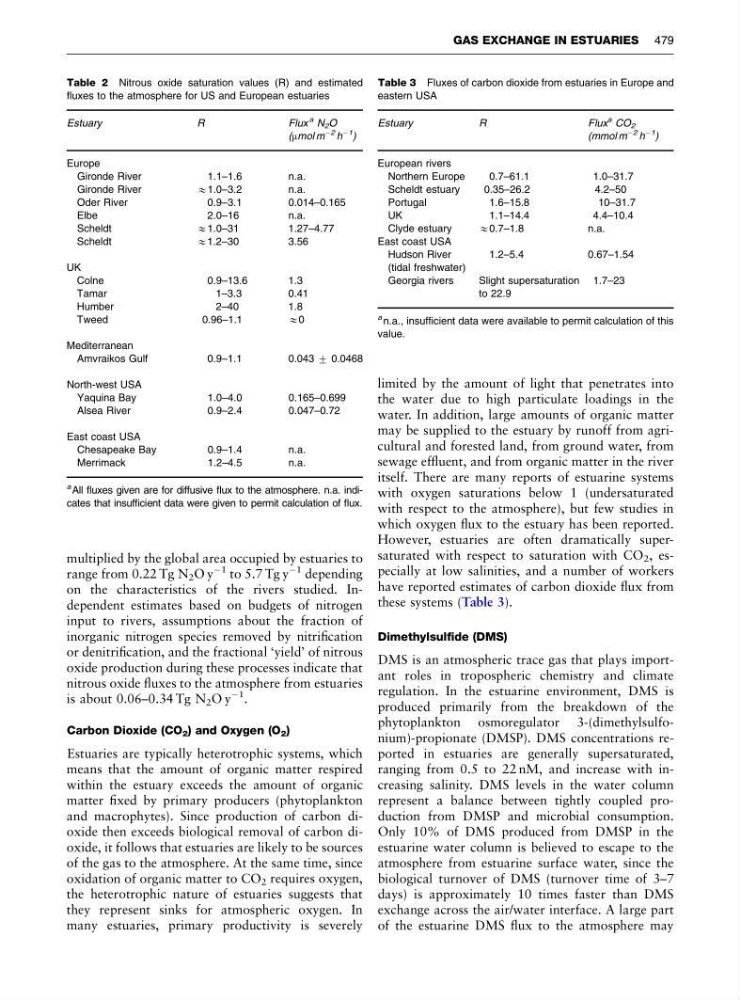
However, estuaries are often dramatically supersaturated with respect to saturation with CO 2 , especially at low salinities, and a number of workers
have reported estimates of carbon dioxide flux from
these systems (Table 3).
Dimethylsulfide (DMS)
DMS is an atmospheric trace gas that plays important roles in tropospheric chemistry and climate
regulation. In the estuarine environment, DMS is
produced primarily from the breakdown of the
phytoplankton osmoregulator 3-(dimethylsulfonium)-propionate (DMSP). DMS concentrations reported in estuaries are generally supersaturated,
ranging from 0.5 to 22 nM, and increase with increasing salinity. DMS levels in the water column
represent a balance between tightly coupled production from DMSP and microbial consumption.
Only 10% of DMS produced from DMSP in the
estuarine water column is believed to escape to the
atmosphere from estuarine surface water, since the
biological turnover of DMS (turnover time of 3–7
days) is approximately 10 times faster than DMS
exchange across the air/water interface. A large part
of the estuarine DMS flux to the atmosphere may
Table 3 Fluxes of carbon dioxide from estuaries in Europe and
eastern USA
Estuary
R
Flux
a CO 2
(mmol m
À2 h
À1 )
European rivers
Northern Europe
0.7–61.1
1.0–31.7
Scheldt estuary
0.35–26.2
4.2–50
Portugal
1.6–15.8
10–31.7
UK
1.1–14.4
4.4–10.4
Clyde estuary
E0.7–1.8
n.a.
East coast USA
Hudson River
1.2–5.4
0.67–1.54
(tidal freshwater)
Georgia rivers
Slight supersaturation
to 22.9
1.7–23
a n.a., insufficient data were available to permit calculation of this
value.
Table 2 Nitrous oxide saturation values (R) and estimated
fluxes to the atmosphere for US and European estuaries
Estuary
R
Flux
a N 2 O
(mmol m
À2 h
À1 )
Europe
Gironde River
1.1–1.6
n.a.
Gironde River
E1.0–3.2
n.a.
Oder River
0.9–3.1
0.014–0.165
Elbe
2.0–16
n.a.
Scheldt
E1.0–31
1.27–4.77
Scheldt
E1.2–30
3.56
UK
Colne
0.9–13.6
1.3
Tamar
1–3.3
0.41
Humber
2–40
1.8
Tweed
0.96–1.1
E0
Mediterranean
Amvraikos Gulf
0.9–1.1
0.043 7 0.0468
North-west USA
Yaquina Bay
1.0–4.0
0.165–0.699
Alsea River
0.9–2.4
0.047–0.72
East coast USA
Chesapeake Bay
0.9–1.4
n.a.
Merrimack
1.2–4.5
n.a.
a All fluxes given are for diffusive flux to the atmosphere. n.a. indicates that insufficient data were given to permit calculation of flux.
GAS EXCHANGE IN ESTUARIES 479
range from 0.22 Tg N 2 O y
À1 to 5.7 Tg y
À1 depending
on the characteristics of the rivers studied. Independent estimates based on budgets of nitrogen
input to rivers, assumptions about the fraction of
inorganic nitrogen species removed by nitrification
or denitrification, and the fractional ‘yield’ of nitrous
oxide production during these processes indicate that
nitrous oxide fluxes to the atmosphere from estuaries
is about 0.06–0.34 Tg N 2 O y
À1
.
Carbon Dioxide (CO 2 ) and Oxygen (O 2 )
Estuaries are typically heterotrophic systems, which
means that the amount of organic matter respired
within the estuary exceeds the amount of organic
matter fixed by primary producers (phytoplankton
and macrophytes). Since production of carbon dioxide then exceeds biological removal of carbon dioxide, it follows that estuaries are likely to be sources
of the gas to the atmosphere. At the same time, since
oxidation of organic matter to CO 2 requires oxygen,
the heterotrophic nature of estuaries suggests that
they represent sinks for atmospheric oxygen. In
many estuaries, primary productivity is severely
limited by the amount of light that penetrates into
the water due to high particulate loadings in the
water. In addition, large amounts of organic matter
may be supplied to the estuary by runoff from agricultural and forested land, from ground water, from
sewage effluent, and from organic matter in the river
itself. There are many reports of estuarine systems
with oxygen saturations below 1 (undersaturated
with respect to the atmosphere), but few studies in
which oxygen flux to the estuary has been reported.
However, estuaries are often dramatically supersaturated with respect to saturation with CO 2 , especially at low salinities, and a number of workers
have reported estimates of carbon dioxide flux from
these systems (Table 3).
Dimethylsulfide (DMS)
DMS is an atmospheric trace gas that plays important roles in tropospheric chemistry and climate
regulation. In the estuarine environment, DMS is
produced primarily from the breakdown of the
phytoplankton osmoregulator 3-(dimethylsulfonium)-propionate (DMSP). DMS concentrations reported in estuaries are generally supersaturated,
ranging from 0.5 to 22 nM, and increase with increasing salinity. DMS levels in the water column
represent a balance between tightly coupled production from DMSP and microbial consumption.
Only 10% of DMS produced from DMSP in the
estuarine water column is believed to escape to the
atmosphere from estuarine surface water, since the
biological turnover of DMS (turnover time of 3–7
days) is approximately 10 times faster than DMS
exchange across the air/water interface. A large part
of the estuarine DMS flux to the atmosphere may
Table 3 Fluxes of carbon dioxide from estuaries in Europe and
eastern USA
Estuary
R
Flux
a CO 2
(mmol m
À2 h
À1 )
European rivers
Northern Europe
0.7–61.1
1.0–31.7
Scheldt estuary
0.35–26.2
4.2–50
Portugal
1.6–15.8
10–31.7
UK
1.1–14.4
4.4–10.4
Clyde estuary
E0.7–1.8
n.a.
East coast USA
Hudson River
1.2–5.4
0.67–1.54
(tidal freshwater)
Georgia rivers
Slight supersaturation
to 22.9
1.7–23
a n.a., insufficient data were available to permit calculation of this
value.
Table 2 Nitrous oxide saturation values (R) and estimated
fluxes to the atmosphere for US and European estuaries
Estuary
R
Flux
a N 2 O
(mmol m
À2 h
À1 )
Europe
Gironde River
1.1–1.6
n.a.
Gironde River
E1.0–3.2
n.a.
Oder River
0.9–3.1
0.014–0.165
Elbe
2.0–16
n.a.
Scheldt
E1.0–31
1.27–4.77
Scheldt
E1.2–30
3.56
UK
Colne
0.9–13.6
1.3
Tamar
1–3.3
0.41
Humber
2–40
1.8
Tweed
0.96–1.1
E0
Mediterranean
Amvraikos Gulf
0.9–1.1
0.043 7 0.0468
North-west USA
Yaquina Bay
1.0–4.0
0.165–0.699
Alsea River
0.9–2.4
0.047–0.72
East coast USA
Chesapeake Bay
0.9–1.4
n.a.
Merrimack
1.2–4.5
n.a.
a All fluxes given are for diffusive flux to the atmosphere. n.a. indicates that insufficient data were given to permit calculation of flux.
GAS EXCHANGE IN ESTUARIES 479