

above, the largest portion of the high frequency signal is controlled by ice volume changes.
The benthic foraminiferal d
18 O increase at
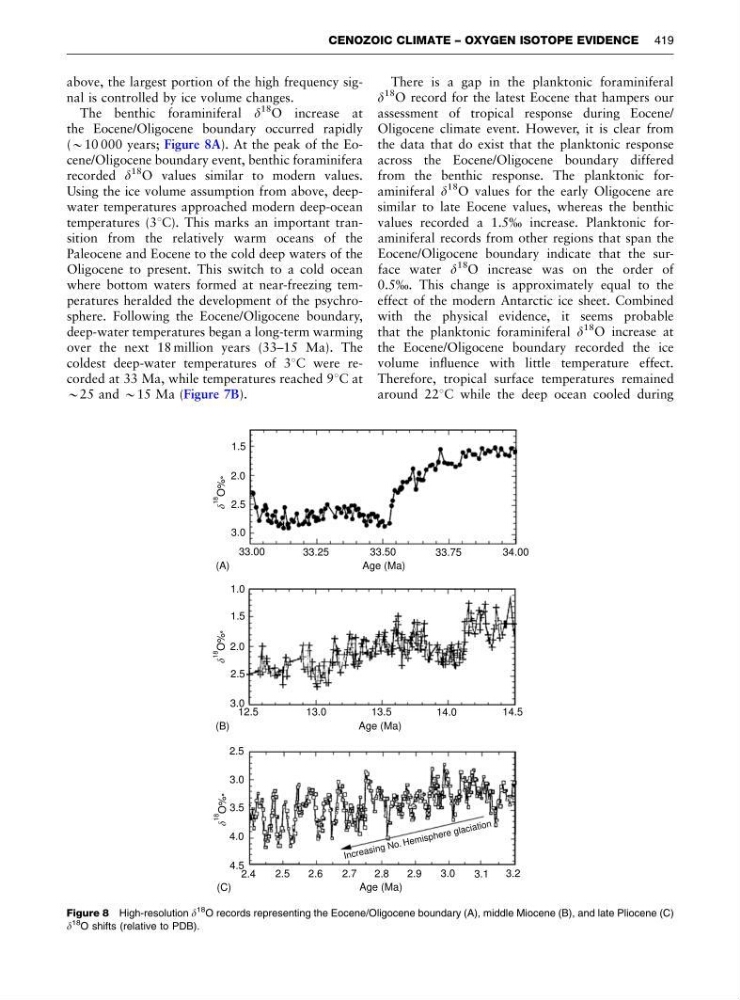
the Eocene/Oligocene boundary occurred rapidly
(B10 000 years; Figure 8A). At the peak of the Eocene/Oligocene boundary event, benthic foraminifera
recorded d
18 O values similar to modern values.
Using the ice volume assumption from above, deepwater temperatures approached modern deep-ocean
temperatures (31C). This marks an important transition from the relatively warm oceans of the
Paleocene and Eocene to the cold deep waters of the
Oligocene to present. This switch to a cold ocean
where bottom waters formed at near-freezing temperatures heralded the development of the psychrosphere. Following the Eocene/Oligocene boundary,
deep-water temperatures began a long-term warming
over the next 18 million years (33–15 Ma). The
coldest deep-water temperatures of 31C were recorded at 33 Ma, while temperatures reached 91C at
B25 and B15 Ma (Figure 7B).
There is a gap in the planktonic foraminiferal
d
18 O record for the latest Eocene that hampers our
assessment of tropical response during Eocene/
Oligocene climate event. However, it is clear from
the data that do exist that the planktonic response
across the Eocene/Oligocene boundary differed
from the benthic response. The planktonic foraminiferal d
18 O values for the early Oligocene are
similar to late Eocene values, whereas the benthic
values recorded a 1.5% increase. Planktonic foraminiferal records from other regions that span the
Eocene/Oligocene boundary indicate that the surface water d
18
O increase was on the order of
0.5%. This change is approximately equal to the
effect of the modern Antarctic ice sheet. Combined
with the physical evidence, it seems probable
that the planktonic foraminiferal d
18 O increase at
the Eocene/Oligocene boundary recorded the ice
volume influence with little temperature effect.
Therefore, tropical surface temperatures remained
around 221C while the deep ocean cooled during
1.5
2.0
2.5
3.0
33.00
33.25
33.50
33.75
34.00
Age (Ma)
18
O%
˚
(A)
1.0
1.5
2.0
2.5
3.0
12.5
13.0
13.5
14.0
14.5
Age (Ma)
18
O%
˚
(B)
2.5
3.0
3.5
4.0
4.5
18
O%
˚
2.4
2.5
2.6
2.7
2.8
2.9
3.0
3.1
3.2
In cr ea si ng N o. H em is ph er e gl ac ia tio n
Age (Ma)
(C)
Figure 8 High-resolution d
18 O records representing the Eocene/Oligocene boundary (A), middle Miocene (B), and late Pliocene (C)
d
18
O shifts (relative to PDB).
CENOZOIC CLIMATE – OXYGEN ISOTOPE EVIDENCE 419
The benthic foraminiferal d
18 O increase at
the Eocene/Oligocene boundary occurred rapidly
(B10 000 years; Figure 8A). At the peak of the Eocene/Oligocene boundary event, benthic foraminifera
recorded d
18 O values similar to modern values.
Using the ice volume assumption from above, deepwater temperatures approached modern deep-ocean
temperatures (31C). This marks an important transition from the relatively warm oceans of the
Paleocene and Eocene to the cold deep waters of the
Oligocene to present. This switch to a cold ocean
where bottom waters formed at near-freezing temperatures heralded the development of the psychrosphere. Following the Eocene/Oligocene boundary,
deep-water temperatures began a long-term warming
over the next 18 million years (33–15 Ma). The
coldest deep-water temperatures of 31C were recorded at 33 Ma, while temperatures reached 91C at
B25 and B15 Ma (Figure 7B).
There is a gap in the planktonic foraminiferal
d
18 O record for the latest Eocene that hampers our
assessment of tropical response during Eocene/
Oligocene climate event. However, it is clear from
the data that do exist that the planktonic response
across the Eocene/Oligocene boundary differed
from the benthic response. The planktonic foraminiferal d
18 O values for the early Oligocene are
similar to late Eocene values, whereas the benthic
values recorded a 1.5% increase. Planktonic foraminiferal records from other regions that span the
Eocene/Oligocene boundary indicate that the surface water d
18
O increase was on the order of
0.5%. This change is approximately equal to the
effect of the modern Antarctic ice sheet. Combined
with the physical evidence, it seems probable
that the planktonic foraminiferal d
18 O increase at
the Eocene/Oligocene boundary recorded the ice
volume influence with little temperature effect.
Therefore, tropical surface temperatures remained
around 221C while the deep ocean cooled during
1.5
2.0
2.5
3.0
33.00
33.25
33.50
33.75
34.00
Age (Ma)
18
O%
˚
(A)
1.0
1.5
2.0
2.5
3.0
12.5
13.0
13.5
14.0
14.5
Age (Ma)
18
O%
˚
(B)
2.5
3.0
3.5
4.0
4.5
18
O%
˚
2.4
2.5
2.6
2.7
2.8
2.9
3.0
3.1
3.2
In cr ea si ng N o. H em is ph er e gl ac ia tio n
Age (Ma)
(C)
Figure 8 High-resolution d
18 O records representing the Eocene/Oligocene boundary (A), middle Miocene (B), and late Pliocene (C)
d
18
O shifts (relative to PDB).
CENOZOIC CLIMATE – OXYGEN ISOTOPE EVIDENCE 419