

biogeochemical zonation that should parallel the
burrow walls. Burrows may provide a pathway for
communication between deep sediment and overlying water that does not depend on vertical
diffusion. Because communication depends only on
transport through the dissolved phase, it is called
irrigation. This transport is distinct from bioturbation, a process that may also be important, but it is
Concentration
Depth
Cl
_
Diffusion
Salt
dissolution
at discrete
horizon
(A)
O 2
Diffusion
+
reaction
No reaction
Concentration
(B)
TCO 2
Concentration
(C)
NH 4
+
Nitrification
Denitrification
Reaction,
diffusion,
irrigation
Concentration
Reaction rate
Production
rate
TCO 2
Only
reaction
+
diffusion
(D)
O 2
N O3
_
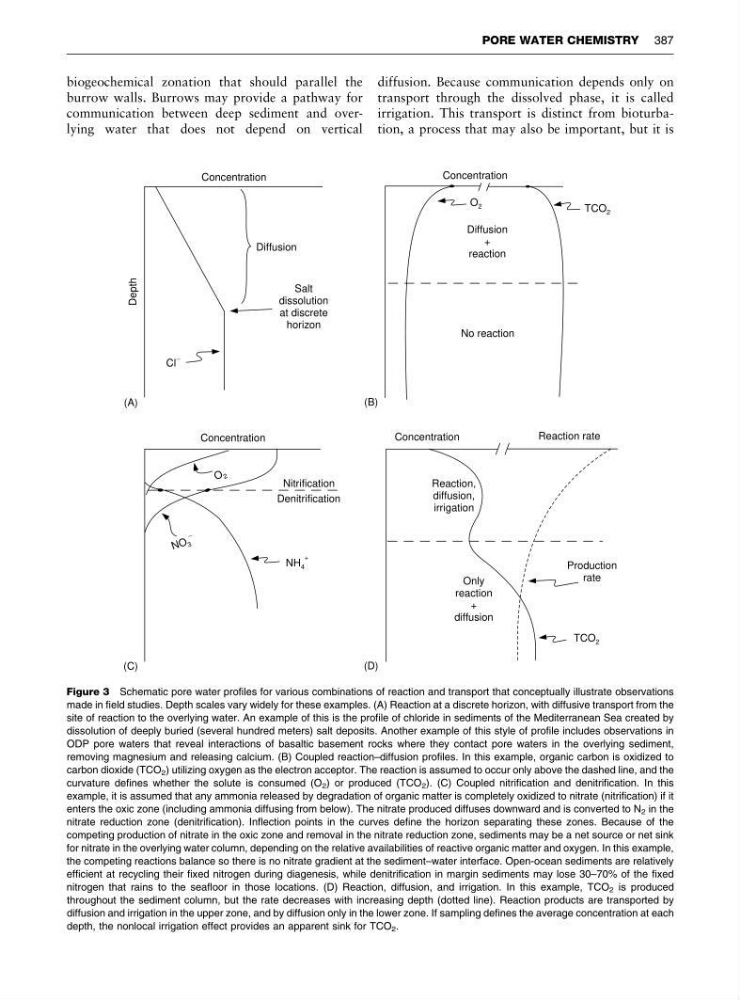
Figure 3 Schematic pore water profiles for various combinations of reaction and transport that conceptually illustrate observations
made in field studies. Depth scales vary widely for these examples. (A) Reaction at a discrete horizon, with diffusive transport from the
site of reaction to the overlying water. An example of this is the profile of chloride in sediments of the Mediterranean Sea created by
dissolution of deeply buried (several hundred meters) salt deposits. Another example of this style of profile includes observations in
ODP pore waters that reveal interactions of basaltic basement rocks where they contact pore waters in the overlying sediment,
removing magnesium and releasing calcium. (B) Coupled reaction–diffusion profiles. In this example, organic carbon is oxidized to
carbon dioxide (TCO 2 ) utilizing oxygen as the electron acceptor. The reaction is assumed to occur only above the dashed line, and the
curvature defines whether the solute is consumed (O 2 ) or produced (TCO 2 ). (C) Coupled nitrification and denitrification. In this
example, it is assumed that any ammonia released by degradation of organic matter is completely oxidized to nitrate (nitrification) if it
enters the oxic zone (including ammonia diffusing from below). The nitrate produced diffuses downward and is converted to N 2 in the
nitrate reduction zone (denitrification). Inflection points in the curves define the horizon separating these zones. Because of the
competing production of nitrate in the oxic zone and removal in the nitrate reduction zone, sediments may be a net source or net sink
for nitrate in the overlying water column, depending on the relative availabilities of reactive organic matter and oxygen. In this example,
the competing reactions balance so there is no nitrate gradient at the sediment–water interface. Open-ocean sediments are relatively
efficient at recycling their fixed nitrogen during diagenesis, while denitrification in margin sediments may lose 30–70% of the fixed
nitrogen that rains to the seafloor in those locations. (D) Reaction, diffusion, and irrigation. In this example, TCO 2 is produced
throughout the sediment column, but the rate decreases with increasing depth (dotted line). Reaction products are transported by
diffusion and irrigation in the upper zone, and by diffusion only in the lower zone. If sampling defines the average concentration at each
depth, the nonlocal irrigation effect provides an apparent sink for TCO 2 .
PORE WATER CHEMISTRY 387
burrow walls. Burrows may provide a pathway for
communication between deep sediment and overlying water that does not depend on vertical
diffusion. Because communication depends only on
transport through the dissolved phase, it is called
irrigation. This transport is distinct from bioturbation, a process that may also be important, but it is
Concentration
Depth
Cl
_
Diffusion
Salt
dissolution
at discrete
horizon
(A)
O 2
Diffusion
+
reaction
No reaction
Concentration
(B)
TCO 2
Concentration
(C)
NH 4
+
Nitrification
Denitrification
Reaction,
diffusion,
irrigation
Concentration
Reaction rate
Production
rate
TCO 2
Only
reaction
+
diffusion
(D)
O 2
N O3
_
Figure 3 Schematic pore water profiles for various combinations of reaction and transport that conceptually illustrate observations
made in field studies. Depth scales vary widely for these examples. (A) Reaction at a discrete horizon, with diffusive transport from the
site of reaction to the overlying water. An example of this is the profile of chloride in sediments of the Mediterranean Sea created by
dissolution of deeply buried (several hundred meters) salt deposits. Another example of this style of profile includes observations in
ODP pore waters that reveal interactions of basaltic basement rocks where they contact pore waters in the overlying sediment,
removing magnesium and releasing calcium. (B) Coupled reaction–diffusion profiles. In this example, organic carbon is oxidized to
carbon dioxide (TCO 2 ) utilizing oxygen as the electron acceptor. The reaction is assumed to occur only above the dashed line, and the
curvature defines whether the solute is consumed (O 2 ) or produced (TCO 2 ). (C) Coupled nitrification and denitrification. In this
example, it is assumed that any ammonia released by degradation of organic matter is completely oxidized to nitrate (nitrification) if it
enters the oxic zone (including ammonia diffusing from below). The nitrate produced diffuses downward and is converted to N 2 in the
nitrate reduction zone (denitrification). Inflection points in the curves define the horizon separating these zones. Because of the
competing production of nitrate in the oxic zone and removal in the nitrate reduction zone, sediments may be a net source or net sink
for nitrate in the overlying water column, depending on the relative availabilities of reactive organic matter and oxygen. In this example,
the competing reactions balance so there is no nitrate gradient at the sediment–water interface. Open-ocean sediments are relatively
efficient at recycling their fixed nitrogen during diagenesis, while denitrification in margin sediments may lose 30–70% of the fixed
nitrogen that rains to the seafloor in those locations. (D) Reaction, diffusion, and irrigation. In this example, TCO 2 is produced
throughout the sediment column, but the rate decreases with increasing depth (dotted line). Reaction products are transported by
diffusion and irrigation in the upper zone, and by diffusion only in the lower zone. If sampling defines the average concentration at each
depth, the nonlocal irrigation effect provides an apparent sink for TCO 2 .
PORE WATER CHEMISTRY 387