

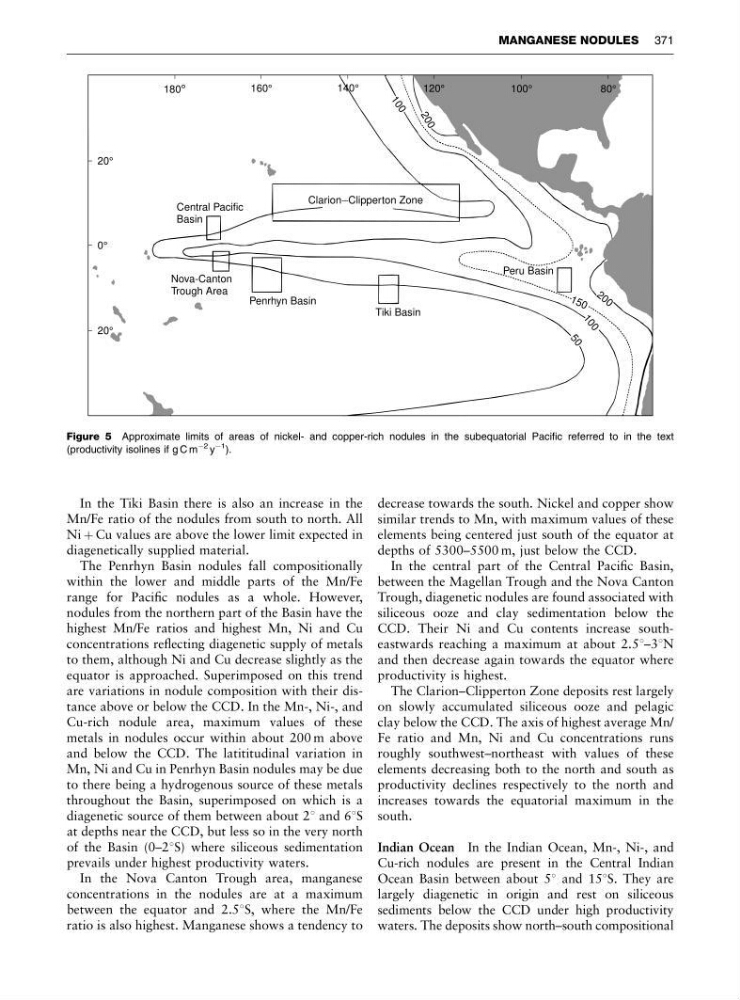
In the Tiki Basin there is also an increase in the
Mn/Fe ratio of the nodules from south to north. All
Ni þ Cu values are above the lower limit expected in
diagenetically supplied material.
The Penrhyn Basin nodules fall compositionally
within the lower and middle parts of the Mn/Fe
range for Pacific nodules as a whole. However,
nodules from the northern part of the Basin have the
highest Mn/Fe ratios and highest Mn, Ni and Cu
concentrations reflecting diagenetic supply of metals
to them, although Ni and Cu decrease slightly as the
equator is approached. Superimposed on this trend
are variations in nodule composition with their distance above or below the CCD. In the Mn-, Ni-, and
Cu-rich nodule area, maximum values of these
metals in nodules occur within about 200 m above
and below the CCD. The latititudinal variation in
Mn, Ni and Cu in Penrhyn Basin nodules may be due
to there being a hydrogenous source of these metals
throughout the Basin, superimposed on which is a
diagenetic source of them between about 21 and 61S
at depths near the CCD, but less so in the very north
of the Basin (0–21S) where siliceous sedimentation
prevails under highest productivity waters.
In the Nova Canton Trough area, manganese
concentrations in the nodules are at a maximum
between the equator and 2.51S, where the Mn/Fe
ratio is also highest. Manganese shows a tendency to
decrease towards the south. Nickel and copper show
similar trends to Mn, with maximum values of these
elements being centered just south of the equator at
depths of 5300–5500 m, just below the CCD.
In the central part of the Central Pacific Basin,
between the Magellan Trough and the Nova Canton
Trough, diagenetic nodules are found associated with
siliceous ooze and clay sedimentation below the
CCD. Their Ni and Cu contents increase southeastwards reaching a maximum at about 2.51–31N
and then decrease again towards the equator where
productivity is highest.
The Clarion–Clipperton Zone deposits rest largely
on slowly accumulated siliceous ooze and pelagic
clay below the CCD. The axis of highest average Mn/
Fe ratio and Mn, Ni and Cu concentrations runs
roughly southwest–northeast with values of these
elements decreasing both to the north and south as
productivity declines respectively to the north and
increases towards the equatorial maximum in the
south.
Indian Ocean In the Indian Ocean, Mn-, Ni-, and
Cu-rich nodules are present in the Central Indian
Ocean Basin between about 51 and 151S. They are
largely diagenetic in origin and rest on siliceous
sediments below the CCD under high productivity
waters. The deposits show north–south compositional
20°
0°
20°
180°
160°
140°
Central Pacific
Basin
Nova-Canton
Trough Area
Penrhyn Basin
Tiki Basin
Peru Basin
Clarion _ Clipperton Zone
1 0 0
2 0 0
2 0 0
1 5 0
1 0 0
5 0
120°
100°
80°
Figure 5 Approximate limits of areas of nickel- and copper-rich nodules in the subequatorial Pacific referred to in the text
(productivity isolines if g C m
À2 y
À1 ).
MANGANESE NODULES 371
Mn/Fe ratio of the nodules from south to north. All
Ni þ Cu values are above the lower limit expected in
diagenetically supplied material.
The Penrhyn Basin nodules fall compositionally
within the lower and middle parts of the Mn/Fe
range for Pacific nodules as a whole. However,
nodules from the northern part of the Basin have the
highest Mn/Fe ratios and highest Mn, Ni and Cu
concentrations reflecting diagenetic supply of metals
to them, although Ni and Cu decrease slightly as the
equator is approached. Superimposed on this trend
are variations in nodule composition with their distance above or below the CCD. In the Mn-, Ni-, and
Cu-rich nodule area, maximum values of these
metals in nodules occur within about 200 m above
and below the CCD. The latititudinal variation in
Mn, Ni and Cu in Penrhyn Basin nodules may be due
to there being a hydrogenous source of these metals
throughout the Basin, superimposed on which is a
diagenetic source of them between about 21 and 61S
at depths near the CCD, but less so in the very north
of the Basin (0–21S) where siliceous sedimentation
prevails under highest productivity waters.
In the Nova Canton Trough area, manganese
concentrations in the nodules are at a maximum
between the equator and 2.51S, where the Mn/Fe
ratio is also highest. Manganese shows a tendency to
decrease towards the south. Nickel and copper show
similar trends to Mn, with maximum values of these
elements being centered just south of the equator at
depths of 5300–5500 m, just below the CCD.
In the central part of the Central Pacific Basin,
between the Magellan Trough and the Nova Canton
Trough, diagenetic nodules are found associated with
siliceous ooze and clay sedimentation below the
CCD. Their Ni and Cu contents increase southeastwards reaching a maximum at about 2.51–31N
and then decrease again towards the equator where
productivity is highest.
The Clarion–Clipperton Zone deposits rest largely
on slowly accumulated siliceous ooze and pelagic
clay below the CCD. The axis of highest average Mn/
Fe ratio and Mn, Ni and Cu concentrations runs
roughly southwest–northeast with values of these
elements decreasing both to the north and south as
productivity declines respectively to the north and
increases towards the equatorial maximum in the
south.
Indian Ocean In the Indian Ocean, Mn-, Ni-, and
Cu-rich nodules are present in the Central Indian
Ocean Basin between about 51 and 151S. They are
largely diagenetic in origin and rest on siliceous
sediments below the CCD under high productivity
waters. The deposits show north–south compositional
20°
0°
20°
180°
160°
140°
Central Pacific
Basin
Nova-Canton
Trough Area
Penrhyn Basin
Tiki Basin
Peru Basin
Clarion _ Clipperton Zone
1 0 0
2 0 0
2 0 0
1 5 0
1 0 0
5 0
120°
100°
80°
Figure 5 Approximate limits of areas of nickel- and copper-rich nodules in the subequatorial Pacific referred to in the text
(productivity isolines if g C m
À2 y
À1 ).
MANGANESE NODULES 371