

Seafloor Diagenesis
With time and burial, carbonate oozes undergo
a progressive sequence of diagenesis and are transformed first to chalk and then to limestone through
a combination of gravitational compaction,
dissolution, reprecipitation, and recrystallization.
Porosity is reduced from about 70% in typical unconsolidated carbonate oozes to roughly 10% in
cemented limestones, while overall volume decreases
by about one-third. Drilling results have shown that
the transformation from ooze to chalk typically
1 2
3 4
5
6
7
8
9
_ 1.6
_ 1.2
_ 0.8
_ 0.4
0
0.4
70
60
50
40
0
50
100
150
200
250
300
350
0
10
20
30
40
50
Age (1000 y BP)
% Foraminiferal fragments
δ O (PDB)
18
% CaCO
3
Core P6408 _ 9
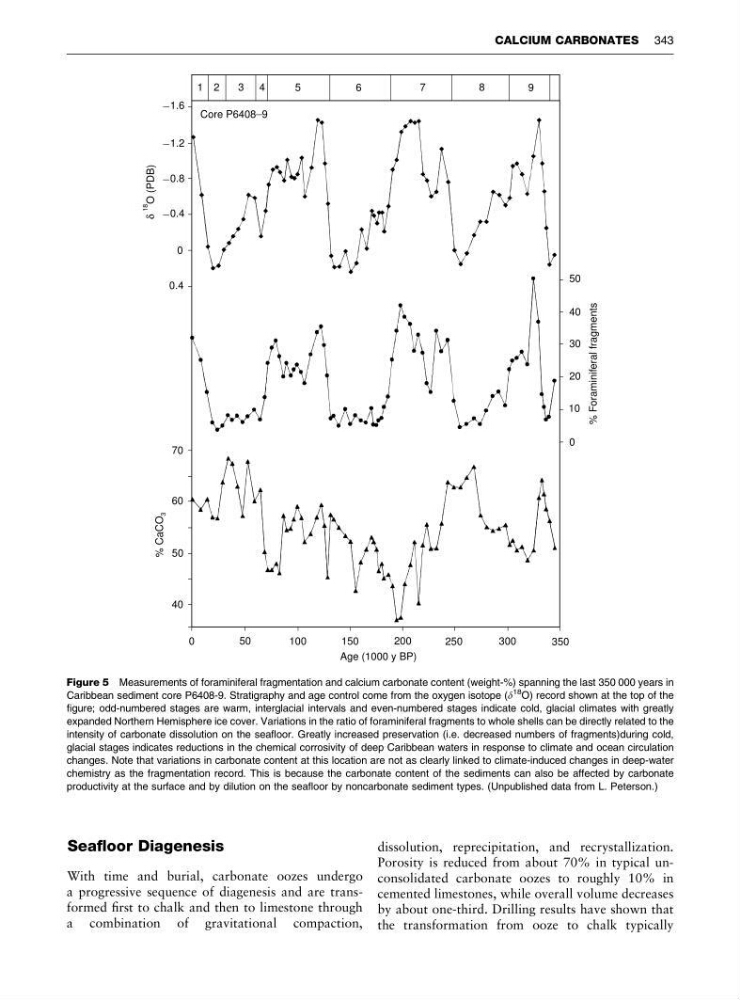
Figure 5 Measurements of foraminiferal fragmentation and calcium carbonate content (weight-%) spanning the last 350 000 years in
Caribbean sediment core P6408-9. Stratigraphy and age control come from the oxygen isotope (d
18
O) record shown at the top of the
figure; odd-numbered stages are warm, interglacial intervals and even-numbered stages indicate cold, glacial climates with greatly
expanded Northern Hemisphere ice cover. Variations in the ratio of foraminiferal fragments to whole shells can be directly related to the
intensity of carbonate dissolution on the seafloor. Greatly increased preservation (i.e. decreased numbers of fragments)during cold,
glacial stages indicates reductions in the chemical corrosivity of deep Caribbean waters in response to climate and ocean circulation
changes. Note that variations in carbonate content at this location are not as clearly linked to climate-induced changes in deep-water
chemistry as the fragmentation record. This is because the carbonate content of the sediments can also be affected by carbonate
productivity at the surface and by dilution on the seafloor by noncarbonate sediment types. (Unpublished data from L. Peterson.)
CALCIUM CARBONATES 343
With time and burial, carbonate oozes undergo
a progressive sequence of diagenesis and are transformed first to chalk and then to limestone through
a combination of gravitational compaction,
dissolution, reprecipitation, and recrystallization.
Porosity is reduced from about 70% in typical unconsolidated carbonate oozes to roughly 10% in
cemented limestones, while overall volume decreases
by about one-third. Drilling results have shown that
the transformation from ooze to chalk typically
1 2
3 4
5
6
7
8
9
_ 1.6
_ 1.2
_ 0.8
_ 0.4
0
0.4
70
60
50
40
0
50
100
150
200
250
300
350
0
10
20
30
40
50
Age (1000 y BP)
% Foraminiferal fragments
δ O (PDB)
18
% CaCO
3
Core P6408 _ 9
Figure 5 Measurements of foraminiferal fragmentation and calcium carbonate content (weight-%) spanning the last 350 000 years in
Caribbean sediment core P6408-9. Stratigraphy and age control come from the oxygen isotope (d
18
O) record shown at the top of the
figure; odd-numbered stages are warm, interglacial intervals and even-numbered stages indicate cold, glacial climates with greatly
expanded Northern Hemisphere ice cover. Variations in the ratio of foraminiferal fragments to whole shells can be directly related to the
intensity of carbonate dissolution on the seafloor. Greatly increased preservation (i.e. decreased numbers of fragments)during cold,
glacial stages indicates reductions in the chemical corrosivity of deep Caribbean waters in response to climate and ocean circulation
changes. Note that variations in carbonate content at this location are not as clearly linked to climate-induced changes in deep-water
chemistry as the fragmentation record. This is because the carbonate content of the sediments can also be affected by carbonate
productivity at the surface and by dilution on the seafloor by noncarbonate sediment types. (Unpublished data from L. Peterson.)
CALCIUM CARBONATES 343