

closer to a depth of about 5000 m. Close to continental margins the CCD tends to shoal, although much
of this apparent rise can be attributed to carbonate
dilution by terrigenous input from the continents.
Rarely does carbonate ooze accumulate on seafloor
that is deeper than about 5 km.
In practice, the CCD is identified by the depth
transition from carbonate ooze to red clay or siliceous ooze that effectively defines the upper limit of
the zone of no net CaCO 3 accumulation on the
seafloor. Given the practical difficulty (e.g. analytical
precision, redeposition) of determining the depth
level at which the carbonate content of sediment goes
to zero, some investigators choose instead to recognize a carbonate critical depth (CCrD), defined as the
depth level at which carbonate contents drop to
o10% of the bulk sediment composition. The CCrD
lies systematically and only slightly shallower than
the CCD. A similar boundary to the CCD can be
recognized marking the lower depth limit of aragonite-bearing sediment in the ocean, the aragonite
compensation depth or ACD. Because of the greater
solubility of aragonite as compared with calcite, the
ACD is always much shallower than the CCD.
Above the CCD, the level at which significant
dissolution of carbonate first becomes apparent is
called the lysocline. As originally defined, the term
lysocline was used to describe the depth level where a
pronounced decrease in the preservation of foraminiferal assemblages is observed. It thus marks a
facies boundary separating well-preserved from
poorly preserved assemblages on the seafloor. This
level is now more specifically referred to as the foraminiferal lysocline to differentiate it from the coccolith lysocline and pteropod lysocline, which may
differ in depth because of varying resistance to dissolution or differences in solubility (in the case of the
aragonitic pteropods). In addition, it is customary to
recognize a sedimentary or carbonate lysocline as the
depth at which a noticeable decrease in the carbonate
content of the sediment begins to occur.
In theory, the lysocline records the sedimentary
expression of the saturation horizon, that is the
depth-dependent transition from waters oversaturated to waters undersaturated with respect to
carbonate solubility (Figure 4). The lysocline thus
marks the top of a depth zone, bounded at the bottom by the CCD, over which the bulk of carbonate
dissolution in the ocean is expected to occur in response to saturation state-driven chemistry. The
thickness of this sublysocline zone, as indicated by
the vertical separation between the lysocline and
CCD, is variable and is governed by the rate of carbonate supply, the actual dissolution gradient, and
1000
2000
3000
4000
5000
6000
_ 30
_ 20
_ 10
0
10
20
30
40
50
Δ CO (Calcite)
3
_
2
Water depth (m)
GEOSECS data
( moles kg )
μ
_ 1
Undersaturated
Oversaturated
Pacific
Atlantic
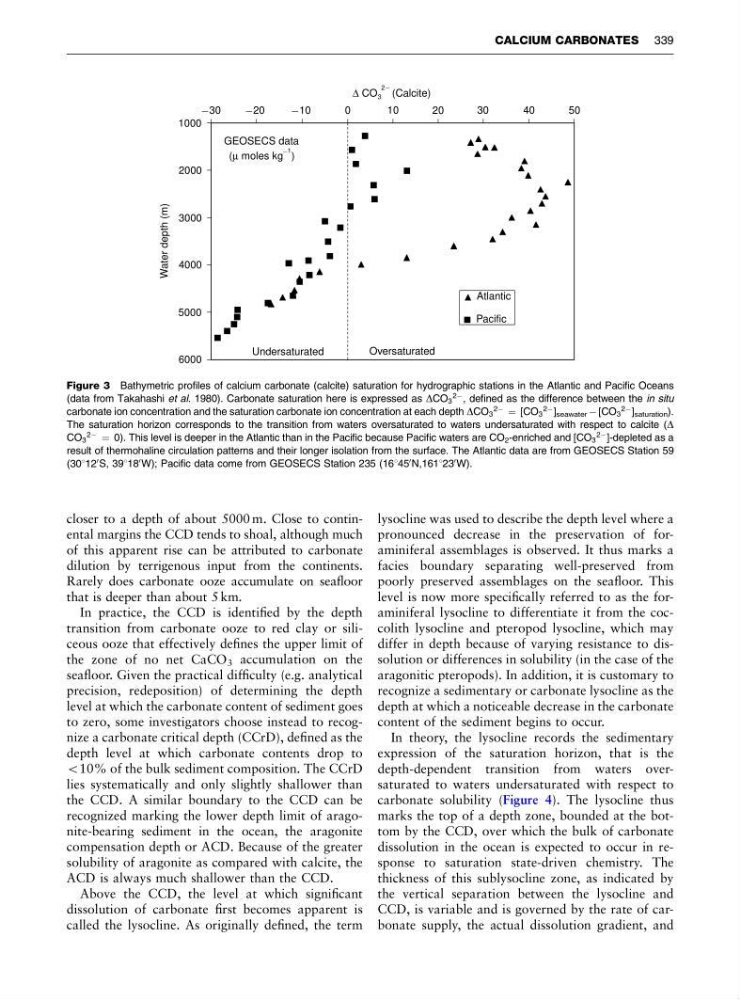
Figure 3 Bathymetric profiles of calcium carbonate (calcite) saturation for hydrographic stations in the Atlantic and Pacific Oceans
(data from Takahashi et al. 1980). Carbonate saturation here is expressed as DCO 3
2À , defined as the difference between the in situ
carbonate ion concentration and the saturation carbonate ion concentration at each depth DCO 3
2À ¼ [CO 3
2À ] seawater À [CO 3
2À ] saturation ).
The saturation horizon corresponds to the transition from waters oversaturated to waters undersaturated with respect to calcite (D
CO 3
2À ¼ 0). This level is deeper in the Atlantic than in the Pacific because Pacific waters are CO 2 -enriched and [CO 3
2À ]-depleted as a
result of thermohaline circulation patterns and their longer isolation from the surface. The Atlantic data are from GEOSECS Station 59
(30112
0 S, 39118
0 W); Pacific data come from GEOSECS Station 235 (16145
0 N,161123
0 W).
CALCIUM CARBONATES 339
of this apparent rise can be attributed to carbonate
dilution by terrigenous input from the continents.
Rarely does carbonate ooze accumulate on seafloor
that is deeper than about 5 km.
In practice, the CCD is identified by the depth
transition from carbonate ooze to red clay or siliceous ooze that effectively defines the upper limit of
the zone of no net CaCO 3 accumulation on the
seafloor. Given the practical difficulty (e.g. analytical
precision, redeposition) of determining the depth
level at which the carbonate content of sediment goes
to zero, some investigators choose instead to recognize a carbonate critical depth (CCrD), defined as the
depth level at which carbonate contents drop to
o10% of the bulk sediment composition. The CCrD
lies systematically and only slightly shallower than
the CCD. A similar boundary to the CCD can be
recognized marking the lower depth limit of aragonite-bearing sediment in the ocean, the aragonite
compensation depth or ACD. Because of the greater
solubility of aragonite as compared with calcite, the
ACD is always much shallower than the CCD.
Above the CCD, the level at which significant
dissolution of carbonate first becomes apparent is
called the lysocline. As originally defined, the term
lysocline was used to describe the depth level where a
pronounced decrease in the preservation of foraminiferal assemblages is observed. It thus marks a
facies boundary separating well-preserved from
poorly preserved assemblages on the seafloor. This
level is now more specifically referred to as the foraminiferal lysocline to differentiate it from the coccolith lysocline and pteropod lysocline, which may
differ in depth because of varying resistance to dissolution or differences in solubility (in the case of the
aragonitic pteropods). In addition, it is customary to
recognize a sedimentary or carbonate lysocline as the
depth at which a noticeable decrease in the carbonate
content of the sediment begins to occur.
In theory, the lysocline records the sedimentary
expression of the saturation horizon, that is the
depth-dependent transition from waters oversaturated to waters undersaturated with respect to
carbonate solubility (Figure 4). The lysocline thus
marks the top of a depth zone, bounded at the bottom by the CCD, over which the bulk of carbonate
dissolution in the ocean is expected to occur in response to saturation state-driven chemistry. The
thickness of this sublysocline zone, as indicated by
the vertical separation between the lysocline and
CCD, is variable and is governed by the rate of carbonate supply, the actual dissolution gradient, and
1000
2000
3000
4000
5000
6000
_ 30
_ 20
_ 10
0
10
20
30
40
50
Δ CO (Calcite)
3
_
2
Water depth (m)
GEOSECS data
( moles kg )
μ
_ 1
Undersaturated
Oversaturated
Pacific
Atlantic
Figure 3 Bathymetric profiles of calcium carbonate (calcite) saturation for hydrographic stations in the Atlantic and Pacific Oceans
(data from Takahashi et al. 1980). Carbonate saturation here is expressed as DCO 3
2À , defined as the difference between the in situ
carbonate ion concentration and the saturation carbonate ion concentration at each depth DCO 3
2À ¼ [CO 3
2À ] seawater À [CO 3
2À ] saturation ).
The saturation horizon corresponds to the transition from waters oversaturated to waters undersaturated with respect to calcite (D
CO 3
2À ¼ 0). This level is deeper in the Atlantic than in the Pacific because Pacific waters are CO 2 -enriched and [CO 3
2À ]-depleted as a
result of thermohaline circulation patterns and their longer isolation from the surface. The Atlantic data are from GEOSECS Station 59
(30112
0 S, 39118
0 W); Pacific data come from GEOSECS Station 235 (16145
0 N,161123
0 W).
CALCIUM CARBONATES 339