

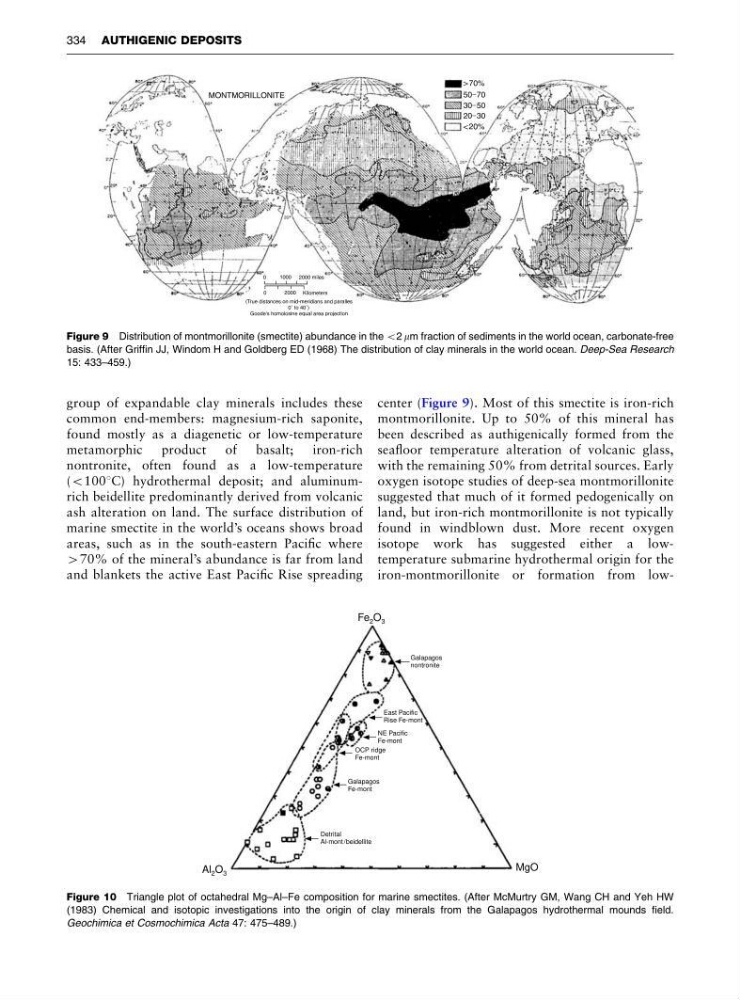
group of expandable clay minerals includes these
common end-members: magnesium-rich saponite,
found mostly as a diagenetic or low-temperature
metamorphic product of basalt; iron-rich
nontronite, often found as a low-temperature
(o1001C) hydrothermal deposit; and aluminumrich beidellite predominantly derived from volcanic
ash alteration on land. The surface distribution of
marine smectite in the world’s oceans shows broad
areas, such as in the south-eastern Pacific where
470% of the mineral’s abundance is far from land
and blankets the active East Pacific Rise spreading
center (Figure 9). Most of this smectite is iron-rich
montmorillonite. Up to 50% of this mineral has
been described as authigenically formed from the
seafloor temperature alteration of volcanic glass,
with the remaining 50% from detrital sources. Early
oxygen isotope studies of deep-sea montmorillonite
suggested that much of it formed pedogenically on
land, but iron-rich montmorillonite is not typically
found in windblown dust. More recent oxygen
isotope work has suggested either a lowtemperature submarine hydrothermal origin for the
iron-montmorillonite or formation from lowFigure 9 Distribution of montmorillonite (smectite) abundance in the o2 mm fraction of sediments in the world ocean, carbonate-free
basis. (After Griffin JJ, Windom H and Goldberg ED (1968) The distribution of clay minerals in the world ocean. Deep-Sea Research
15: 433–459.)
Al O
2 3
MgO
Fe O
2 3
Galapagos
nontronite
East Pacific
Rise Fe-mont
NE Pacific
Fe-mont
OCP ridge
Fe-mont
Galapagos
Fe-mont
Detrital
Al-mont /beidellite
Figure 10 Triangle plot of octahedral Mg–Al–Fe composition for marine smectites. (After McMurtry GM, Wang CH and Yeh HW
(1983) Chemical and isotopic investigations into the origin of clay minerals from the Galapagos hydrothermal mounds field.
Geochimica et Cosmochimica Acta 47: 475–489.)
334 AUTHIGENIC DEPOSITS
common end-members: magnesium-rich saponite,
found mostly as a diagenetic or low-temperature
metamorphic product of basalt; iron-rich
nontronite, often found as a low-temperature
(o1001C) hydrothermal deposit; and aluminumrich beidellite predominantly derived from volcanic
ash alteration on land. The surface distribution of
marine smectite in the world’s oceans shows broad
areas, such as in the south-eastern Pacific where
470% of the mineral’s abundance is far from land
and blankets the active East Pacific Rise spreading
center (Figure 9). Most of this smectite is iron-rich
montmorillonite. Up to 50% of this mineral has
been described as authigenically formed from the
seafloor temperature alteration of volcanic glass,
with the remaining 50% from detrital sources. Early
oxygen isotope studies of deep-sea montmorillonite
suggested that much of it formed pedogenically on
land, but iron-rich montmorillonite is not typically
found in windblown dust. More recent oxygen
isotope work has suggested either a lowtemperature submarine hydrothermal origin for the
iron-montmorillonite or formation from lowFigure 9 Distribution of montmorillonite (smectite) abundance in the o2 mm fraction of sediments in the world ocean, carbonate-free
basis. (After Griffin JJ, Windom H and Goldberg ED (1968) The distribution of clay minerals in the world ocean. Deep-Sea Research
15: 433–459.)
Al O
2 3
MgO
Fe O
2 3
Galapagos
nontronite
East Pacific
Rise Fe-mont
NE Pacific
Fe-mont
OCP ridge
Fe-mont
Galapagos
Fe-mont
Detrital
Al-mont /beidellite
Figure 10 Triangle plot of octahedral Mg–Al–Fe composition for marine smectites. (After McMurtry GM, Wang CH and Yeh HW
(1983) Chemical and isotopic investigations into the origin of clay minerals from the Galapagos hydrothermal mounds field.
Geochimica et Cosmochimica Acta 47: 475–489.)
334 AUTHIGENIC DEPOSITS