

the cryosphere, and the lithosphere, but at a much
lower rate. The techniques of the 1950s for studying
the cosmogenic nuclides were barely adequate to
study the isotopes produced in the atmosphere.
However, because of their value in understanding
geophysical and geochemical processes, they were
studied fairly extensively until the 1970s. A number
of technical developments in the 1970s have made it
easier to study the ‘atmospheric’ cosmogenic isotopes
in the ocean environs, and even the cosmogenic isotopes produced in situ in terrestrial materials, including the hydrosphere and the cryosphere.
The cosmogenic tracer-based information obtained from studies of the lithosphere and the cryosphere is of great value in interpreting the oceanic
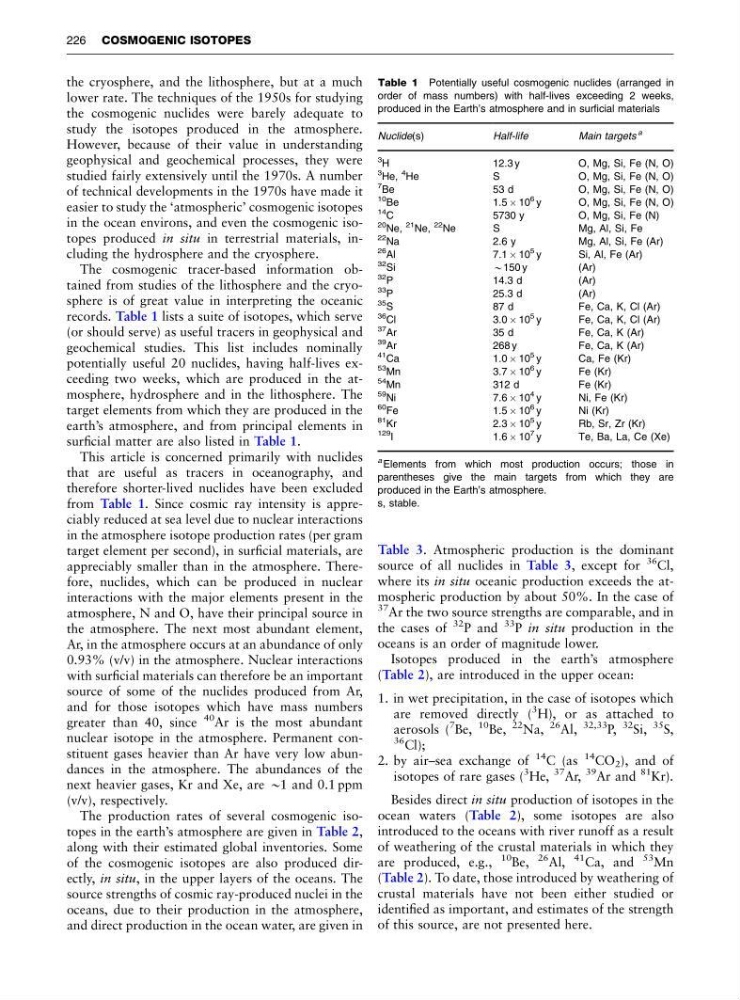
records. Table 1 lists a suite of isotopes, which serve
(or should serve) as useful tracers in geophysical and
geochemical studies. This list includes nominally
potentially useful 20 nuclides, having half-lives exceeding two weeks, which are produced in the atmosphere, hydrosphere and in the lithosphere. The
target elements from which they are produced in the
earth’s atmosphere, and from principal elements in
surficial matter are also listed in Table 1.
This article is concerned primarily with nuclides
that are useful as tracers in oceanography, and
therefore shorter-lived nuclides have been excluded
from Table 1. Since cosmic ray intensity is appreciably reduced at sea level due to nuclear interactions
in the atmosphere isotope production rates (per gram
target element per second), in surficial materials, are
appreciably smaller than in the atmosphere. Therefore, nuclides, which can be produced in nuclear
interactions with the major elements present in the
atmosphere, N and O, have their principal source in
the atmosphere. The next most abundant element,
Ar, in the atmosphere occurs at an abundance of only
0.93% (v/v) in the atmosphere. Nuclear interactions
with surficial materials can therefore be an important
source of some of the nuclides produced from Ar,
and for those isotopes which have mass numbers
greater than 40, since
40
Ar is the most abundant
nuclear isotope in the atmosphere. Permanent constituent gases heavier than Ar have very low abundances in the atmosphere. The abundances of the
next heavier gases, Kr and Xe, are B1 and 0.1 ppm
(v/v), respectively.
The production rates of several cosmogenic isotopes in the earth’s atmosphere are given in Table 2,
along with their estimated global inventories. Some
of the cosmogenic isotopes are also produced directly, in situ, in the upper layers of the oceans. The
source strengths of cosmic ray-produced nuclei in the
oceans, due to their production in the atmosphere,
and direct production in the ocean water, are given in
Table 3. Atmospheric production is the dominant
source of all nuclides in Table 3, except for
36
Cl,
where its in situ oceanic production exceeds the atmospheric production by about 50%. In the case of
37 Ar the two source strengths are comparable, and in
the cases of
32 P and
33 P in situ production in the
oceans is an order of magnitude lower.
Isotopes produced in the earth’s atmosphere
(Table 2), are introduced in the upper ocean:
1. in wet precipitation, in the case of isotopes which
are removed directly (
3 H), or as attached to
aerosols (
7
Be,
10
Be,
22 Na,
26 Al,
32,33 P,
32
Si,
35
S,
36 Cl);
2. by air–sea exchange of
14
C (as
14
CO 2 ), and of
isotopes of rare gases (
3 He,
37 Ar,
39
Ar and
81 Kr).
Besides direct in situ production of isotopes in the
ocean waters (Table 2), some isotopes are also
introduced to the oceans with river runoff as a result
of weathering of the crustal materials in which they
are produced, e.g.,
10
Be,
26 Al,
41 Ca, and
53
Mn
(Table 2). To date, those introduced by weathering of
crustal materials have not been either studied or
identified as important, and estimates of the strength
of this source, are not presented here.
Table 1 Potentially useful cosmogenic nuclides (arranged in
order of mass numbers) with half-lives exceeding 2 weeks,
produced in the Earth’s atmosphere and in surficial materials
Nuclide(s)
Half-life
Main targets
a
3
H
12.3 y
O, Mg, Si, Fe (N, O)
3 He,
4 He
S
O, Mg, Si, Fe (N, O)
7 Be
53 d
O, Mg, Si, Fe (N, O)
10 Be
1.5 Â 10
6 y
O, Mg, Si, Fe (N, O)
14 C
5730 y
O, Mg, Si, Fe (N)
20 Ne,
21 Ne,
22 Ne
S
Mg, Al, Si, Fe
22 Na
2.6 y
Mg, Al, Si, Fe (Ar)
26 Al
7.1 Â 10
5 y
Si, Al, Fe (Ar)
32 Si
B150 y
(Ar)
32 P
14.3 d
(Ar)
33 P
25.3 d
(Ar)
35 S
87 d
Fe, Ca, K, Cl (Ar)
36 Cl
3.0 Â 10
5 y
Fe, Ca, K, Cl (Ar)
37 Ar
35 d
Fe, Ca, K (Ar)
39 Ar
268 y
Fe, Ca, K (Ar)
41 Ca
1.0 Â 10
5 y
Ca, Fe (Kr)
53 Mn
3.7 Â 10
6 y
Fe (Kr)
54 Mn
312 d
Fe (Kr)
59 Ni
7.6 Â 10
4 y
Ni, Fe (Kr)
60 Fe
1.5 Â 10
6 y
Ni (Kr)
81 Kr
2.3 Â 10
5 y
Rb, Sr, Zr (Kr)
129 I
1.6 Â 10
7 y
Te, Ba, La, Ce (Xe)
a Elements from which most production occurs; those in
parentheses give the main targets from which they are
produced in the Earth’s atmosphere.
s, stable.
226 COSMOGENIC ISOTOPES
lower rate. The techniques of the 1950s for studying
the cosmogenic nuclides were barely adequate to
study the isotopes produced in the atmosphere.
However, because of their value in understanding
geophysical and geochemical processes, they were
studied fairly extensively until the 1970s. A number
of technical developments in the 1970s have made it
easier to study the ‘atmospheric’ cosmogenic isotopes
in the ocean environs, and even the cosmogenic isotopes produced in situ in terrestrial materials, including the hydrosphere and the cryosphere.
The cosmogenic tracer-based information obtained from studies of the lithosphere and the cryosphere is of great value in interpreting the oceanic
records. Table 1 lists a suite of isotopes, which serve
(or should serve) as useful tracers in geophysical and
geochemical studies. This list includes nominally
potentially useful 20 nuclides, having half-lives exceeding two weeks, which are produced in the atmosphere, hydrosphere and in the lithosphere. The
target elements from which they are produced in the
earth’s atmosphere, and from principal elements in
surficial matter are also listed in Table 1.
This article is concerned primarily with nuclides
that are useful as tracers in oceanography, and
therefore shorter-lived nuclides have been excluded
from Table 1. Since cosmic ray intensity is appreciably reduced at sea level due to nuclear interactions
in the atmosphere isotope production rates (per gram
target element per second), in surficial materials, are
appreciably smaller than in the atmosphere. Therefore, nuclides, which can be produced in nuclear
interactions with the major elements present in the
atmosphere, N and O, have their principal source in
the atmosphere. The next most abundant element,
Ar, in the atmosphere occurs at an abundance of only
0.93% (v/v) in the atmosphere. Nuclear interactions
with surficial materials can therefore be an important
source of some of the nuclides produced from Ar,
and for those isotopes which have mass numbers
greater than 40, since
40
Ar is the most abundant
nuclear isotope in the atmosphere. Permanent constituent gases heavier than Ar have very low abundances in the atmosphere. The abundances of the
next heavier gases, Kr and Xe, are B1 and 0.1 ppm
(v/v), respectively.
The production rates of several cosmogenic isotopes in the earth’s atmosphere are given in Table 2,
along with their estimated global inventories. Some
of the cosmogenic isotopes are also produced directly, in situ, in the upper layers of the oceans. The
source strengths of cosmic ray-produced nuclei in the
oceans, due to their production in the atmosphere,
and direct production in the ocean water, are given in
Table 3. Atmospheric production is the dominant
source of all nuclides in Table 3, except for
36
Cl,
where its in situ oceanic production exceeds the atmospheric production by about 50%. In the case of
37 Ar the two source strengths are comparable, and in
the cases of
32 P and
33 P in situ production in the
oceans is an order of magnitude lower.
Isotopes produced in the earth’s atmosphere
(Table 2), are introduced in the upper ocean:
1. in wet precipitation, in the case of isotopes which
are removed directly (
3 H), or as attached to
aerosols (
7
Be,
10
Be,
22 Na,
26 Al,
32,33 P,
32
Si,
35
S,
36 Cl);
2. by air–sea exchange of
14
C (as
14
CO 2 ), and of
isotopes of rare gases (
3 He,
37 Ar,
39
Ar and
81 Kr).
Besides direct in situ production of isotopes in the
ocean waters (Table 2), some isotopes are also
introduced to the oceans with river runoff as a result
of weathering of the crustal materials in which they
are produced, e.g.,
10
Be,
26 Al,
41 Ca, and
53
Mn
(Table 2). To date, those introduced by weathering of
crustal materials have not been either studied or
identified as important, and estimates of the strength
of this source, are not presented here.
Table 1 Potentially useful cosmogenic nuclides (arranged in
order of mass numbers) with half-lives exceeding 2 weeks,
produced in the Earth’s atmosphere and in surficial materials
Nuclide(s)
Half-life
Main targets
a
3
H
12.3 y
O, Mg, Si, Fe (N, O)
3 He,
4 He
S
O, Mg, Si, Fe (N, O)
7 Be
53 d
O, Mg, Si, Fe (N, O)
10 Be
1.5 Â 10
6 y
O, Mg, Si, Fe (N, O)
14 C
5730 y
O, Mg, Si, Fe (N)
20 Ne,
21 Ne,
22 Ne
S
Mg, Al, Si, Fe
22 Na
2.6 y
Mg, Al, Si, Fe (Ar)
26 Al
7.1 Â 10
5 y
Si, Al, Fe (Ar)
32 Si
B150 y
(Ar)
32 P
14.3 d
(Ar)
33 P
25.3 d
(Ar)
35 S
87 d
Fe, Ca, K, Cl (Ar)
36 Cl
3.0 Â 10
5 y
Fe, Ca, K, Cl (Ar)
37 Ar
35 d
Fe, Ca, K (Ar)
39 Ar
268 y
Fe, Ca, K (Ar)
41 Ca
1.0 Â 10
5 y
Ca, Fe (Kr)
53 Mn
3.7 Â 10
6 y
Fe (Kr)
54 Mn
312 d
Fe (Kr)
59 Ni
7.6 Â 10
4 y
Ni, Fe (Kr)
60 Fe
1.5 Â 10
6 y
Ni (Kr)
81 Kr
2.3 Â 10
5 y
Rb, Sr, Zr (Kr)
129 I
1.6 Â 10
7 y
Te, Ba, La, Ce (Xe)
a Elements from which most production occurs; those in
parentheses give the main targets from which they are
produced in the Earth’s atmosphere.
s, stable.
226 COSMOGENIC ISOTOPES