

URANIUM-THORIUM SERIES ISOTOPES IN OCEAN
PROFILES
S. Krishnaswami, Physical Research Laboratory,
Ahmedabad, India
Copyright & 2001 Elsevier Ltd.
Introduction
Natural radioactivity in the environment originates
from two sources. First, primordial radionuclides
which were incorporated into the Earth at the time of
its formation are still present in it because of their
long half-lives.
238 U,
235 U,
232 Th and their decay
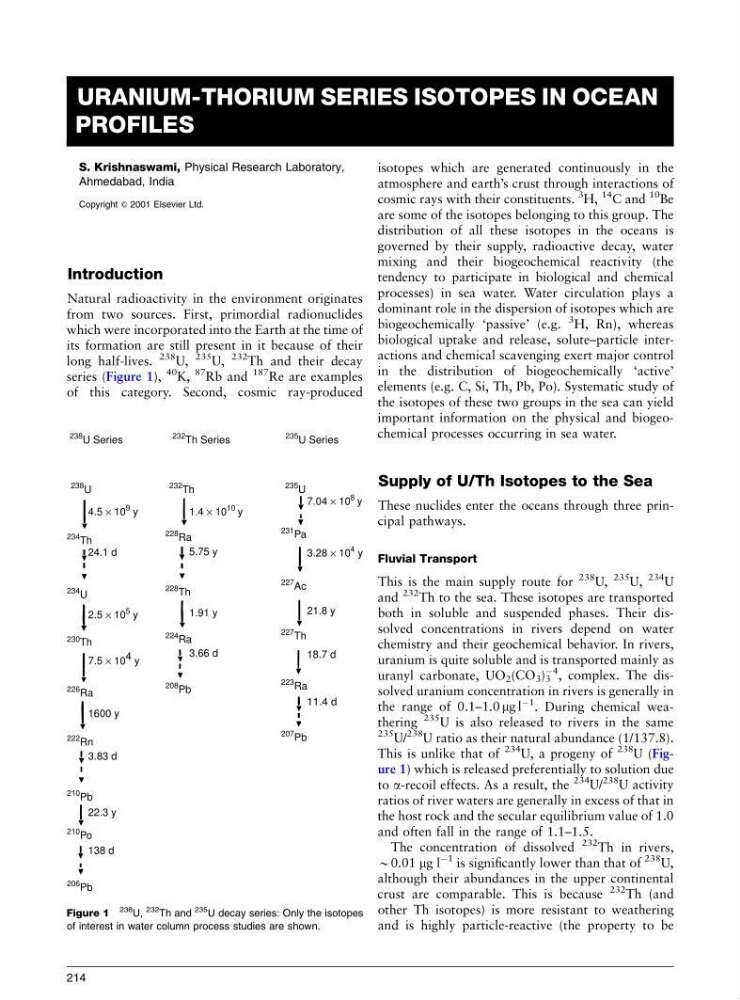
series (Figure 1),
40
K,
87 Rb and
187 Re are examples
of this category. Second, cosmic ray-produced
isotopes which are generated continuously in the
atmosphere and earth’s crust through interactions of
cosmic rays with their constituents.
3
H,
14
C and
10 Be
are some of the isotopes belonging to this group. The
distribution of all these isotopes in the oceans is
governed by their supply, radioactive decay, water
mixing and their biogeochemical reactivity (the
tendency to participate in biological and chemical
processes) in sea water. Water circulation plays a
dominant role in the dispersion of isotopes which are
biogeochemically ‘passive’ (e.g.
3 H, Rn), whereas
biological uptake and release, solute–particle interactions and chemical scavenging exert major control
in the distribution of biogeochemically ‘active’
elements (e.g. C, Si, Th, Pb, Po). Systematic study of
the isotopes of these two groups in the sea can yield
important information on the physical and biogeochemical processes occurring in sea water.
Supply of U/Th Isotopes to the Sea
These nuclides enter the oceans through three principal pathways.
Fluvial Transport
This is the main supply route for
238 U,
235 U,
234 U
and
232 Th to the sea. These isotopes are transported
both in soluble and suspended phases. Their dissolved concentrations in rivers depend on water
chemistry and their geochemical behavior. In rivers,
uranium is quite soluble and is transported mainly as
uranyl carbonate, UO 2 (CO 3 ) 3
À4 , complex. The dissolved uranium concentration in rivers is generally in
the range of 0.1–1.0 mg l
À1
. During chemical weathering
235 U is also released to rivers in the same
235 U/
238 U ratio as their natural abundance (1/137.8).
This is unlike that of
234 U, a progeny of
238 U (Figure 1) which is released preferentially to solution due
to a-recoil effects. As a result, the
234
U/
238 U activity
ratios of river waters are generally in excess of that in
the host rock and the secular equilibrium value of 1.0
and often fall in the range of 1.1–1.5.
The concentration of dissolved
232 Th in rivers,
B0.01 mg l
À1 is significantly lower than that of
238 U,
although their abundances in the upper continental
crust are comparable. This is because
232 Th (and
other Th isotopes) is more resistant to weathering
and is highly particle-reactive (the property to be
238 U Series
232
Th Series
235
U Series
238
U
234 Th
234 U
230 Th
226 Ra
222 Rn
210 Pb
210 Po
206 Pb
138 d
22.3 y
3.83 d
1600 y
7.5 × 10 4 y
2.5 × 10
5 y
24.1 d
4.5 × 10
9 y
232
Th
235
U
231
Pa
227
Ac
227
Th
223
Ra
207
Pb
228
Ra
228
Th
224
Ra
208
Pb
1.4 × 10
10 y
7.04 × 10
8 y
3.28 × 10
4 y
21.8 y
18.7 d
11.4 d
5.75 y
1.91 y
3.66 d
Figure 1
238
U,
232 Th and
235 U decay series: Only the isotopes
of interest in water column process studies are shown.
214
PROFILES
S. Krishnaswami, Physical Research Laboratory,
Ahmedabad, India
Copyright & 2001 Elsevier Ltd.
Introduction
Natural radioactivity in the environment originates
from two sources. First, primordial radionuclides
which were incorporated into the Earth at the time of
its formation are still present in it because of their
long half-lives.
238 U,
235 U,
232 Th and their decay
series (Figure 1),
40
K,
87 Rb and
187 Re are examples
of this category. Second, cosmic ray-produced
isotopes which are generated continuously in the
atmosphere and earth’s crust through interactions of
cosmic rays with their constituents.
3
H,
14
C and
10 Be
are some of the isotopes belonging to this group. The
distribution of all these isotopes in the oceans is
governed by their supply, radioactive decay, water
mixing and their biogeochemical reactivity (the
tendency to participate in biological and chemical
processes) in sea water. Water circulation plays a
dominant role in the dispersion of isotopes which are
biogeochemically ‘passive’ (e.g.
3 H, Rn), whereas
biological uptake and release, solute–particle interactions and chemical scavenging exert major control
in the distribution of biogeochemically ‘active’
elements (e.g. C, Si, Th, Pb, Po). Systematic study of
the isotopes of these two groups in the sea can yield
important information on the physical and biogeochemical processes occurring in sea water.
Supply of U/Th Isotopes to the Sea
These nuclides enter the oceans through three principal pathways.
Fluvial Transport
This is the main supply route for
238 U,
235 U,
234 U
and
232 Th to the sea. These isotopes are transported
both in soluble and suspended phases. Their dissolved concentrations in rivers depend on water
chemistry and their geochemical behavior. In rivers,
uranium is quite soluble and is transported mainly as
uranyl carbonate, UO 2 (CO 3 ) 3
À4 , complex. The dissolved uranium concentration in rivers is generally in
the range of 0.1–1.0 mg l
À1
. During chemical weathering
235 U is also released to rivers in the same
235 U/
238 U ratio as their natural abundance (1/137.8).
This is unlike that of
234 U, a progeny of
238 U (Figure 1) which is released preferentially to solution due
to a-recoil effects. As a result, the
234
U/
238 U activity
ratios of river waters are generally in excess of that in
the host rock and the secular equilibrium value of 1.0
and often fall in the range of 1.1–1.5.
The concentration of dissolved
232 Th in rivers,
B0.01 mg l
À1 is significantly lower than that of
238 U,
although their abundances in the upper continental
crust are comparable. This is because
232 Th (and
other Th isotopes) is more resistant to weathering
and is highly particle-reactive (the property to be
238 U Series
232
Th Series
235
U Series
238
U
234 Th
234 U
230 Th
226 Ra
222 Rn
210 Pb
210 Po
206 Pb
138 d
22.3 y
3.83 d
1600 y
7.5 × 10 4 y
2.5 × 10
5 y
24.1 d
4.5 × 10
9 y
232
Th
235
U
231
Pa
227
Ac
227
Th
223
Ra
207
Pb
228
Ra
228
Th
224
Ra
208
Pb
1.4 × 10
10 y
7.04 × 10
8 y
3.28 × 10
4 y
21.8 y
18.7 d
11.4 d
5.75 y
1.91 y
3.66 d
Figure 1
238
U,
232 Th and
235 U decay series: Only the isotopes
of interest in water column process studies are shown.
214