

biological utilization. Biologically produced organic
particles as well as calcium carbonate and opal
shells sink and dissolve in deeper parts of the water
column, thereby returning nutrients to the dissolved
pool, while utilizing and drawing down dissolved
oxygen. Overall, the biogeochemical processes act as
a vertical nutrient and carbon pump creating significant vertical gradients and pronounced subsurface
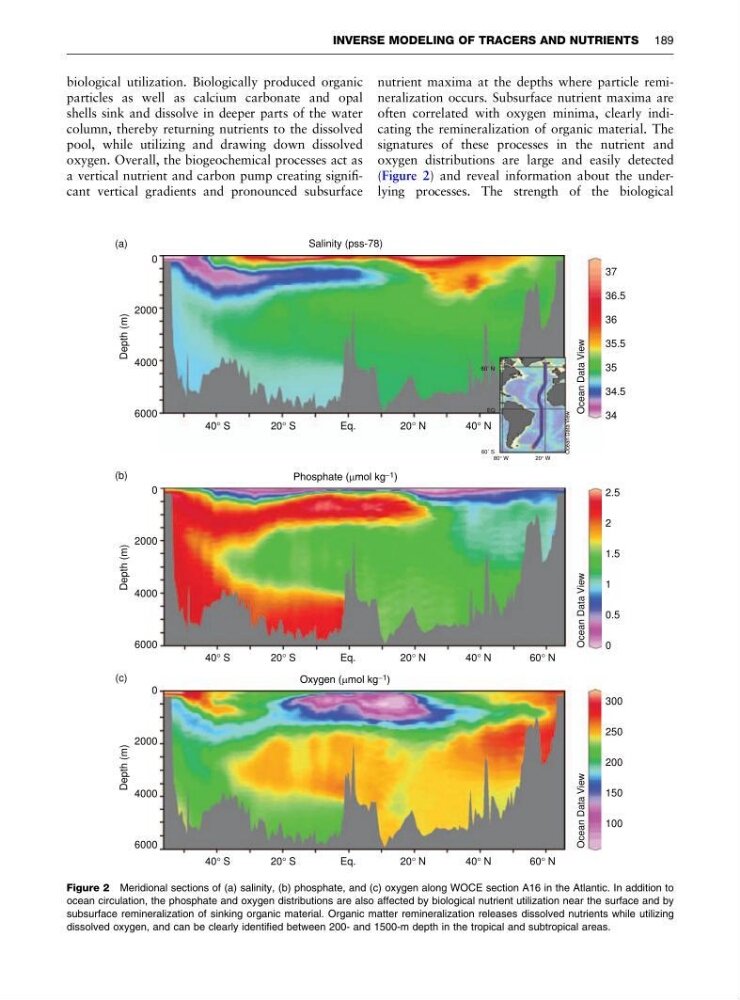
nutrient maxima at the depths where particle remineralization occurs. Subsurface nutrient maxima are
often correlated with oxygen minima, clearly indicating the remineralization of organic material. The
signatures of these processes in the nutrient and
oxygen distributions are large and easily detected
(Figure 2) and reveal information about the underlying processes. The strength of the biological
Depth (m)
0
2000
4000
6000
40° S
2 0 ° S
Eq.
20° N
4 0 ° N
40° S
2 0 ° S
Eq.
20° N
4 0 ° N
6 0 ° N
40° S
2 0 ° S
Eq.
20° N
4 0 ° N
6 0 ° N
Ocean Data View
Ocean Data View
Ocean Data View
37
36.5
36
35.5
35
34.5
34
2.5
2
1.5
1
0.5
0
300
250
200
150
100
(a)
Depth (m)
0
2000
4000
6000
(b)
Depth (m)
0
2000
4000
6000
(c)
60˚ N
60˚ S
EQ
Ocean Data View
80° W
2 0 ° W
Salinity (pss-78)
Figure 2 Meridional sections of (a) salinity, (b) phosphate, and (c) oxygen along WOCE section A16 in the Atlantic. In addition to
ocean circulation, the phosphate and oxygen distributions are also affected by biological nutrient utilization near the surface and by
subsurface remineralization of sinking organic material. Organic matter remineralization releases dissolved nutrients while utilizing
dissolved oxygen, and can be clearly identified between 200- and 1500-m depth in the tropical and subtropical areas.
INVERSE MODELING OF TRACERS AND NUTRIENTS 189
particles as well as calcium carbonate and opal
shells sink and dissolve in deeper parts of the water
column, thereby returning nutrients to the dissolved
pool, while utilizing and drawing down dissolved
oxygen. Overall, the biogeochemical processes act as
a vertical nutrient and carbon pump creating significant vertical gradients and pronounced subsurface
nutrient maxima at the depths where particle remineralization occurs. Subsurface nutrient maxima are
often correlated with oxygen minima, clearly indicating the remineralization of organic material. The
signatures of these processes in the nutrient and
oxygen distributions are large and easily detected
(Figure 2) and reveal information about the underlying processes. The strength of the biological
Depth (m)
0
2000
4000
6000
40° S
2 0 ° S
Eq.
20° N
4 0 ° N
40° S
2 0 ° S
Eq.
20° N
4 0 ° N
6 0 ° N
40° S
2 0 ° S
Eq.
20° N
4 0 ° N
6 0 ° N
Ocean Data View
Ocean Data View
Ocean Data View
37
36.5
36
35.5
35
34.5
34
2.5
2
1.5
1
0.5
0
300
250
200
150
100
(a)
Depth (m)
0
2000
4000
6000
(b)
Depth (m)
0
2000
4000
6000
(c)
60˚ N
60˚ S
EQ
Ocean Data View
80° W
2 0 ° W
Salinity (pss-78)
Figure 2 Meridional sections of (a) salinity, (b) phosphate, and (c) oxygen along WOCE section A16 in the Atlantic. In addition to
ocean circulation, the phosphate and oxygen distributions are also affected by biological nutrient utilization near the surface and by
subsurface remineralization of sinking organic material. Organic matter remineralization releases dissolved nutrients while utilizing
dissolved oxygen, and can be clearly identified between 200- and 1500-m depth in the tropical and subtropical areas.
INVERSE MODELING OF TRACERS AND NUTRIENTS 189