

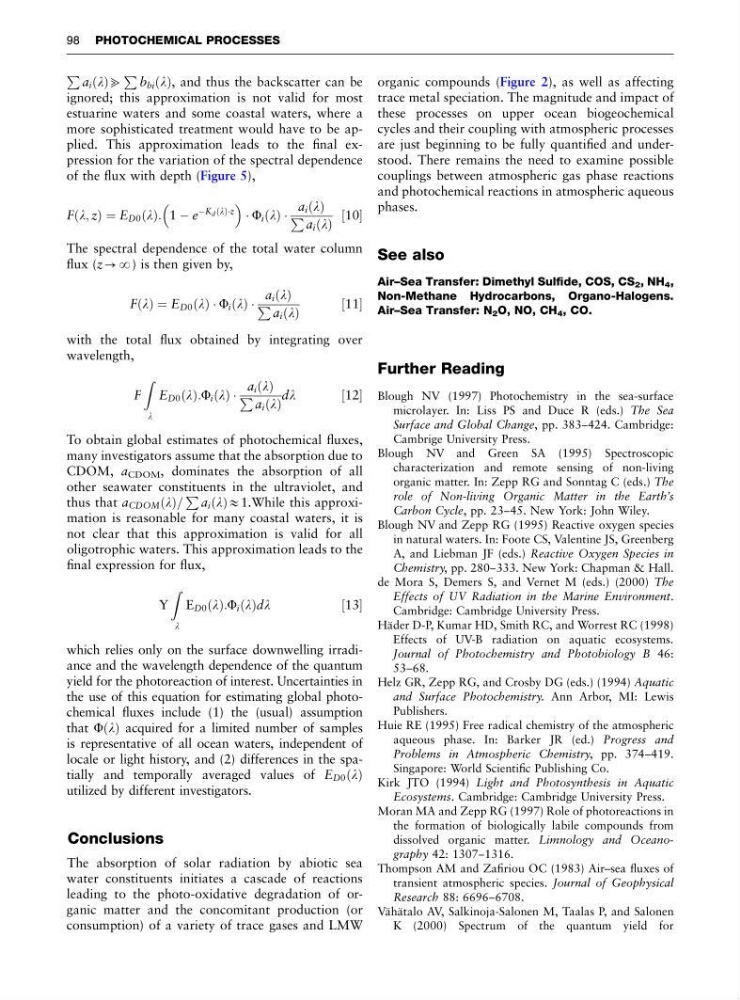
P a i ðlÞb
P b bi ðlÞ, and thus the backscatter can be
ignored; this approximation is not valid for most
estuarine waters and some coastal waters, where a
more sophisticated treatment would have to be applied. This approximation leads to the final expression for the variation of the spectral dependence
of the flux with depth (Figure 5),
F l; z
ð Þ ¼ E D0 ðlÞ: 1 À e
ÀK d l
ð ÞÁz
Á F i l
ð Þ Á
a i l
ð Þ
P a i l
ð Þ
½10
The spectral dependence of the total water column
flux (z-N) is then given by,
F l
ð Þ ¼ E D0 ðlÞ Á F i l
ð Þ Á
a i l
ð Þ
P a i l
ð Þ
½11
with the total flux obtained by integrating over
wavelength,
F
Z
l
E D0 ðlÞ:F i l
ð Þ Á
a i l
ð Þ
P a i l
ð Þ
dl
½12
To obtain global estimates of photochemical fluxes,
many investigators assume that the absorption due to
CDOM, a CDOM , dominates the absorption of all
other seawater constituents in the ultraviolet, and
thus that a CDOM ðlÞ=
P a i ðlÞE1.While this approximation is reasonable for many coastal waters, it is
not clear that this approximation is valid for all
oligotrophic waters. This approximation leads to the
final expression for flux,
Y
Z
l
E D0 ðlÞ:F i l
ð Þdl
½13
which relies only on the surface downwelling irradiance and the wavelength dependence of the quantum
yield for the photoreaction of interest. Uncertainties in
the use of this equation for estimating global photochemical fluxes include (1) the (usual) assumption
that FðlÞ acquired for a limited number of samples
is representative of all ocean waters, independent of
locale or light history, and (2) differences in the spatially and temporally averaged values of E D0 ðlÞ
utilized by different investigators.
Conclusions
The absorption of solar radiation by abiotic sea
water constituents initiates a cascade of reactions
leading to the photo-oxidative degradation of organic matter and the concomitant production (or
consumption) of a variety of trace gases and LMW
organic compounds (Figure 2), as well as affecting
trace metal speciation. The magnitude and impact of
these processes on upper ocean biogeochemical
cycles and their coupling with atmospheric processes
are just beginning to be fully quantified and understood. There remains the need to examine possible
couplings between atmospheric gas phase reactions
and photochemical reactions in atmospheric aqueous
phases.
See also
Air–Sea Transfer: Dimethyl Sulfide, COS, CS 2 , NH 4 ,
Non-Methane Hydrocarbons, Organo-Halogens.
Air–Sea Transfer: N 2 O, NO, CH 4 , CO.
Further Reading
Blough NV (1997) Photochemistry in the sea-surface
microlayer. In: Liss PS and Duce R (eds.) The Sea
Surface and Global Change, pp. 383--424. Cambridge:
Cambrige University Press.
Blough NV and Green SA (1995) Spectroscopic
characterization and remote sensing of non-living
organic matter. In: Zepp RG and Sonntag C (eds.) The
role of Non-living Organic Matter in the Earth’s
Carbon Cycle, pp. 23--45. New York: John Wiley.
Blough NV and Zepp RG (1995) Reactive oxygen species
in natural waters. In: Foote CS, Valentine JS, Greenberg
A, and Liebman JF (eds.) Reactive Oxygen Species in
Chemistry, pp. 280--333. New York: Chapman & Hall.
de Mora S, Demers S, and Vernet M (eds.) (2000) The
Effects of UV Radiation in the Marine Environment.
Cambridge: Cambridge University Press.
Ha ¨ der D-P, Kumar HD, Smith RC, and Worrest RC (1998)
Effects of UV-B radiation on aquatic ecosystems.
Journal of Photochemistry and Photobiology B 46:
53--68.
Helz GR, Zepp RG, and Crosby DG (eds.) (1994) Aquatic
and Surface Photochemistry. Ann Arbor, MI: Lewis
Publishers.
Huie RE (1995) Free radical chemistry of the atmospheric
aqueous phase. In: Barker JR (ed.) Progress and
Problems in Atmospheric Chemistry, pp. 374--419.
Singapore: World Scientific Publishing Co.
Kirk JTO (1994) Light and Photosynthesis in Aquatic
Ecosystems. Cambridge: Cambridge University Press.
Moran MA and Zepp RG (1997) Role of photoreactions in
the formation of biologically labile compounds from
dissolved organic matter. Limnology and Oceanography 42: 1307--1316.
Thompson AM and Zafiriou OC (1983) Air–sea fluxes of
transient atmospheric species. Journal of Geophysical
Research 88: 6696--6708.
Va ¨ ha ¨ talo AV, Salkinoja-Salonen M, Taalas P, and Salonen
K (2000) Spectrum of the quantum yield for
98 PHOTOCHEMICAL PROCESSES
P b bi ðlÞ, and thus the backscatter can be
ignored; this approximation is not valid for most
estuarine waters and some coastal waters, where a
more sophisticated treatment would have to be applied. This approximation leads to the final expression for the variation of the spectral dependence
of the flux with depth (Figure 5),
F l; z
ð Þ ¼ E D0 ðlÞ: 1 À e
ÀK d l
ð ÞÁz
Á F i l
ð Þ Á
a i l
ð Þ
P a i l
ð Þ
½10
The spectral dependence of the total water column
flux (z-N) is then given by,
F l
ð Þ ¼ E D0 ðlÞ Á F i l
ð Þ Á
a i l
ð Þ
P a i l
ð Þ
½11
with the total flux obtained by integrating over
wavelength,
F
Z
l
E D0 ðlÞ:F i l
ð Þ Á
a i l
ð Þ
P a i l
ð Þ
dl
½12
To obtain global estimates of photochemical fluxes,
many investigators assume that the absorption due to
CDOM, a CDOM , dominates the absorption of all
other seawater constituents in the ultraviolet, and
thus that a CDOM ðlÞ=
P a i ðlÞE1.While this approximation is reasonable for many coastal waters, it is
not clear that this approximation is valid for all
oligotrophic waters. This approximation leads to the
final expression for flux,
Y
Z
l
E D0 ðlÞ:F i l
ð Þdl
½13
which relies only on the surface downwelling irradiance and the wavelength dependence of the quantum
yield for the photoreaction of interest. Uncertainties in
the use of this equation for estimating global photochemical fluxes include (1) the (usual) assumption
that FðlÞ acquired for a limited number of samples
is representative of all ocean waters, independent of
locale or light history, and (2) differences in the spatially and temporally averaged values of E D0 ðlÞ
utilized by different investigators.
Conclusions
The absorption of solar radiation by abiotic sea
water constituents initiates a cascade of reactions
leading to the photo-oxidative degradation of organic matter and the concomitant production (or
consumption) of a variety of trace gases and LMW
organic compounds (Figure 2), as well as affecting
trace metal speciation. The magnitude and impact of
these processes on upper ocean biogeochemical
cycles and their coupling with atmospheric processes
are just beginning to be fully quantified and understood. There remains the need to examine possible
couplings between atmospheric gas phase reactions
and photochemical reactions in atmospheric aqueous
phases.
See also
Air–Sea Transfer: Dimethyl Sulfide, COS, CS 2 , NH 4 ,
Non-Methane Hydrocarbons, Organo-Halogens.
Air–Sea Transfer: N 2 O, NO, CH 4 , CO.
Further Reading
Blough NV (1997) Photochemistry in the sea-surface
microlayer. In: Liss PS and Duce R (eds.) The Sea
Surface and Global Change, pp. 383--424. Cambridge:
Cambrige University Press.
Blough NV and Green SA (1995) Spectroscopic
characterization and remote sensing of non-living
organic matter. In: Zepp RG and Sonntag C (eds.) The
role of Non-living Organic Matter in the Earth’s
Carbon Cycle, pp. 23--45. New York: John Wiley.
Blough NV and Zepp RG (1995) Reactive oxygen species
in natural waters. In: Foote CS, Valentine JS, Greenberg
A, and Liebman JF (eds.) Reactive Oxygen Species in
Chemistry, pp. 280--333. New York: Chapman & Hall.
de Mora S, Demers S, and Vernet M (eds.) (2000) The
Effects of UV Radiation in the Marine Environment.
Cambridge: Cambridge University Press.
Ha ¨ der D-P, Kumar HD, Smith RC, and Worrest RC (1998)
Effects of UV-B radiation on aquatic ecosystems.
Journal of Photochemistry and Photobiology B 46:
53--68.
Helz GR, Zepp RG, and Crosby DG (eds.) (1994) Aquatic
and Surface Photochemistry. Ann Arbor, MI: Lewis
Publishers.
Huie RE (1995) Free radical chemistry of the atmospheric
aqueous phase. In: Barker JR (ed.) Progress and
Problems in Atmospheric Chemistry, pp. 374--419.
Singapore: World Scientific Publishing Co.
Kirk JTO (1994) Light and Photosynthesis in Aquatic
Ecosystems. Cambridge: Cambridge University Press.
Moran MA and Zepp RG (1997) Role of photoreactions in
the formation of biologically labile compounds from
dissolved organic matter. Limnology and Oceanography 42: 1307--1316.
Thompson AM and Zafiriou OC (1983) Air–sea fluxes of
transient atmospheric species. Journal of Geophysical
Research 88: 6696--6708.
Va ¨ ha ¨ talo AV, Salkinoja-Salonen M, Taalas P, and Salonen
K (2000) Spectrum of the quantum yield for
98 PHOTOCHEMICAL PROCESSES