

INSTRUMENTS TESTED
The heterotrophic OC consumption measurements performed up till now have been
carried out with a total OC analyzer based on high temperature oxidation of 100 µl of
sample (mod. 400/P, Carlo Erba). More information about this instrument and the
improvements of it can be found in Bertoni et al. (1982). Mainly because of the extensive
routine maintenance required by the above unit, quite recently I started to use a microprocessor controlled total OC analyzer. It is based on U. V. oxidation of a 3 to 8 ml sample
carried by an oxygen-sodium persulphate stream (mod. 1850, Astro).
Although with this latter unit no OC consumption measurements have been made up to
now, the first results with lake water samples allow a comparison of the two instruments.
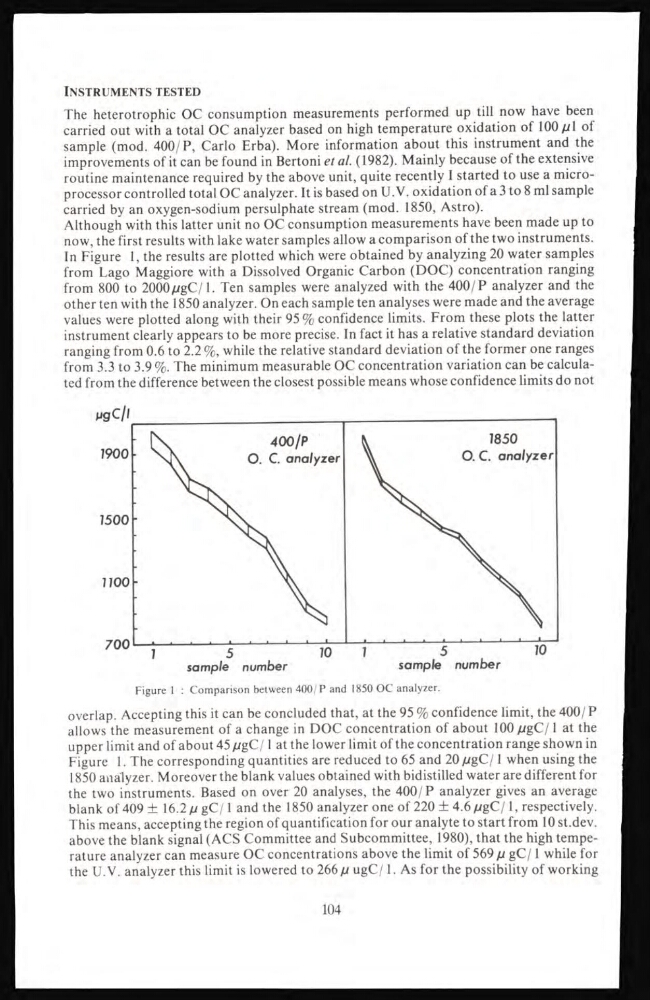
In Figure 1, the results are plotted which were obtained by analyzing 20 water samples
from Lago Maggiore with a Dissolved Organic Carbon (DOC) concentration ranging
from 800 to 2000 µgC/1. Ten samples were analyzed with the 400/P analyzer and the
other ten with the 1850 analyzer. On each sample ten analyses were made and the average
values were plotted along with their 95 % confidence limits. From these plots the latter
instrument clearly appears to be more precise. In fact it has a relative standard deviation
ranging from 0.6 to 2.2 %, while the relative standard deviation of the former one ranges
from 3.3 to 3.9 %. The minimum measurable OC concentration variation can be calculated from the difference between the closest possible means whose confidence limits do not
overlap. Accepting this it can be concluded that, at the 95 % confidence limit, the 400/ P
allows the measurement of a change in DOC concentration of about 100 µgC/1 at the
upper limit and of about 45 µgC j 1 at the lower limit of the concentration range shown in
Figure 1. The corresponding quantities are reduced to 65 and 20 yugC/1 when using the
1850 analyzer. Moreover the blank values obtained with bidistilled water are different for
the two instruments. Based on over 20 analyses, the 400/P analyzer gives an average
blank of 409 ± 16.2 µ gC/1 and the 1850 analyzer one of 220 ± 4.6 yugC/1, respectively.
This means, accepting the region of quantification for our analyte to start from 10 st.dev.
above the blank signal (ACS Committee and Subcommittee, 1980), that the high temperature analyzer can measure OC concentrations above the limit of 569 µ gC/1 while for
the U.V. analyzer this limit is lowered to 266 µ ugC/1. As for the possibility of working
104
The heterotrophic OC consumption measurements performed up till now have been
carried out with a total OC analyzer based on high temperature oxidation of 100 µl of
sample (mod. 400/P, Carlo Erba). More information about this instrument and the
improvements of it can be found in Bertoni et al. (1982). Mainly because of the extensive
routine maintenance required by the above unit, quite recently I started to use a microprocessor controlled total OC analyzer. It is based on U. V. oxidation of a 3 to 8 ml sample
carried by an oxygen-sodium persulphate stream (mod. 1850, Astro).
Although with this latter unit no OC consumption measurements have been made up to
now, the first results with lake water samples allow a comparison of the two instruments.
In Figure 1, the results are plotted which were obtained by analyzing 20 water samples
from Lago Maggiore with a Dissolved Organic Carbon (DOC) concentration ranging
from 800 to 2000 µgC/1. Ten samples were analyzed with the 400/P analyzer and the
other ten with the 1850 analyzer. On each sample ten analyses were made and the average
values were plotted along with their 95 % confidence limits. From these plots the latter
instrument clearly appears to be more precise. In fact it has a relative standard deviation
ranging from 0.6 to 2.2 %, while the relative standard deviation of the former one ranges
from 3.3 to 3.9 %. The minimum measurable OC concentration variation can be calculated from the difference between the closest possible means whose confidence limits do not
overlap. Accepting this it can be concluded that, at the 95 % confidence limit, the 400/ P
allows the measurement of a change in DOC concentration of about 100 µgC/1 at the
upper limit and of about 45 µgC j 1 at the lower limit of the concentration range shown in
Figure 1. The corresponding quantities are reduced to 65 and 20 yugC/1 when using the
1850 analyzer. Moreover the blank values obtained with bidistilled water are different for
the two instruments. Based on over 20 analyses, the 400/P analyzer gives an average
blank of 409 ± 16.2 µ gC/1 and the 1850 analyzer one of 220 ± 4.6 yugC/1, respectively.
This means, accepting the region of quantification for our analyte to start from 10 st.dev.
above the blank signal (ACS Committee and Subcommittee, 1980), that the high temperature analyzer can measure OC concentrations above the limit of 569 µ gC/1 while for
the U.V. analyzer this limit is lowered to 266 µ ugC/1. As for the possibility of working
104