

1) sterile sea water
2) xanthan
3) acetyl-free xanthan
4) pyruvate-free xanthan
5) glucuronic acid
Acetyl- and pyruvate-free xanthans were prepared as described by Dentini et ai, 1984).
Unmodified xanthan was supplied by Sigma.
The bottles were incubated at 25°C either aerobically or under an atmosphere of 85 %
N 2 /10% H 2 /5 % CO 2 . Initially, and after 5 days incubation, SRB shake tube counts
were performed on the samples as described by Postgate (1979). ETS activity after
incubation was determined on cell-free extracts of the sediments using the method of
Olanczuk-Neyman and Vosjan(1977). INT was supplied by Sigma, homogenization was
for 2 minutes and incubation of the assay mixture was for 10 minutes at 25°C. Any
chemical reduction of the INT was determined by the method of Pamatmat et al.( 1981).
RESULT AND DISCUSSION
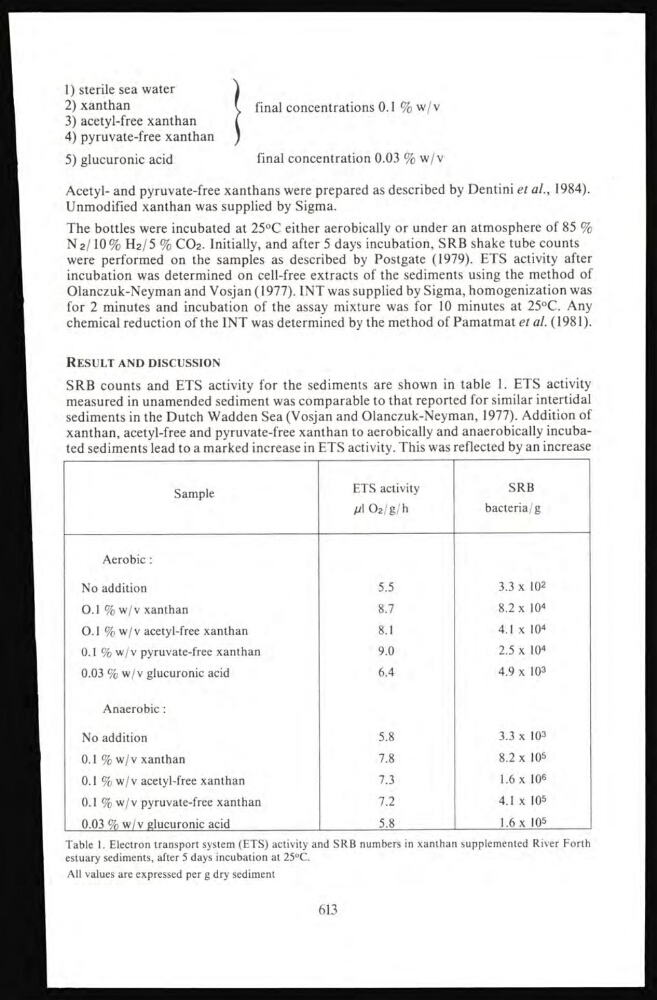
SRB counts and ETS activity for the sediments are shown in table 1. ETS activity
measured in unamended sediment was comparable to that reported for similar intertidal
sediments in the Dutch Wadden Sea (Vosjan and Olanczuk-Neyman, 1977). Addition of
xanthan, acetyl-free and pyruvate-free xanthan to aerobically and anaerobically incubated sediments lead to a marked increase in ETS activity. This was reflected by an increase
Sample
ETS activity
µ1 O 2 /g/h
SRB
bacteria/g
Aerobic :
No addition
5.5
3.3 x 10 2
O.1 % w/v xanthan
8.7
8.2 x 10 4
O.1 % w/v acetyl-free xanthan
8.1
4.1 x 10 4
0.1 % w/v pyruvate-free xanthan
9.0
2.5 x 10 4
0.03 % w/v glucuronic acid
6.4
4.9 x 10 3
Anaerobic :
No addition
5.8
3.3 x 10 3
0.1 % w/v xanthan
7.8
8.2 x 10 5
0.1 % w/v acetyl-free xanthan
7.3
1.6 x 10 6
0.1 % w/v pyruvate-free xanthan
7.2
4.1 x 10 5
0.03 % w/v glucuronic acid
5.8
1.6 x 10 5
Table 1. Electron transport system (ETS) activity and SRB numbers in xanthan supplemented River Forth
estuary sediments, after 5 days incubation at 25°C.
All values are expressed per g dry sediment
} final concentrations 0.1 % w/v
final concentration 0.03 % w/v
613
2) xanthan
3) acetyl-free xanthan
4) pyruvate-free xanthan
5) glucuronic acid
Acetyl- and pyruvate-free xanthans were prepared as described by Dentini et ai, 1984).
Unmodified xanthan was supplied by Sigma.
The bottles were incubated at 25°C either aerobically or under an atmosphere of 85 %
N 2 /10% H 2 /5 % CO 2 . Initially, and after 5 days incubation, SRB shake tube counts
were performed on the samples as described by Postgate (1979). ETS activity after
incubation was determined on cell-free extracts of the sediments using the method of
Olanczuk-Neyman and Vosjan(1977). INT was supplied by Sigma, homogenization was
for 2 minutes and incubation of the assay mixture was for 10 minutes at 25°C. Any
chemical reduction of the INT was determined by the method of Pamatmat et al.( 1981).
RESULT AND DISCUSSION
SRB counts and ETS activity for the sediments are shown in table 1. ETS activity
measured in unamended sediment was comparable to that reported for similar intertidal
sediments in the Dutch Wadden Sea (Vosjan and Olanczuk-Neyman, 1977). Addition of
xanthan, acetyl-free and pyruvate-free xanthan to aerobically and anaerobically incubated sediments lead to a marked increase in ETS activity. This was reflected by an increase
Sample
ETS activity
µ1 O 2 /g/h
SRB
bacteria/g
Aerobic :
No addition
5.5
3.3 x 10 2
O.1 % w/v xanthan
8.7
8.2 x 10 4
O.1 % w/v acetyl-free xanthan
8.1
4.1 x 10 4
0.1 % w/v pyruvate-free xanthan
9.0
2.5 x 10 4
0.03 % w/v glucuronic acid
6.4
4.9 x 10 3
Anaerobic :
No addition
5.8
3.3 x 10 3
0.1 % w/v xanthan
7.8
8.2 x 10 5
0.1 % w/v acetyl-free xanthan
7.3
1.6 x 10 6
0.1 % w/v pyruvate-free xanthan
7.2
4.1 x 10 5
0.03 % w/v glucuronic acid
5.8
1.6 x 10 5
Table 1. Electron transport system (ETS) activity and SRB numbers in xanthan supplemented River Forth
estuary sediments, after 5 days incubation at 25°C.
All values are expressed per g dry sediment
} final concentrations 0.1 % w/v
final concentration 0.03 % w/v
613