

Strain
Plasmid molecular weights (Mdal)
Unidentified Gram-negative rod W1
80, 57, 50, 38, 4.3, 2.2, 1.7, 1.3, 1.0
Unidentified Gram-negative
75, 6.0, 2.9, 2.3, 1.2
Unidentified Gram-negative rod W5
68, 57, 50, 4.3, 2.2, 1.7, 1.3, 1.0
Unidentified Gram-negative rod W6
80, 5.0, 1.9, 1.4, 1.1
Vibrio sp. W7
57
Unidentified Gram-negative rod W8
44, 31, 2.9, 1.3, 1.1, 1.0
Vibrio sp. W10
108, 70, 57, 40, 4.0, 1.6, 1.3, 1.1, 1.0
Unidentified Gram-negative rod Wll
108, 74, 68, 50, 9.5, 5.6, 2.3, 1.5, 1.2
Unidentified Gram-negative rod W14
31,28
Vibrio fluvialis W20 (pG01, pG02)
36. 2.1
Unidentified Gram-negative rod S28
105, 77, 68, 60, 3.4, 3.3, 3.1
Unidentified Gram-negative rod W29
77
Klebsiella/ Enterobacter/Hafnia/ Serratia W
32 44, 2.3
Klebsiella/Enterobacter/ Hafnia/Serratia W
33 98, 68, 60, 6.0, 5.6
Unidentified Gram-negative rod W42
92
Flavobacterium sp. S45
60
Unidentified Gram-negative rod S51
44, 38, 36, 2.5, 1.9
Klebsiella/ Enterobacter/Hafnia/ Serratia S53 (pG03, pG04) 34.3, 2.9
Klebsiella/ Enterobacter/Hafnia/ Serratia S54
96, 2.0
Flavobacterium sp. SB23 (pG05)
34
Flavobacterium sp. SB23 cured strain
-
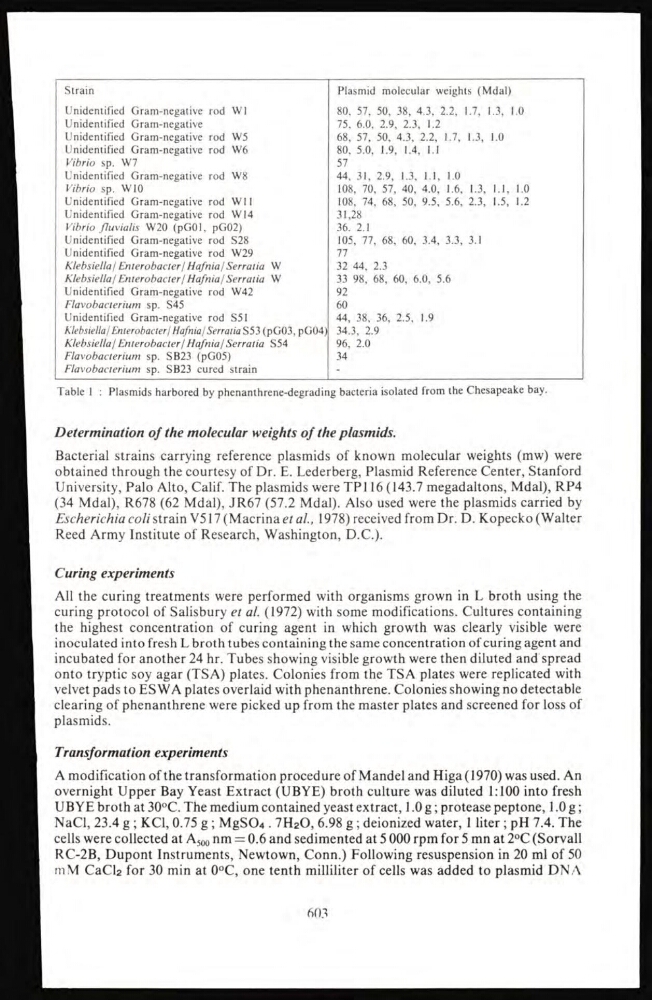
Table 1 : Plasmids harbored by phenanthrene-degrading bacteria isolated from the Chesapeake bay.
Determination of the molecular weights of the plasmids.
Bacterial strains carrying reference plasmids of known molecular weights (mw) were
obtained through the courtesy of Dr. E. Lederberg, Plasmid Reference Center, Stanford
University, Palo Alto, Calif. The plasmids were TP116 (143.7 megadaltons, Mdal), RP4
(34 Mdal), R678 (62 Mdal), JR67 (57.2 Mdal). Also used were the plasmids carried by
Escherichia coli strain V517 (Macrina et al., 1978) received from Dr. D. Kopecko (Walter
Reed Army Institute of Research, Washington, D.C.).
Curing experiments
All the curing treatments were performed with organisms grown in L broth using the
curing protocol of Salisbury et al. (1972) with some modifications. Cultures containing
the highest concentration of curing agent in which growth was clearly visible were
inoculated into fresh L broth tubes containing the same concentration of curing agent and
incubated for another 24 hr. Tubes showing visible growth were then diluted and spread
onto tryptic soy agar (TSA) plates. Colonies from the TSA plates were replicated with
velvet pads to ESWA plates overlaid with phenanthrene. Colonies showing no detectable
clearing of phenanthrene were picked up from the master plates and screened for loss of
plasmids.
Transformation experiments
A modification of the transformation procedure of Mandel and Higa(1970) was used. An
overnight Upper Bay Yeast Extract (UBYE) broth culture was diluted 1:100 into fresh
UBYE broth at 30°C. The medium contained yeast extract, 1.0 g ; protease peptone, 1.0 g ;
NaCl, 23.4 g ; KCl,0.75 g ; MgSCO 4 . 7H 2 O, 6.98 g ; deionized water, 1 liter ; pH 7.4. The
cells were collected at A 500 nm = 0.6 and sedimented at 5 000 rpm for 5 mn at 2°C (Sorvall
RC-2B, Dupont Instruments, Newtown, Conn.) Following resuspension in 20 ml of 50
mM CaCl 2 for 30 min at 0°C, one tenth milliliter of cells was added to plasmid DNA
603
Plasmid molecular weights (Mdal)
Unidentified Gram-negative rod W1
80, 57, 50, 38, 4.3, 2.2, 1.7, 1.3, 1.0
Unidentified Gram-negative
75, 6.0, 2.9, 2.3, 1.2
Unidentified Gram-negative rod W5
68, 57, 50, 4.3, 2.2, 1.7, 1.3, 1.0
Unidentified Gram-negative rod W6
80, 5.0, 1.9, 1.4, 1.1
Vibrio sp. W7
57
Unidentified Gram-negative rod W8
44, 31, 2.9, 1.3, 1.1, 1.0
Vibrio sp. W10
108, 70, 57, 40, 4.0, 1.6, 1.3, 1.1, 1.0
Unidentified Gram-negative rod Wll
108, 74, 68, 50, 9.5, 5.6, 2.3, 1.5, 1.2
Unidentified Gram-negative rod W14
31,28
Vibrio fluvialis W20 (pG01, pG02)
36. 2.1
Unidentified Gram-negative rod S28
105, 77, 68, 60, 3.4, 3.3, 3.1
Unidentified Gram-negative rod W29
77
Klebsiella/ Enterobacter/Hafnia/ Serratia W
32 44, 2.3
Klebsiella/Enterobacter/ Hafnia/Serratia W
33 98, 68, 60, 6.0, 5.6
Unidentified Gram-negative rod W42
92
Flavobacterium sp. S45
60
Unidentified Gram-negative rod S51
44, 38, 36, 2.5, 1.9
Klebsiella/ Enterobacter/Hafnia/ Serratia S53 (pG03, pG04) 34.3, 2.9
Klebsiella/ Enterobacter/Hafnia/ Serratia S54
96, 2.0
Flavobacterium sp. SB23 (pG05)
34
Flavobacterium sp. SB23 cured strain
-
Table 1 : Plasmids harbored by phenanthrene-degrading bacteria isolated from the Chesapeake bay.
Determination of the molecular weights of the plasmids.
Bacterial strains carrying reference plasmids of known molecular weights (mw) were
obtained through the courtesy of Dr. E. Lederberg, Plasmid Reference Center, Stanford
University, Palo Alto, Calif. The plasmids were TP116 (143.7 megadaltons, Mdal), RP4
(34 Mdal), R678 (62 Mdal), JR67 (57.2 Mdal). Also used were the plasmids carried by
Escherichia coli strain V517 (Macrina et al., 1978) received from Dr. D. Kopecko (Walter
Reed Army Institute of Research, Washington, D.C.).
Curing experiments
All the curing treatments were performed with organisms grown in L broth using the
curing protocol of Salisbury et al. (1972) with some modifications. Cultures containing
the highest concentration of curing agent in which growth was clearly visible were
inoculated into fresh L broth tubes containing the same concentration of curing agent and
incubated for another 24 hr. Tubes showing visible growth were then diluted and spread
onto tryptic soy agar (TSA) plates. Colonies from the TSA plates were replicated with
velvet pads to ESWA plates overlaid with phenanthrene. Colonies showing no detectable
clearing of phenanthrene were picked up from the master plates and screened for loss of
plasmids.
Transformation experiments
A modification of the transformation procedure of Mandel and Higa(1970) was used. An
overnight Upper Bay Yeast Extract (UBYE) broth culture was diluted 1:100 into fresh
UBYE broth at 30°C. The medium contained yeast extract, 1.0 g ; protease peptone, 1.0 g ;
NaCl, 23.4 g ; KCl,0.75 g ; MgSCO 4 . 7H 2 O, 6.98 g ; deionized water, 1 liter ; pH 7.4. The
cells were collected at A 500 nm = 0.6 and sedimented at 5 000 rpm for 5 mn at 2°C (Sorvall
RC-2B, Dupont Instruments, Newtown, Conn.) Following resuspension in 20 ml of 50
mM CaCl 2 for 30 min at 0°C, one tenth milliliter of cells was added to plasmid DNA
603