

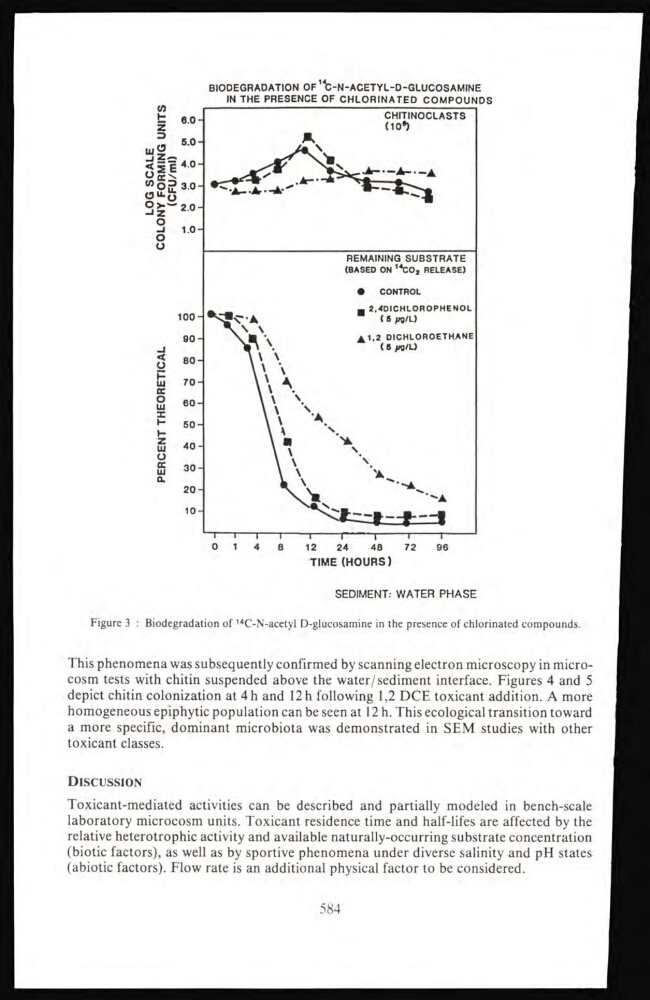
BIODEGRADATION OF
14 CN-ACETYL-D-GLUCOSAMINE
IN THE PRESENCE OF CHLORINATED COMPOUNDS
SEDIMENT: WATER PHASE
Figure 3 : Biodegradation of
14 C-N-acetyl D-glucosamine in the presence of chlorinated compounds.
This phenomena was subsequently confirmed by scanning electron microscopy in microcosm tests with chitin suspended above the water/ sediment interface. Figures 4 and 5
depict chitin colonization at 4h and 12 h following 1,2 DCE toxicant addition. A more
homogeneous epiphytic population can be seen at 12 h. This ecological transition toward
a more specific, dominant microbiota was demonstrated in SEM studies with other
toxicant classes.
DISCUSSION
Toxicant-mediated activities can be described and partially modeled in bench-scale
laboratory microcosm units. Toxicant residence time and half-lifes are affected by the
relative heterotrophic activity and available naturally-occurring substrate concentration
(biotic factors), as well as by sportive phenomena under diverse salinity and pH states
(abiotic factors). Flow rate is an additional physical factor to be considered.
584
14 CN-ACETYL-D-GLUCOSAMINE
IN THE PRESENCE OF CHLORINATED COMPOUNDS
SEDIMENT: WATER PHASE
Figure 3 : Biodegradation of
14 C-N-acetyl D-glucosamine in the presence of chlorinated compounds.
This phenomena was subsequently confirmed by scanning electron microscopy in microcosm tests with chitin suspended above the water/ sediment interface. Figures 4 and 5
depict chitin colonization at 4h and 12 h following 1,2 DCE toxicant addition. A more
homogeneous epiphytic population can be seen at 12 h. This ecological transition toward
a more specific, dominant microbiota was demonstrated in SEM studies with other
toxicant classes.
DISCUSSION
Toxicant-mediated activities can be described and partially modeled in bench-scale
laboratory microcosm units. Toxicant residence time and half-lifes are affected by the
relative heterotrophic activity and available naturally-occurring substrate concentration
(biotic factors), as well as by sportive phenomena under diverse salinity and pH states
(abiotic factors). Flow rate is an additional physical factor to be considered.
584