

benthic communities in a sandy-mud sediment of the brackish water Kiel Bight (Baltic
Sea; FRG) between September 1981 and June 1982. From these parameters, the following will be discussed in this paper. ATP-measurements were used to describe overall
benthic biomass. Bacterial number and biomass were extrapolated from epifluorescence
microscopy preparations. Direct calorimetry (heat production) served as an indicator for
overall benthic metabolism. Decomposition of particulate organic material was derived
from exoenzymatic activity measurements. Details of the methods used as well as a
characterization of the sediments sampled are described in two recent papers and literature cited therein (Graf et al. 1983, Meyer-Reil 1983).
SUMMER
BREAK
AUTUMN
WINTER
SPRING
STAGNATION ,
UP
,
INPUT
,
INPUT
,
INPUT
,
1
S
1
Ô
1
N
1
D
1
i
1
F
1
M
1
Â
1
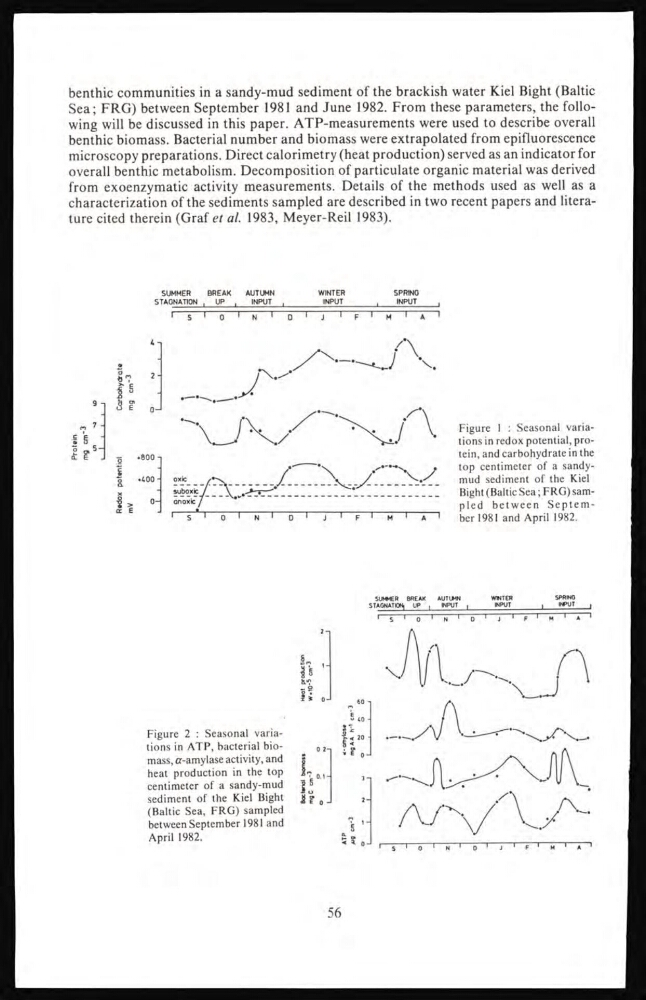
Figure 1 : Seasonal variations in redox potential, protein, and carbohydrate in the
top centimeter of a sandymud sediment of the Kiel
Bight (Baltic Sea ; FRG) sampled between September 1981 and April 1982.
Figure 2 : Seasonal variations in ATP, bacterial biomass, a-amylase activity, and
heat production in the top
centimeter of a sandy-mud
sediment of the Kiel Bight
(Baltic Sea, FRG) sampled
between September 1981 and
April 1982.
56
Sea; FRG) between September 1981 and June 1982. From these parameters, the following will be discussed in this paper. ATP-measurements were used to describe overall
benthic biomass. Bacterial number and biomass were extrapolated from epifluorescence
microscopy preparations. Direct calorimetry (heat production) served as an indicator for
overall benthic metabolism. Decomposition of particulate organic material was derived
from exoenzymatic activity measurements. Details of the methods used as well as a
characterization of the sediments sampled are described in two recent papers and literature cited therein (Graf et al. 1983, Meyer-Reil 1983).
SUMMER
BREAK
AUTUMN
WINTER
SPRING
STAGNATION ,
UP
,
INPUT
,
INPUT
,
INPUT
,
1
S
1
Ô
1
N
1
D
1
i
1
F
1
M
1
Â
1
Figure 1 : Seasonal variations in redox potential, protein, and carbohydrate in the
top centimeter of a sandymud sediment of the Kiel
Bight (Baltic Sea ; FRG) sampled between September 1981 and April 1982.
Figure 2 : Seasonal variations in ATP, bacterial biomass, a-amylase activity, and
heat production in the top
centimeter of a sandy-mud
sediment of the Kiel Bight
(Baltic Sea, FRG) sampled
between September 1981 and
April 1982.
56