

Animals
Month
Gut (n = 28)
V. harveyi V. fischeri
Water (n= 27)
V. harveyi V.fischeri
Sediment (n = 25)
V. harveyi V. fischeri
A. benedicti
B. tranquebarica
June, 1982
July
August
June, 1982
July
August
7
4
4
3
1
2
2
4
I
4
2
3
1
2
5
3
4
1
2
5
1
3
3
1
3
4
1
3
1
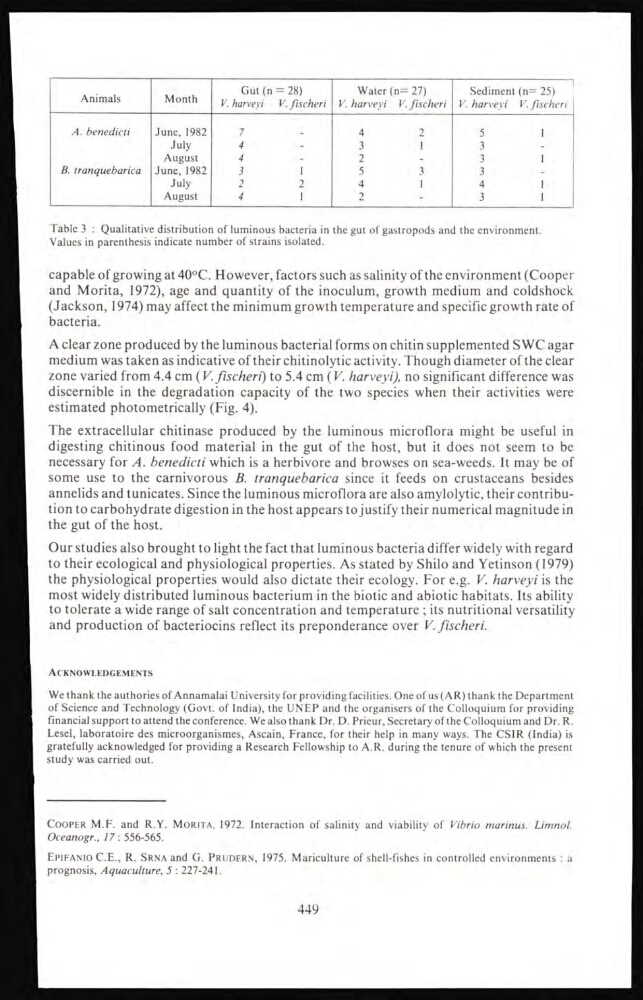
Table 3 : Qualitative distribution of luminous bacteria in the gut of gastropods and the environment.
Values in parenthesis indicate number of strains isolated.
capable of growing at 40°C. However, factors such as salinity of the environment (Cooper
and Morita, 1972), age and quantity of the inoculum, growth medium and coldshock
(Jackson, 1974) may affect the minimum growth temperature and specific growth rate of
bacteria.
A clear zone produced by the luminous bacterial forms on chitin supplemented SWC agar
medium was taken as indicative of their chitinolytic activity. Though diameter of the clear
zone varied from 4.4 cm ( V.fischeri) to 5.4 cm ( V. harveyi), no significant difference was
discernible in the degradation capacity of the two species when their activities were
estimated photometrically (Fig. 4).
The extracellular chitinase produced by the luminous microflora might be useful in
digesting chitinous food material in the gut of the host, but it does not seem to be
necessary for A. benedicti which is a herbivore and browses on sea-weeds. It may be of
some use to the carnivorous B. tranquebarica since it feeds on crustaceans besides
annelids and tunicates. Since the luminous microflora are also amylolytic, their contribution to carbohydrate digestion in the host appears to justify their numerical magnitude in
the gut of the host.
Our studies also brought to light the fact that luminous bacteria differ widely with regard
to their ecological and physiological properties. As stated by Shilo and Yetinson ( 1979)
the physiological properties would also dictate their ecology. For e.g. V. harveyi is the
most widely distributed luminous bacterium in the biotic and abiotic habitats. Its ability
to tolerate a wide range of salt concentration and temperature ; its nutritional versatility
and production of bacteriocins reflect its preponderance over V.fischeri.
ACKNOWLEDGEMENTS
We thank the authories of Annamalai University for providing facilities. One of us (AR) thank the Department
of Science and Technology (Govt. of India), the UNEP and the organisers of the Colloquium for providing
financial support to attend the conference. We also thank Dr. D. Prieur, Secretary of the Colloquium and Dr. R.
Lesel, laboratoire des microorganismes, Ascain, France, for their help in many ways. The CSIR (India) is
gratefully acknowledged for providing a Research Fellowship to A.R. during the tenure of which the present
study was carried out.
COOPER M.F. and R.Y. MORITA, 1972. Interaction of salinity and viability of Vibrio marinus. Limnol.
Oceanogr., 17: 556-565.
EPIFANIO C.E., R. SRNA and G. PRUDERN, 1975. Mariculture of shell-fishes in controlled environments : a
prognosis, Aquaculture, 5 : 227-241.
449
Month
Gut (n = 28)
V. harveyi V. fischeri
Water (n= 27)
V. harveyi V.fischeri
Sediment (n = 25)
V. harveyi V. fischeri
A. benedicti
B. tranquebarica
June, 1982
July
August
June, 1982
July
August
7
4
4
3
1
2
2
4
I
4
2
3
1
2
5
3
4
1
2
5
1
3
3
1
3
4
1
3
1
Table 3 : Qualitative distribution of luminous bacteria in the gut of gastropods and the environment.
Values in parenthesis indicate number of strains isolated.
capable of growing at 40°C. However, factors such as salinity of the environment (Cooper
and Morita, 1972), age and quantity of the inoculum, growth medium and coldshock
(Jackson, 1974) may affect the minimum growth temperature and specific growth rate of
bacteria.
A clear zone produced by the luminous bacterial forms on chitin supplemented SWC agar
medium was taken as indicative of their chitinolytic activity. Though diameter of the clear
zone varied from 4.4 cm ( V.fischeri) to 5.4 cm ( V. harveyi), no significant difference was
discernible in the degradation capacity of the two species when their activities were
estimated photometrically (Fig. 4).
The extracellular chitinase produced by the luminous microflora might be useful in
digesting chitinous food material in the gut of the host, but it does not seem to be
necessary for A. benedicti which is a herbivore and browses on sea-weeds. It may be of
some use to the carnivorous B. tranquebarica since it feeds on crustaceans besides
annelids and tunicates. Since the luminous microflora are also amylolytic, their contribution to carbohydrate digestion in the host appears to justify their numerical magnitude in
the gut of the host.
Our studies also brought to light the fact that luminous bacteria differ widely with regard
to their ecological and physiological properties. As stated by Shilo and Yetinson ( 1979)
the physiological properties would also dictate their ecology. For e.g. V. harveyi is the
most widely distributed luminous bacterium in the biotic and abiotic habitats. Its ability
to tolerate a wide range of salt concentration and temperature ; its nutritional versatility
and production of bacteriocins reflect its preponderance over V.fischeri.
ACKNOWLEDGEMENTS
We thank the authories of Annamalai University for providing facilities. One of us (AR) thank the Department
of Science and Technology (Govt. of India), the UNEP and the organisers of the Colloquium for providing
financial support to attend the conference. We also thank Dr. D. Prieur, Secretary of the Colloquium and Dr. R.
Lesel, laboratoire des microorganismes, Ascain, France, for their help in many ways. The CSIR (India) is
gratefully acknowledged for providing a Research Fellowship to A.R. during the tenure of which the present
study was carried out.
COOPER M.F. and R.Y. MORITA, 1972. Interaction of salinity and viability of Vibrio marinus. Limnol.
Oceanogr., 17: 556-565.
EPIFANIO C.E., R. SRNA and G. PRUDERN, 1975. Mariculture of shell-fishes in controlled environments : a
prognosis, Aquaculture, 5 : 227-241.
449