

COMPARISON OF METHODS
FOR
BACTERIAL PRODUCTION
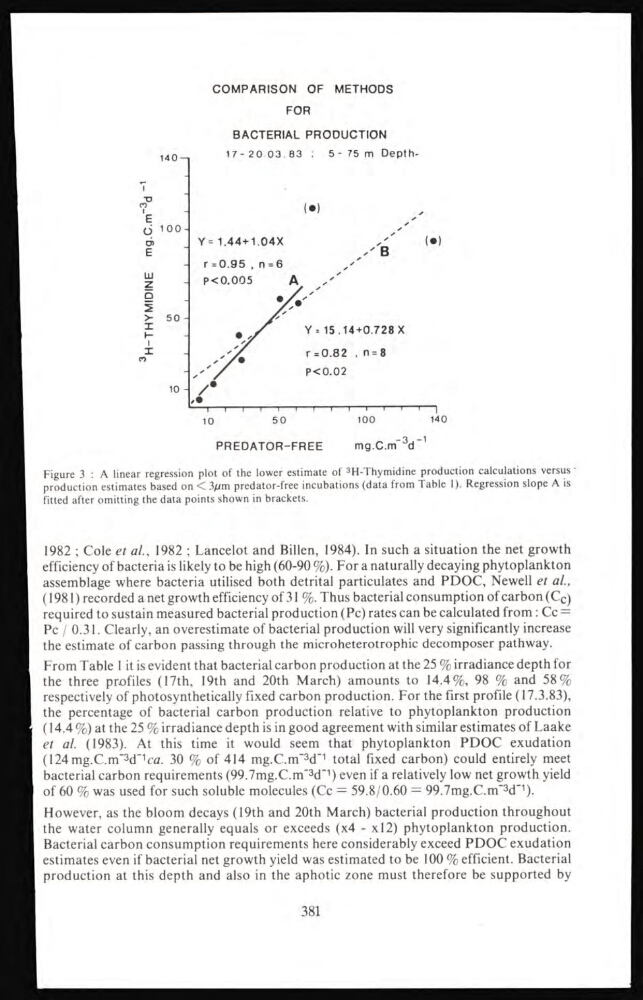
Figure 3 : A linear regression plot of the lower estimate of 3H-Thymidine production calculations versus
production estimates based on < 3µm predator-free incubations (data from Table 1). Regression slope A is
fitted after omitting the data points shown in brackets.
1982 ; Cole et al., 1982 ; Lancelot and Billen, 1984). In such a situation the net growth
efficiency of bacteria is likely to be high (60-90 %). For a naturally decaying phytoplankton
assemblage where bacteria utilised both detrital particulates and PDOC, Newell et ai,
(1981) recorded a net growth efficiency of 31 %. Thus bacterial consumption of carbon (C
c
)
required to sustain measured bacterial production (Pc) rates can be calculated from : Cc =
Pc / 0.31. Clearly, an overestimate of bacterial production will very significantly increase
the estimate of carbon passing through the microheterotrophic decomposer pathway.
From Table 1 it is evident that bacterial carbon production at the 25 % irradiance depth for
the three profiles (17th, 19th and 20th March) amounts to 14.4%, 98 % and 58%
respectively of photosynthetically fixed carbon production. For the first profile (17.3.83),
the percentage of bacterial carbon production relative to phytoplankton production
(14.4%) at the 25 % irradiance depth is in good agreement with similar estimates of Laake
et al. (1983). At this time it would seem that phytoplankton PDOC exudation
(124 mg.C.m -3 d -1 ca. 30 % of 414 mg.C.m -3 d -1 total fixed carbon) could entirely meet
bacterial carbon requirements (99.7mg.C.nT -3 d -1 ) even if a relatively low net growth yield
of 60 % was used for such soluble molecules (Cc = 59.8/0.60 = 99.7mg.C.m -3 d -1 ).
However, as the bloom decays (19th and 20th March) bacterial production throughout
the water column generally equals or exceeds (x4 - x12) phytoplankton production.
Bacterial carbon consumption requirements here considerably exceed PDOC exudation
estimates even if bacterial net growth yield was estimated to be 100 % efficient. Bacterial
production at this depth and also in the aphotic zone must therefore be supported by
381
FOR
BACTERIAL PRODUCTION
Figure 3 : A linear regression plot of the lower estimate of 3H-Thymidine production calculations versus
production estimates based on < 3µm predator-free incubations (data from Table 1). Regression slope A is
fitted after omitting the data points shown in brackets.
1982 ; Cole et al., 1982 ; Lancelot and Billen, 1984). In such a situation the net growth
efficiency of bacteria is likely to be high (60-90 %). For a naturally decaying phytoplankton
assemblage where bacteria utilised both detrital particulates and PDOC, Newell et ai,
(1981) recorded a net growth efficiency of 31 %. Thus bacterial consumption of carbon (C
c
)
required to sustain measured bacterial production (Pc) rates can be calculated from : Cc =
Pc / 0.31. Clearly, an overestimate of bacterial production will very significantly increase
the estimate of carbon passing through the microheterotrophic decomposer pathway.
From Table 1 it is evident that bacterial carbon production at the 25 % irradiance depth for
the three profiles (17th, 19th and 20th March) amounts to 14.4%, 98 % and 58%
respectively of photosynthetically fixed carbon production. For the first profile (17.3.83),
the percentage of bacterial carbon production relative to phytoplankton production
(14.4%) at the 25 % irradiance depth is in good agreement with similar estimates of Laake
et al. (1983). At this time it would seem that phytoplankton PDOC exudation
(124 mg.C.m -3 d -1 ca. 30 % of 414 mg.C.m -3 d -1 total fixed carbon) could entirely meet
bacterial carbon requirements (99.7mg.C.nT -3 d -1 ) even if a relatively low net growth yield
of 60 % was used for such soluble molecules (Cc = 59.8/0.60 = 99.7mg.C.m -3 d -1 ).
However, as the bloom decays (19th and 20th March) bacterial production throughout
the water column generally equals or exceeds (x4 - x12) phytoplankton production.
Bacterial carbon consumption requirements here considerably exceed PDOC exudation
estimates even if bacterial net growth yield was estimated to be 100 % efficient. Bacterial
production at this depth and also in the aphotic zone must therefore be supported by
381