

MATERIALS AND METHODS
Study sites and field methodology
Holyhead Harbour. The inner harbour contains extensive areas of acoustically turbid
anoxic sediment at a depth of approx. 10 m. During March 1982 core samples were taken
and acoustic traces were recorded for a series of sample stations (Fig. 1). Additional mud
cores were obtained for the microcosm experiments.
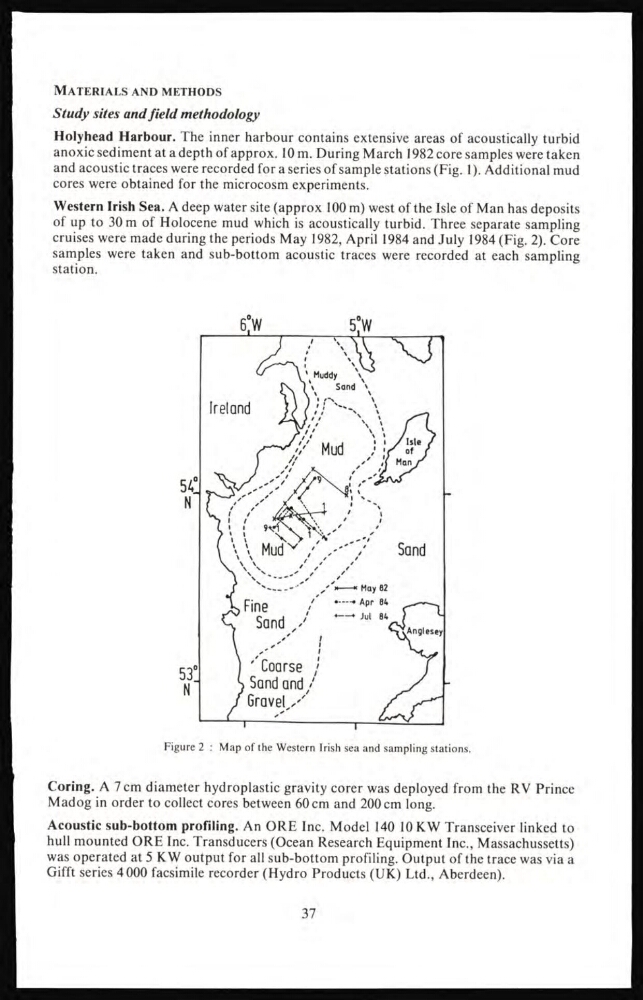
Western Irish Sea. A deep water site (approx 100 m) west of the Isle of Man has deposits
of up to 30 m of Holocene mud which is acoustically turbid. Three separate sampling
cruises were made during the periods May 1982, April 1984 and July 1984 (Fig. 2). Core
samples were taken and sub-bottom acoustic traces were recorded at each sampling
station.
Coring. A 7 cm diameter hydroplastic gravity corer was deployed from the RV Prince
Madog in order to collect cores between 60 cm and 200 cm long.
Acoustic sub-bottom profiling. An ORE Inc. Model 140 10 KW Transceiver linked to
hull mounted ORE Inc. Transducers (Ocean Research Equipment Inc., Massachussetts)
was operated at 5 KW output for all sub-bottom profiling. Output of the trace was via a
Gifft series 4000 facsimile recorder (Hydro Products (UK) Ltd., Aberdeen).
37
Study sites and field methodology
Holyhead Harbour. The inner harbour contains extensive areas of acoustically turbid
anoxic sediment at a depth of approx. 10 m. During March 1982 core samples were taken
and acoustic traces were recorded for a series of sample stations (Fig. 1). Additional mud
cores were obtained for the microcosm experiments.
Western Irish Sea. A deep water site (approx 100 m) west of the Isle of Man has deposits
of up to 30 m of Holocene mud which is acoustically turbid. Three separate sampling
cruises were made during the periods May 1982, April 1984 and July 1984 (Fig. 2). Core
samples were taken and sub-bottom acoustic traces were recorded at each sampling
station.
Coring. A 7 cm diameter hydroplastic gravity corer was deployed from the RV Prince
Madog in order to collect cores between 60 cm and 200 cm long.
Acoustic sub-bottom profiling. An ORE Inc. Model 140 10 KW Transceiver linked to
hull mounted ORE Inc. Transducers (Ocean Research Equipment Inc., Massachussetts)
was operated at 5 KW output for all sub-bottom profiling. Output of the trace was via a
Gifft series 4000 facsimile recorder (Hydro Products (UK) Ltd., Aberdeen).
37