

mg/l of N-serve. Basically these calculations involve using ratios of NH4 to CO oxidized
in pure cultures and back calculation using the in situ NH4 concentrations. The method
should be used in a situation where the ammonium oxidizers rather than the methane
oxidizers are the main group responsible for the oxidation of CO. By examining the ratio
of CH4 and CO oxidation one can determine which is major group responsible for the
oxidation (CH4 oxidizers have ratios between 0.380 to 1.87, ammonium oxidizers have a
value between 0.0007 to 0.0428). Therefore, if the in situ NH 4 concentrations are known
and the value for N-serve inhibited CO oxidation is known the rates of nitrification can be
calculated, assuming that we have first order kinetics. This method has been applied not
only to marine waters, but also to lakes and soil and represents a very sensitive method for
rate measurements of nitrification that can reflect the activity at the in situ temperature,
pH, and salinity.
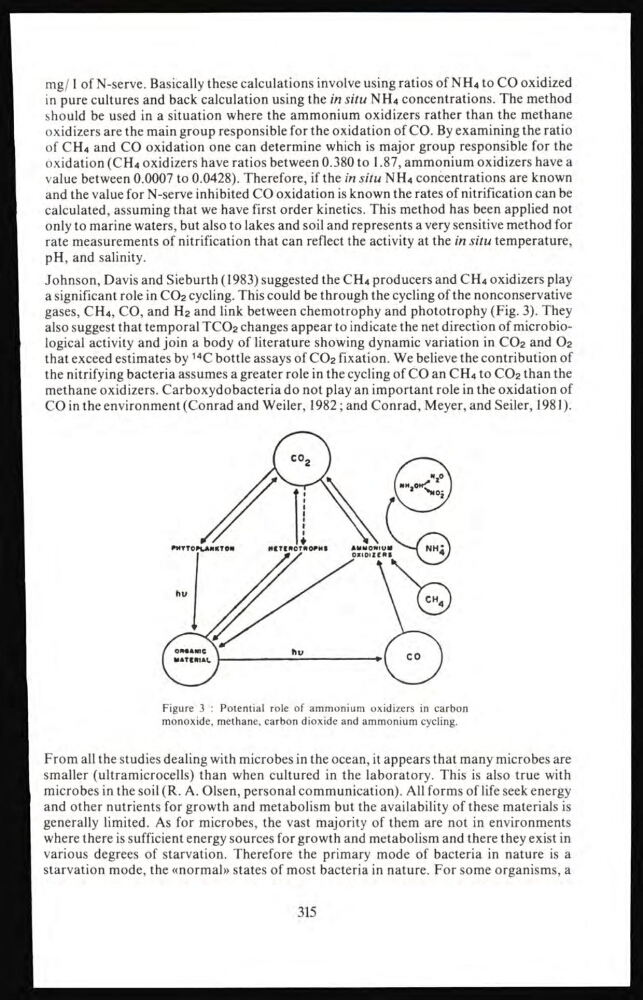
Johnson, Davis and Sieburth (1983) suggested the CH 4 producers and CH 4 oxidizers play
a significant role in CO2 cycling. This could be through the cycling of the nonconservative
gases, CH4, CO, and H 2 and link between chemotrophy and phototrophy (Fig. 3). They
also suggest that temporal TCO2 changes appear to indicate the net direction of microbiological activity and join a body of literature showing dynamic variation in CO2 and O 2
that exceed estimates by 14 C bottle assays of CO2 fixation. We believe the contribution of
the nitrifying bacteria assumes a greater role in the cycling of CO an CH4 to CO2 than the
methane oxidizers. Carboxydobacteria do not play an important role in the oxidation of
CO in the environment (Conrad and Weiler, 1982 ; and Conrad, Meyer, and Seiler, 1981).
Figure 3 : Potential role of ammonium oxidizers in carbon
monoxide, methane, carbon dioxide and ammonium cycling.
From all the studies dealing with microbes in the ocean, it appears that many microbes are
smaller (ultramicrocells) than when cultured in the laboratory. This is also true with
microbes in the soil (R. A. Olsen, personal communication). All forms of life seek energy
and other nutrients for growth and metabolism but the availability of these materials is
generally limited. As for microbes, the vast majority of them are not in environments
where there is sufficient energy sources for growth and metabolism and there they exist in
various degrees of starvation. Therefore the primary mode of bacteria in nature is a
starvation mode, the «normal» states of most bacteria in nature. For some organisms, a
315
in pure cultures and back calculation using the in situ NH4 concentrations. The method
should be used in a situation where the ammonium oxidizers rather than the methane
oxidizers are the main group responsible for the oxidation of CO. By examining the ratio
of CH4 and CO oxidation one can determine which is major group responsible for the
oxidation (CH4 oxidizers have ratios between 0.380 to 1.87, ammonium oxidizers have a
value between 0.0007 to 0.0428). Therefore, if the in situ NH 4 concentrations are known
and the value for N-serve inhibited CO oxidation is known the rates of nitrification can be
calculated, assuming that we have first order kinetics. This method has been applied not
only to marine waters, but also to lakes and soil and represents a very sensitive method for
rate measurements of nitrification that can reflect the activity at the in situ temperature,
pH, and salinity.
Johnson, Davis and Sieburth (1983) suggested the CH 4 producers and CH 4 oxidizers play
a significant role in CO2 cycling. This could be through the cycling of the nonconservative
gases, CH4, CO, and H 2 and link between chemotrophy and phototrophy (Fig. 3). They
also suggest that temporal TCO2 changes appear to indicate the net direction of microbiological activity and join a body of literature showing dynamic variation in CO2 and O 2
that exceed estimates by 14 C bottle assays of CO2 fixation. We believe the contribution of
the nitrifying bacteria assumes a greater role in the cycling of CO an CH4 to CO2 than the
methane oxidizers. Carboxydobacteria do not play an important role in the oxidation of
CO in the environment (Conrad and Weiler, 1982 ; and Conrad, Meyer, and Seiler, 1981).
Figure 3 : Potential role of ammonium oxidizers in carbon
monoxide, methane, carbon dioxide and ammonium cycling.
From all the studies dealing with microbes in the ocean, it appears that many microbes are
smaller (ultramicrocells) than when cultured in the laboratory. This is also true with
microbes in the soil (R. A. Olsen, personal communication). All forms of life seek energy
and other nutrients for growth and metabolism but the availability of these materials is
generally limited. As for microbes, the vast majority of them are not in environments
where there is sufficient energy sources for growth and metabolism and there they exist in
various degrees of starvation. Therefore the primary mode of bacteria in nature is a
starvation mode, the «normal» states of most bacteria in nature. For some organisms, a
315