

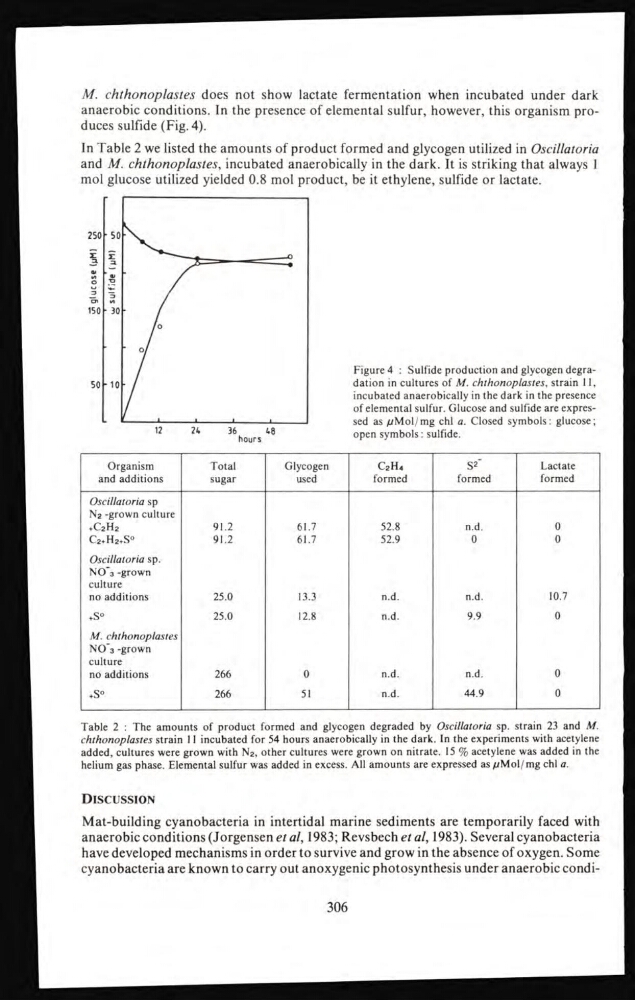
M. chthonoplastes does not show lactate fermentation when incubated under dark
anaerobic conditions. In the presence of elemental sulfur, however, this organism produces sulfide (Fig. 4).
In Table 2 we listed the amounts of product formed and glycogen utilized in Oscillatoria
and M. chthonoplastes, incubated anaerobically in the dark. It is striking that always 1
mol glucose utilized yielded 0.8 mol product, be it ethylene, sulfide or lactate.
Figure 4 : Sulfide production and glycogen degradation in cultures of M. chthonoplastes, strain 11,
incubated anaerobically in the dark in the presence
of elemental sulfur. Glucose and sulfide are expressed as µMol/mg chl a. Closed symbols: glucose;
open symbols : sulfide.
Organism
and additions
Total
sugar
Glycogen
used
C2H4
formed
S 2formed
Lactate
formed
Oscillatoria sp
N 2 -grown culture
+C 2 H 2
91.2
61.7
52.8
n.d.
0
C 2+ H 2+ S°
91.2
61.7
52.9
0
0
Oscillatoria sp.
NO 3 -grown
culture
no additions
25.0
13.3
n.d.
n.d.
10.7
+
S°
25.0
12.8
n.d.
9.9
0
M. chthonoplastes
NO 3 -grown
culture
no additions
266
0
n.d.
n.d.
0
+
S°
266
51
n.d.
44.9
0
Table 2 : The amounts of product formed and glycogen degraded by Oscillatoria sp. strain 23 and M.
chthonoplastes strain 11 incubated for 54 hours anaerobically in the dark. In the experiments with acetylene
added, cultures were grown with N 2 , other cultures were grown on nitrate. 15 % acetylene was added in the
helium gas phase. Elemental sulfur was added in excess. All amounts are expressed as µMol/mg chl a.
DISCUSSION
Mat-building cyanobacteria in intertidal marine sediments are temporarily faced with
anaerobic conditions (Jorgensen et al, 1983; Revsbech et al, 1983). Several cyanobacteria
have developed mechanisms in order to survive and grow in the absence of oxygen. Some
cyanobacteria are known to carry out anoxygenic photosynthesis under anaerobic condi306
anaerobic conditions. In the presence of elemental sulfur, however, this organism produces sulfide (Fig. 4).
In Table 2 we listed the amounts of product formed and glycogen utilized in Oscillatoria
and M. chthonoplastes, incubated anaerobically in the dark. It is striking that always 1
mol glucose utilized yielded 0.8 mol product, be it ethylene, sulfide or lactate.
Figure 4 : Sulfide production and glycogen degradation in cultures of M. chthonoplastes, strain 11,
incubated anaerobically in the dark in the presence
of elemental sulfur. Glucose and sulfide are expressed as µMol/mg chl a. Closed symbols: glucose;
open symbols : sulfide.
Organism
and additions
Total
sugar
Glycogen
used
C2H4
formed
S 2formed
Lactate
formed
Oscillatoria sp
N 2 -grown culture
+C 2 H 2
91.2
61.7
52.8
n.d.
0
C 2+ H 2+ S°
91.2
61.7
52.9
0
0
Oscillatoria sp.
NO 3 -grown
culture
no additions
25.0
13.3
n.d.
n.d.
10.7
+
S°
25.0
12.8
n.d.
9.9
0
M. chthonoplastes
NO 3 -grown
culture
no additions
266
0
n.d.
n.d.
0
+
S°
266
51
n.d.
44.9
0
Table 2 : The amounts of product formed and glycogen degraded by Oscillatoria sp. strain 23 and M.
chthonoplastes strain 11 incubated for 54 hours anaerobically in the dark. In the experiments with acetylene
added, cultures were grown with N 2 , other cultures were grown on nitrate. 15 % acetylene was added in the
helium gas phase. Elemental sulfur was added in excess. All amounts are expressed as µMol/mg chl a.
DISCUSSION
Mat-building cyanobacteria in intertidal marine sediments are temporarily faced with
anaerobic conditions (Jorgensen et al, 1983; Revsbech et al, 1983). Several cyanobacteria
have developed mechanisms in order to survive and grow in the absence of oxygen. Some
cyanobacteria are known to carry out anoxygenic photosynthesis under anaerobic condi306