

bination (Boehringer, W-Germany) (Werner et al, 1970).
Determination of chlorophyll a
Chlorophyll a was determined by extraction of the cells with methanol and measuring the
absorption photometrically at 665 nm. The specific absorption coefficient of McKinney
(1941) was used.
RESULTS
Oscillatoria sp. strain 23 shows nitrogenase activity in the dark under anaerobic conditions (Stal and Krumbein, 1981). These authors supposed that a lactate fermentation
under these conditions probably supplies the energy necessary to survive and to fix
nitrogen. Indeed, incubating Oscillatoria sp. anaerobically in the dark, the pH of the
medium drops drastically from 8.0 to below 6.0 within a few hours. This effect cannot be
observed in the light or aerobically in the dark.
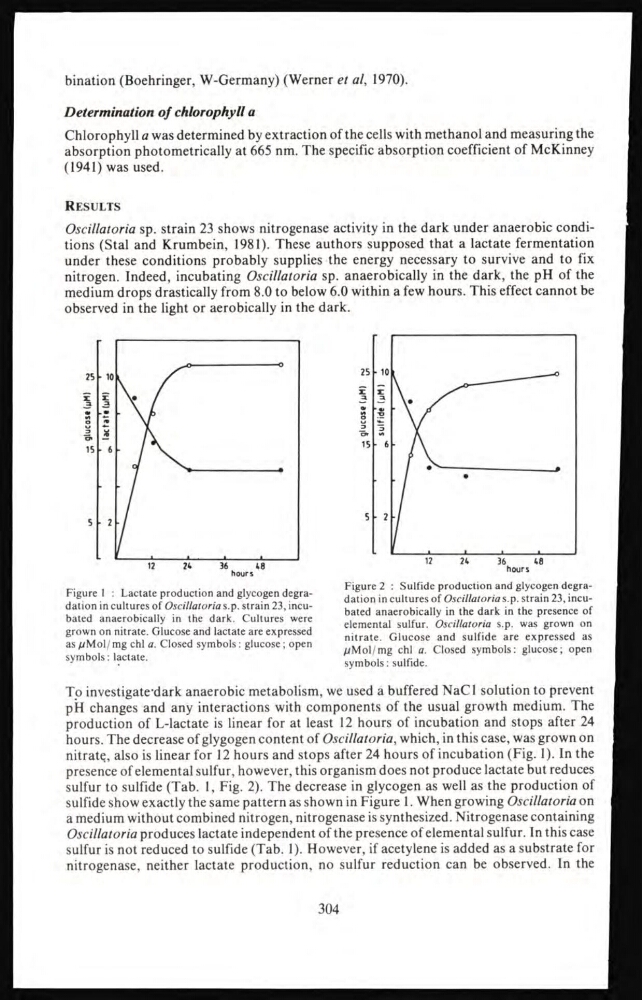
Figure 1 : Lactate production and glycogen degradation in cultures of Oscillatoria s.p. strain 23, incubated anaerobically in the dark. Cultures were
grown on nitrate. Glucose and lactate are expressed
as µMol/mg chl a. Closed symbols : glucose ; open
symbols : lactate.
Figure 2 : Sulfide production and glycogen degradation in cultures of Oscillatoria s.p. strain 23, incubated anaerobically in the dark in the presence of
elemental sulfur. Oscillatoria s.p. was grown on
nitrate. Glucose and sulfide are expressed as
µMol/mg chl a. Closed symbols: glucose; open
symbols : sulfide.
To investigate dark anaerobic metabolism, we used a buffered NaCl solution to prevent
pH changes and any interactions with components of the usual growth medium. The
production of L-lactate is linear for at least 12 hours of incubation and stops after 24
hours. The decrease of glygogen content of Oscillatoria, which, in this case, was grown on
nitrate, also is linear for 12 hours and stops after 24 hours of incubation (Fig. 1). In the
presence of elemental sulfur, however, this organism does not produce lactate but reduces
sulfur to sulfide (Tab. 1, Fig. 2). The decrease in glycogen as well as the production of
sulfide show exactly the same pattern as shown in Figure 1. When growing Oscillatoria on
a medium without combined nitrogen, nitrogenase is synthesized. Nitrogenase containing
Oscillatoria produces lactate independent of the presence of elemental sulfur. In this case
sulfur is not reduced to sulfide (Tab. 1). However, if acetylene is added as a substrate for
nitrogenase, neither lactate production, no sulfur reduction can be observed. In the
304
Determination of chlorophyll a
Chlorophyll a was determined by extraction of the cells with methanol and measuring the
absorption photometrically at 665 nm. The specific absorption coefficient of McKinney
(1941) was used.
RESULTS
Oscillatoria sp. strain 23 shows nitrogenase activity in the dark under anaerobic conditions (Stal and Krumbein, 1981). These authors supposed that a lactate fermentation
under these conditions probably supplies the energy necessary to survive and to fix
nitrogen. Indeed, incubating Oscillatoria sp. anaerobically in the dark, the pH of the
medium drops drastically from 8.0 to below 6.0 within a few hours. This effect cannot be
observed in the light or aerobically in the dark.
Figure 1 : Lactate production and glycogen degradation in cultures of Oscillatoria s.p. strain 23, incubated anaerobically in the dark. Cultures were
grown on nitrate. Glucose and lactate are expressed
as µMol/mg chl a. Closed symbols : glucose ; open
symbols : lactate.
Figure 2 : Sulfide production and glycogen degradation in cultures of Oscillatoria s.p. strain 23, incubated anaerobically in the dark in the presence of
elemental sulfur. Oscillatoria s.p. was grown on
nitrate. Glucose and sulfide are expressed as
µMol/mg chl a. Closed symbols: glucose; open
symbols : sulfide.
To investigate dark anaerobic metabolism, we used a buffered NaCl solution to prevent
pH changes and any interactions with components of the usual growth medium. The
production of L-lactate is linear for at least 12 hours of incubation and stops after 24
hours. The decrease of glygogen content of Oscillatoria, which, in this case, was grown on
nitrate, also is linear for 12 hours and stops after 24 hours of incubation (Fig. 1). In the
presence of elemental sulfur, however, this organism does not produce lactate but reduces
sulfur to sulfide (Tab. 1, Fig. 2). The decrease in glycogen as well as the production of
sulfide show exactly the same pattern as shown in Figure 1. When growing Oscillatoria on
a medium without combined nitrogen, nitrogenase is synthesized. Nitrogenase containing
Oscillatoria produces lactate independent of the presence of elemental sulfur. In this case
sulfur is not reduced to sulfide (Tab. 1). However, if acetylene is added as a substrate for
nitrogenase, neither lactate production, no sulfur reduction can be observed. In the
304