

SAMPLE
MPN % recovery
or bacteria/ml
Tube count % recovery
or bacteria/ml
Desulfovibrio salexigens NCIMB 8403
100%
83%
D. desulfuricans NCIMB 8400
79%
86%
D. desulf. aestuarii NCIMB 9335
93%
83%
Forth 1
54
30
Forth 2
4.0 x 10 3
5.5 x 10 3
Forties *
1.3 x 10 8
2.0 x 10 8
Murchison *
3.5 x 10 8
2.0 x 10 8
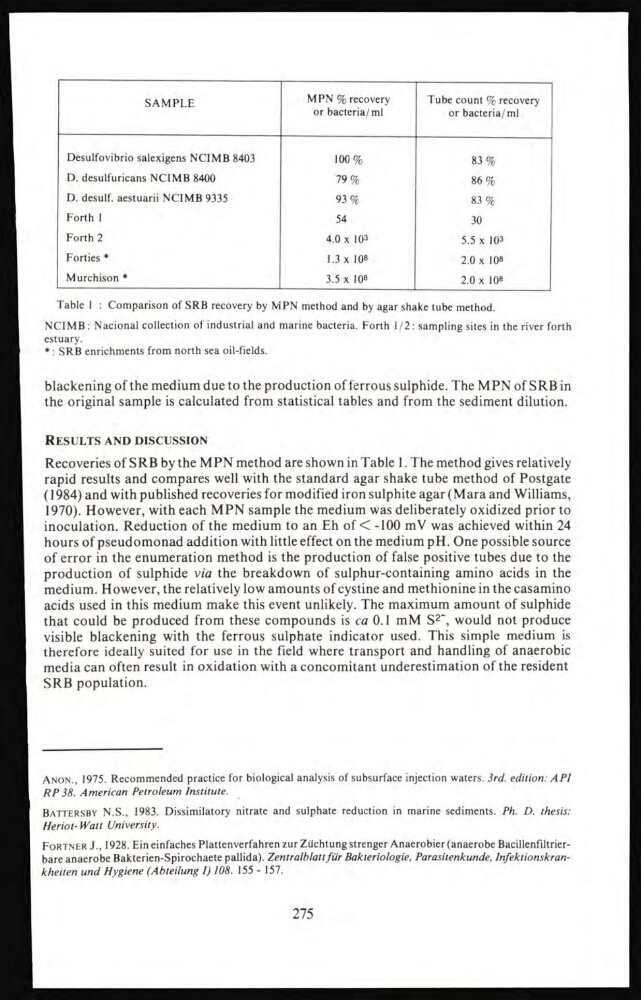
Table 1 : Comparison of SRB recovery by MPN method and by agar shake tube method.
NCIMB : Nacional collection of industrial and marine bacteria. Forth 1/2: sampling sites in the river forth
estuary.
* : SRB enrichments from north sea oil-fields.
blackening of the medium due to the production of ferrous sulphide. The MPN of SRB in
the original sample is calculated from statistical tables and from the sediment dilution.
RESULTS AND DISCUSSION
Recoveries of SRB by the MPN method are shown in Table 1. The method gives relatively
rapid results and compares well with the standard agar shake tube method of Postgate
( 1984) and with published recoveries for modified iron sulphite agar (Mara and Williams,
1970). However, with each MPN sample the medium was deliberately oxidized prior to
inoculation. Reduction of the medium to an Eh of < -100 mV was achieved within 24
hours of pseudomonad addition with little effect on the medium pH. One possible source
of error in the enumeration method is the production of false positive tubes due to the
production of sulphide via the breakdown of sulphur-containing amino acids in the
medium. However, the relatively low amounts of cystine and methionine in the casamino
acids used in this medium make this event unlikely. The maximum amount of sulphide
that could be produced from these compounds is ca 0.1 mM S 2 ", would not produce
visible blackening with the ferrous sulphate indicator used. This simple medium is
therefore ideally suited for use in the field where transport and handling of anaerobic
media can often result in oxidation with a concomitant underestimation of the resident
SRB population.
ANON., 1975. Recommended practice for biological analysis of subsurface injection waters. 3rd. edition: API
RP 38. American Petroleum Institute.
BATTERSBY N.S., 1983. Dissimilatory nitrate and sulphate reduction in marine sediments. Ph. D. thesis:
Heriot- Watt University.
FORTNER J., 1928. Eineinfaches Plattenverfahren zur Züchtung strenger Anaerobier (anaerobe Bacillenfiltrierbare anaerobe Bakterien-Spirochaete pallida). Zentralblatt für Bakteriologie, Parasitenkunde, Infektionskrankheiten und Hygiene (Abteilung I) 108. 155 - 157.
275
MPN % recovery
or bacteria/ml
Tube count % recovery
or bacteria/ml
Desulfovibrio salexigens NCIMB 8403
100%
83%
D. desulfuricans NCIMB 8400
79%
86%
D. desulf. aestuarii NCIMB 9335
93%
83%
Forth 1
54
30
Forth 2
4.0 x 10 3
5.5 x 10 3
Forties *
1.3 x 10 8
2.0 x 10 8
Murchison *
3.5 x 10 8
2.0 x 10 8
Table 1 : Comparison of SRB recovery by MPN method and by agar shake tube method.
NCIMB : Nacional collection of industrial and marine bacteria. Forth 1/2: sampling sites in the river forth
estuary.
* : SRB enrichments from north sea oil-fields.
blackening of the medium due to the production of ferrous sulphide. The MPN of SRB in
the original sample is calculated from statistical tables and from the sediment dilution.
RESULTS AND DISCUSSION
Recoveries of SRB by the MPN method are shown in Table 1. The method gives relatively
rapid results and compares well with the standard agar shake tube method of Postgate
( 1984) and with published recoveries for modified iron sulphite agar (Mara and Williams,
1970). However, with each MPN sample the medium was deliberately oxidized prior to
inoculation. Reduction of the medium to an Eh of < -100 mV was achieved within 24
hours of pseudomonad addition with little effect on the medium pH. One possible source
of error in the enumeration method is the production of false positive tubes due to the
production of sulphide via the breakdown of sulphur-containing amino acids in the
medium. However, the relatively low amounts of cystine and methionine in the casamino
acids used in this medium make this event unlikely. The maximum amount of sulphide
that could be produced from these compounds is ca 0.1 mM S 2 ", would not produce
visible blackening with the ferrous sulphate indicator used. This simple medium is
therefore ideally suited for use in the field where transport and handling of anaerobic
media can often result in oxidation with a concomitant underestimation of the resident
SRB population.
ANON., 1975. Recommended practice for biological analysis of subsurface injection waters. 3rd. edition: API
RP 38. American Petroleum Institute.
BATTERSBY N.S., 1983. Dissimilatory nitrate and sulphate reduction in marine sediments. Ph. D. thesis:
Heriot- Watt University.
FORTNER J., 1928. Eineinfaches Plattenverfahren zur Züchtung strenger Anaerobier (anaerobe Bacillenfiltrierbare anaerobe Bakterien-Spirochaete pallida). Zentralblatt für Bakteriologie, Parasitenkunde, Infektionskrankheiten und Hygiene (Abteilung I) 108. 155 - 157.
275