

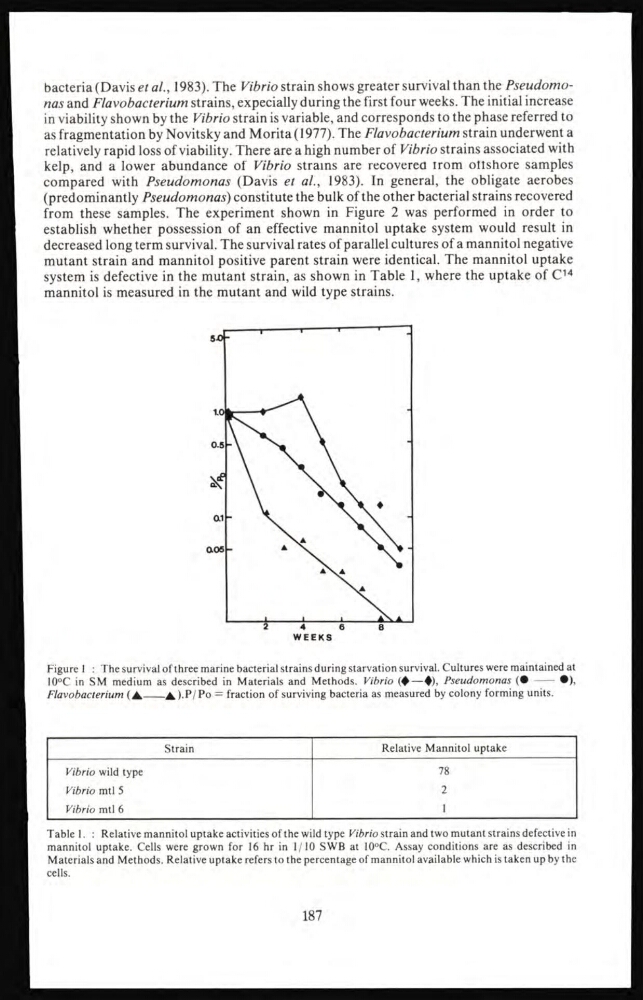
bacteria (Davis et al., 1983). The Vibrio strain shows greater survival than the Pseudomonas and Flavobacterium strains, expecially during the first four weeks. The initial increase
in viability shown by the Vibrio strain is variable, and corresponds to the phase referred to
as fragmentation by Novitsky and Morita (1977). The Flavobacterium strain underwent a
relatively rapid loss of viability. There are a high number of Vibrio strains associated with
kelp, and a lower abundance of Vibrio strains are recovered irom onshore samples
compared with Pseudomonas (Davis et al., 1983). In general, the obligate aerobes
(predominantly Pseudomonas) constitute the bulk of the other bacterial strains recovered
from these samples. The experiment shown in Figure 2 was performed in order to
establish whether possession of an effective mannitol uptake system would result in
decreased long term survival. The survival rates of parallel cultures of a mannitol negative
mutant strain and mannitol positive parent strain were identical. The mannitol uptake
system is defective in the mutant strain, as shown in Table 1, where the uptake of C 14
mannitol is measured in the mutant and wild type strains.
Figure 1 : The survival of three marine bacterial strains during starvation survival. Cultures were maintained at
10°C in SM medium as described in Materials and Methods. Vibrio (♦—♦), Pseudomonas (• — •),
Flavobacterium (A- -A) P/Po = fraction of surviving bacteria as measured by colony forming units.
Strain
Relative Mannitol uptake
Vibrio wild type
78
Vibrio mtl 5
2
Vibrio mtl 6
1
Table 1. : Relative mannitol uptake activities of the wild type Vibrio strain and two mutant strains defective in
mannitol uptake. Cells were grown for 16 hr in 1/10 SWB at 10°C. Assay conditions are as described in
Materials and Methods. Relative uptake refers to the percentage of mannitol available which is taken up by the
cells.
187
in viability shown by the Vibrio strain is variable, and corresponds to the phase referred to
as fragmentation by Novitsky and Morita (1977). The Flavobacterium strain underwent a
relatively rapid loss of viability. There are a high number of Vibrio strains associated with
kelp, and a lower abundance of Vibrio strains are recovered irom onshore samples
compared with Pseudomonas (Davis et al., 1983). In general, the obligate aerobes
(predominantly Pseudomonas) constitute the bulk of the other bacterial strains recovered
from these samples. The experiment shown in Figure 2 was performed in order to
establish whether possession of an effective mannitol uptake system would result in
decreased long term survival. The survival rates of parallel cultures of a mannitol negative
mutant strain and mannitol positive parent strain were identical. The mannitol uptake
system is defective in the mutant strain, as shown in Table 1, where the uptake of C 14
mannitol is measured in the mutant and wild type strains.
Figure 1 : The survival of three marine bacterial strains during starvation survival. Cultures were maintained at
10°C in SM medium as described in Materials and Methods. Vibrio (♦—♦), Pseudomonas (• — •),
Flavobacterium (A- -A) P/Po = fraction of surviving bacteria as measured by colony forming units.
Strain
Relative Mannitol uptake
Vibrio wild type
78
Vibrio mtl 5
2
Vibrio mtl 6
1
Table 1. : Relative mannitol uptake activities of the wild type Vibrio strain and two mutant strains defective in
mannitol uptake. Cells were grown for 16 hr in 1/10 SWB at 10°C. Assay conditions are as described in
Materials and Methods. Relative uptake refers to the percentage of mannitol available which is taken up by the
cells.
187