

The cause for this difference is unclear, but our current hypothesis is that perhaps it is not
temperature but some underlying factor correlated with temperature that is responsible
for this seasonal response. For example, reducing sugar-release from Spartina peaks in
the warner months (Pakulski, University of Georgia, Institute of Ecology, pers. comm.)
Also, phytoplankton production peaks in mid to late August (Thomas, 1966). Input of
bacterial substrates could thus yield a growth response which is positively correlated with
temperature, but not necessarily directly dependent on temperature. One would expect
this response to be dampened as we move farther offshore, since both the marsh-estuary
influence and phytoplankton production decline with distance from shore (Thomas,
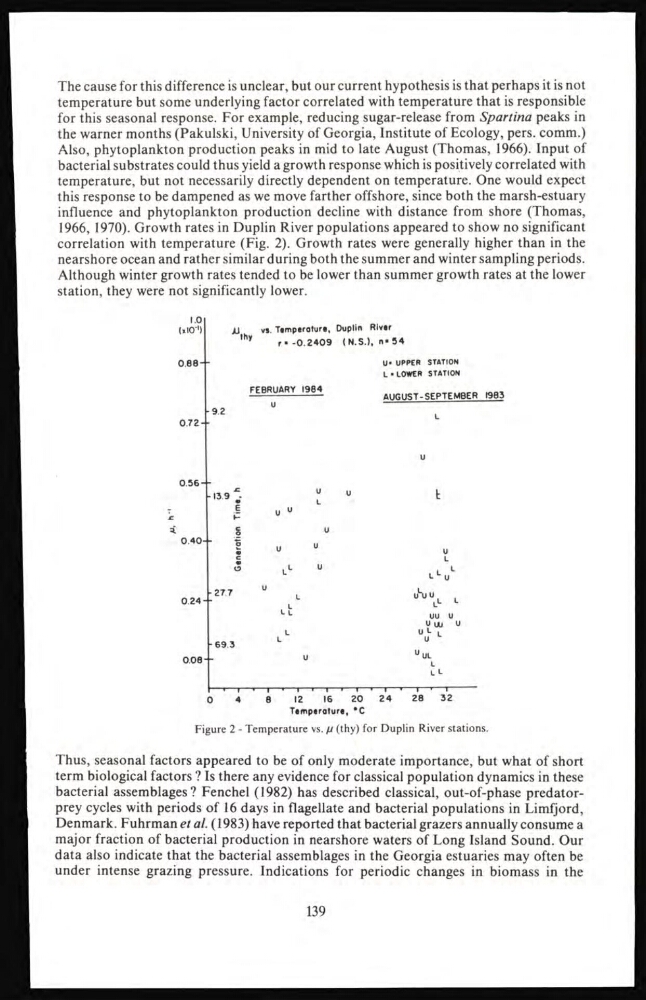
1966, 1970). Growth rates in Duplin River populations appeared to show no significant
correlation with temperature (Fig. 2). Growth rates were generally higher than in the
nearshore ocean and rather similar during both the summer and winter sampling periods.
Although winter growth rates tended to be lower than summer growth rates at the lower
station, they were not significantly lower.
Figure 2 - Temperature vs. µ (thy) for Duplin River stations.
Thus, seasonal factors appeared to be of only moderate importance, but what of short
term biological factors ? Is there any evidence for classical population dynamics in these
bacterial assemblages? Fenchel (1982) has described classical, out-of-phase predatorprey cycles with periods of 16 days in flagellate and bacterial populations in Limfjord,
Denmark. Fuhrman et al. (1983) have reported that bacterial grazers annually consume a
major fraction of bacterial production in nearshore waters of Long Island Sound. Our
data also indicate that the bacterial assemblages in the Georgia estuaries may often be
under intense grazing pressure. Indications for periodic changes in biomass in the
139
temperature but some underlying factor correlated with temperature that is responsible
for this seasonal response. For example, reducing sugar-release from Spartina peaks in
the warner months (Pakulski, University of Georgia, Institute of Ecology, pers. comm.)
Also, phytoplankton production peaks in mid to late August (Thomas, 1966). Input of
bacterial substrates could thus yield a growth response which is positively correlated with
temperature, but not necessarily directly dependent on temperature. One would expect
this response to be dampened as we move farther offshore, since both the marsh-estuary
influence and phytoplankton production decline with distance from shore (Thomas,
1966, 1970). Growth rates in Duplin River populations appeared to show no significant
correlation with temperature (Fig. 2). Growth rates were generally higher than in the
nearshore ocean and rather similar during both the summer and winter sampling periods.
Although winter growth rates tended to be lower than summer growth rates at the lower
station, they were not significantly lower.
Figure 2 - Temperature vs. µ (thy) for Duplin River stations.
Thus, seasonal factors appeared to be of only moderate importance, but what of short
term biological factors ? Is there any evidence for classical population dynamics in these
bacterial assemblages? Fenchel (1982) has described classical, out-of-phase predatorprey cycles with periods of 16 days in flagellate and bacterial populations in Limfjord,
Denmark. Fuhrman et al. (1983) have reported that bacterial grazers annually consume a
major fraction of bacterial production in nearshore waters of Long Island Sound. Our
data also indicate that the bacterial assemblages in the Georgia estuaries may often be
under intense grazing pressure. Indications for periodic changes in biomass in the
139