

Results
Poleward transport of warm and saline waters has been documented
to occur seasonally along the Iberian Peninsula (hrouin et al., 1990).
This flow introduces the main energy input in the bay of Biscay during
the wintertime (Pingree, 1994). We consequently set thc wintertime as
the triggering point for the dynamical cycle. Although it is well documented that the PC peaks ovcr the north-west corner during the winter
months, it has been shown to experience considerable strength, magnitude and time year-to-year variations. Measurements of thermohaline
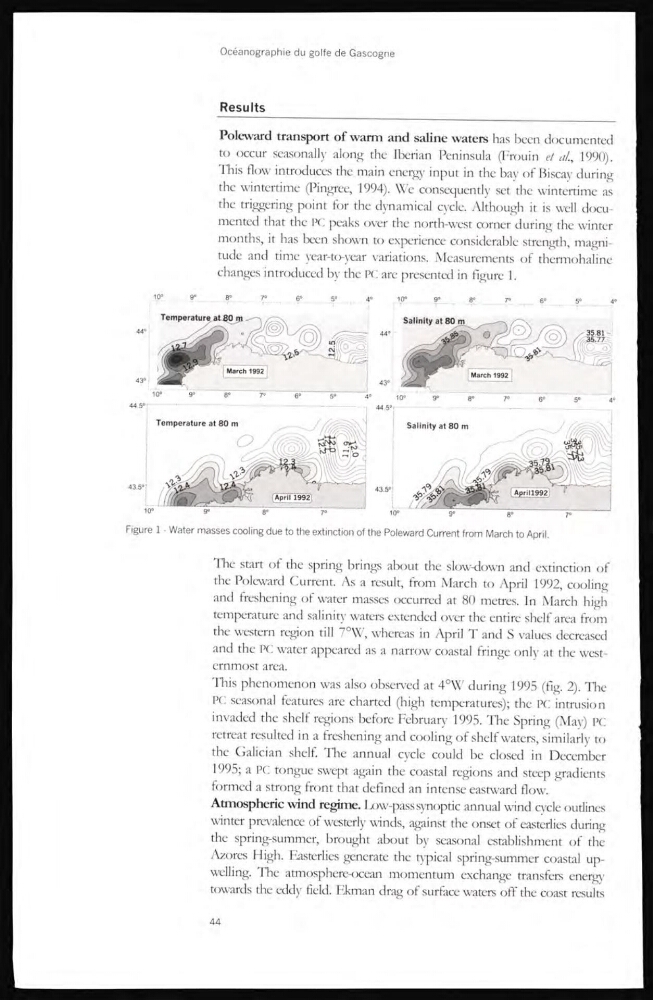
changes introduced by the Pr are presented in figure 1.
Figure 1 - Water masses cooling due to the extinction of the Poleward Current from March to April.
1 he start of the spring bnngs about the slow-down and extinction of
the Polcward Current. As a result, from March to April 1992, cooling
and freshening of water masses occurred at 80 metres. In March high
temperature and salinity waters extended over the entire shelf area from
the western region till 7°W, whereas in April T and S values decreased
and the PC water appeared as a narrow coastal fringe only at the westernmost area.
This phenomenon was also observed at 4°W during 1995 (fig. 2). The
PC seasonal features are charted (high temperatures); the PC intrusion
invaded the shelf regions before February 1995. The Spring (May) PC
retreat resulted in a freshening and cooling of shelf waters, similarly to
the Galician shelf. The annual cycle could be closed in December
1995; a PC tongue swept again the coastal regions and steep gradients
formed a strong front that defined an intense eastward flow.
Atmospheric wind regime. Low-passsynoptic annual wind cycle outlines
winter prevalence of westerly winds, against the onset of easterlies during
the spring-summer, brought about by seasonal establishment of the
Azores High. Easterlies generate the tvpical spring-summer coastal upwelling. The atmosphere-ocean momentum exchange transfers energy
towards the eddy field. Ekman drag of surface waters off the coast results
44
Poleward transport of warm and saline waters has been documented
to occur seasonally along the Iberian Peninsula (hrouin et al., 1990).
This flow introduces the main energy input in the bay of Biscay during
the wintertime (Pingree, 1994). We consequently set thc wintertime as
the triggering point for the dynamical cycle. Although it is well documented that the PC peaks ovcr the north-west corner during the winter
months, it has been shown to experience considerable strength, magnitude and time year-to-year variations. Measurements of thermohaline
changes introduced by the Pr are presented in figure 1.
Figure 1 - Water masses cooling due to the extinction of the Poleward Current from March to April.
1 he start of the spring bnngs about the slow-down and extinction of
the Polcward Current. As a result, from March to April 1992, cooling
and freshening of water masses occurred at 80 metres. In March high
temperature and salinity waters extended over the entire shelf area from
the western region till 7°W, whereas in April T and S values decreased
and the PC water appeared as a narrow coastal fringe only at the westernmost area.
This phenomenon was also observed at 4°W during 1995 (fig. 2). The
PC seasonal features are charted (high temperatures); the PC intrusion
invaded the shelf regions before February 1995. The Spring (May) PC
retreat resulted in a freshening and cooling of shelf waters, similarly to
the Galician shelf. The annual cycle could be closed in December
1995; a PC tongue swept again the coastal regions and steep gradients
formed a strong front that defined an intense eastward flow.
Atmospheric wind regime. Low-passsynoptic annual wind cycle outlines
winter prevalence of westerly winds, against the onset of easterlies during
the spring-summer, brought about by seasonal establishment of the
Azores High. Easterlies generate the tvpical spring-summer coastal upwelling. The atmosphere-ocean momentum exchange transfers energy
towards the eddy field. Ekman drag of surface waters off the coast results
44