

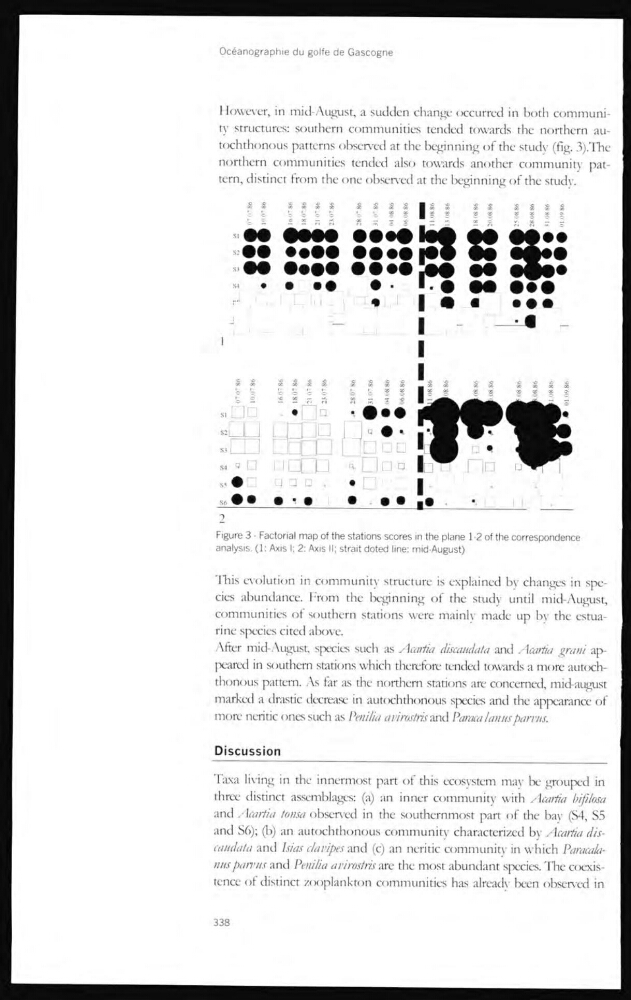
However, in mid-August, a sudden change occurred in both community structures: southern communities tended towards the northern autochthonous patterns observed at the beginning of the studv (fig. 3).The
northern communities tended also towards another communit)' pattern, distinct from the one obsencd at the beginning of the study.
Figure 3 - Factorial map of the stations scores in the plane 1-2 of the correspondence
analysis. (1: Axis I; 2: Axis II; strait doted line: mid-August)
This ee-olution in community structure is explaincd by changes in species abundance. From the beginning of the study until mid-August,
communities of southern stations were mainly made up by the estuarine species cited above.
After mid-August, species such as Acartia discaudata and Acarda grani appeared in southem stations which therefore tended towards a more autochthonous pattem. As far as the northem stations are concemed, mid-august
marked a drastic decrease in autochthonous species and the appearance of
more netitic ones such as Penilia aviroslris and Paraca lanusparvus.
Discussion
Taxa living in the innermost part of this ecosystem may be grouped in
three distinct assemblagcs: (a) an inner community with Acartia biftlosa
and Acartia tonsa observed in the southernmost part of the bay (S4, S5
and S6); (b) an autochthonous community characterized by Acartia discaudata and Isias clavipes and (c) an neritic community' in which Paracalanusparvus and Penilia avirostris are the most abundant species. The coexistence of distinct zooplankton communities has already been observed in
338
northern communities tended also towards another communit)' pattern, distinct from the one obsencd at the beginning of the study.
Figure 3 - Factorial map of the stations scores in the plane 1-2 of the correspondence
analysis. (1: Axis I; 2: Axis II; strait doted line: mid-August)
This ee-olution in community structure is explaincd by changes in species abundance. From the beginning of the study until mid-August,
communities of southern stations were mainly made up by the estuarine species cited above.
After mid-August, species such as Acartia discaudata and Acarda grani appeared in southem stations which therefore tended towards a more autochthonous pattem. As far as the northem stations are concemed, mid-august
marked a drastic decrease in autochthonous species and the appearance of
more netitic ones such as Penilia aviroslris and Paraca lanusparvus.
Discussion
Taxa living in the innermost part of this ecosystem may be grouped in
three distinct assemblagcs: (a) an inner community with Acartia biftlosa
and Acartia tonsa observed in the southernmost part of the bay (S4, S5
and S6); (b) an autochthonous community characterized by Acartia discaudata and Isias clavipes and (c) an neritic community' in which Paracalanusparvus and Penilia avirostris are the most abundant species. The coexistence of distinct zooplankton communities has already been observed in
338