

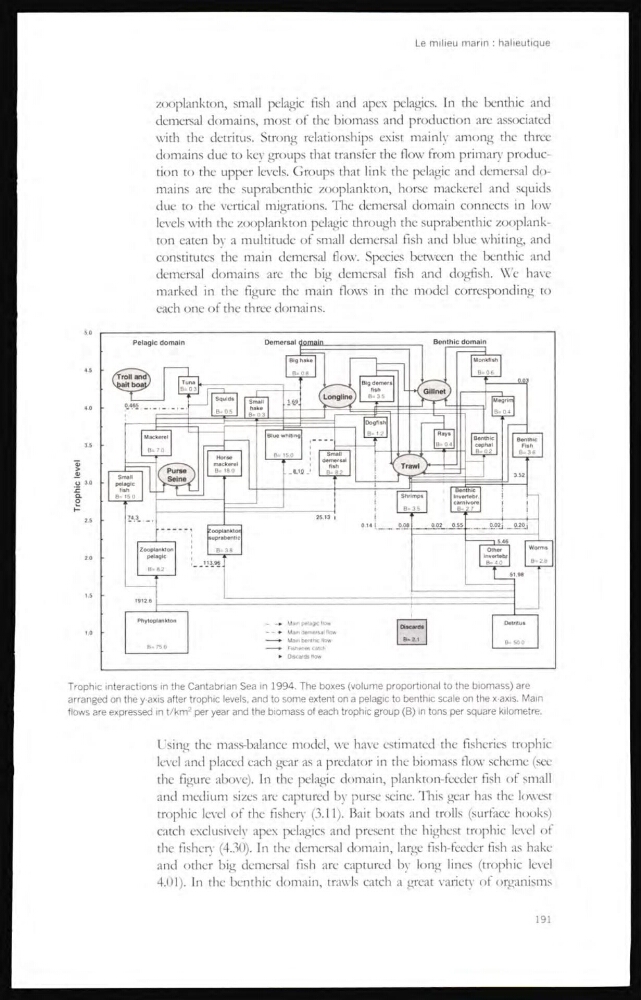
zooplankton, small pelagic fish and apex pelagics. In the benthic and
demersal domains, most of the biomass and production are associated
with the detritus. Strong relationships exist mainly among the three
domains due to key groups that transfer the flow from primary production to the upper levels. Groups that link the pelagic and demersal domains are the suprabenthic zooplankton, horse mackerel and squids
due to the vertical migrations. The demersal domain connects in low
levels with the zooplankton pelagic through the suprabenthic zooplankton eaten by a multitude of small demersal fish and blue whiting, and
constitutes the main demersal flow. Species between the benthic and
demersal domains are the big demersal fish and dogfish. We have
marked in the figure the main flows in the model corresponding to
each one of the three domains.
Trophic interactions in the Cantabrian Sea in 1994. The boxes (volume proportional to the biomass) are
arranged on the y-axis after trophic levels, and to some extent on a pelagic to benthic scale on the x-axis. Main
flows are expressed in t/km
2 per year and the biomass of each trophic group (B) in tons per square kilometre.
Using the mass-balance model, we have estimated the fisheries trophic
level and placed each gear as a predator in the biomass flow scheme (see
the figure above). In the pelagic domain, plankton-feeder fish of small
and medium sizes are captured by purse seine. This gear has the lowest
trophic level of the fishery (3.11). Bait boats and trolls (surface hooks)
catch exclusively apex pelagics and present the highest trophic level of
the fishery (4.30). In the demersal domain, large fish-feeder fish as hake
and other big demersal fish are captured by long lines (trophic le\el
4.01). In the benthic domain, trawls catch a great variety of organisms
191
demersal domains, most of the biomass and production are associated
with the detritus. Strong relationships exist mainly among the three
domains due to key groups that transfer the flow from primary production to the upper levels. Groups that link the pelagic and demersal domains are the suprabenthic zooplankton, horse mackerel and squids
due to the vertical migrations. The demersal domain connects in low
levels with the zooplankton pelagic through the suprabenthic zooplankton eaten by a multitude of small demersal fish and blue whiting, and
constitutes the main demersal flow. Species between the benthic and
demersal domains are the big demersal fish and dogfish. We have
marked in the figure the main flows in the model corresponding to
each one of the three domains.
Trophic interactions in the Cantabrian Sea in 1994. The boxes (volume proportional to the biomass) are
arranged on the y-axis after trophic levels, and to some extent on a pelagic to benthic scale on the x-axis. Main
flows are expressed in t/km
2 per year and the biomass of each trophic group (B) in tons per square kilometre.
Using the mass-balance model, we have estimated the fisheries trophic
level and placed each gear as a predator in the biomass flow scheme (see
the figure above). In the pelagic domain, plankton-feeder fish of small
and medium sizes are captured by purse seine. This gear has the lowest
trophic level of the fishery (3.11). Bait boats and trolls (surface hooks)
catch exclusively apex pelagics and present the highest trophic level of
the fishery (4.30). In the demersal domain, large fish-feeder fish as hake
and other big demersal fish are captured by long lines (trophic le\el
4.01). In the benthic domain, trawls catch a great variety of organisms
191