

et aux apports fluviaux. Le modèle a été calibré à partir de mesures in
situ (campagnes en mer, réseaux de surveillance Réphy et RNO) et de
l’imagerie satellitale de la couleur de l’eau.
Introduction
Estuaries play an intertace role between the land and the marine ecosystem. They are directly submitted to human influence. Near river
mouth areas like Loire and Gironde, waters are modified by the influence ot freshwater with high anthropogenic nutrient content and are
place ot high phytoplanktonic development. There is an increasing concern about the ecological effects of anthropogenic nutrient inputs. Such
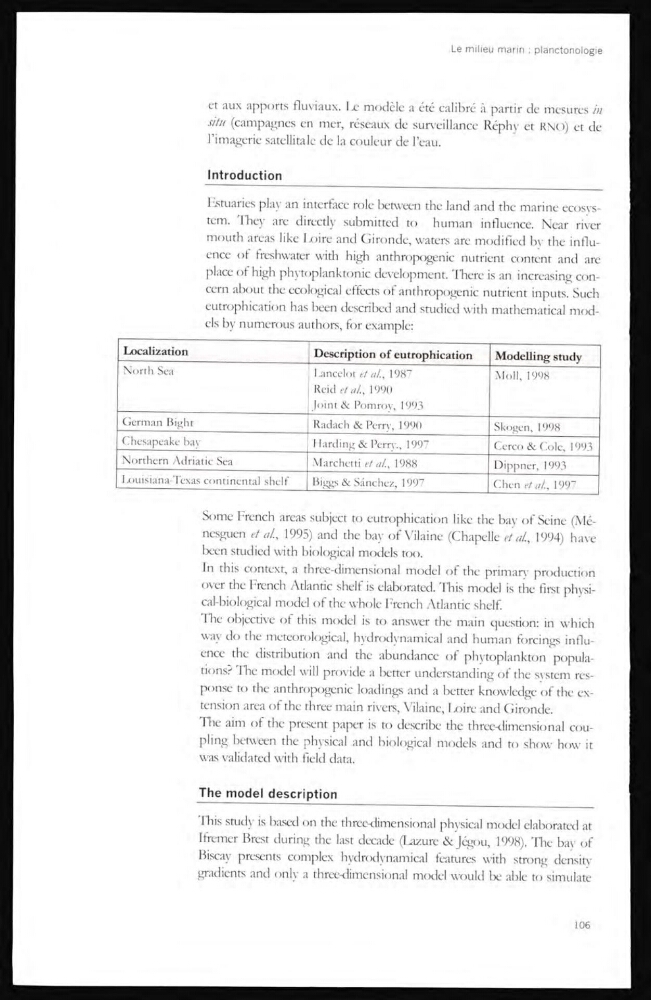
eutrophication has been described and studied with mathematical models by numerous authors, for example:
Localization
Description of eutrophication
Modelling study
North Sea
Lancelot et al, 1987
Reid et al., 1990
Joint & Pomrov, 1993
Moll, 1998
Gcrman Bight
Radach & Perry, 1990
Skogen, 1998
Chcsapeake bav
Flarding & Perry., 1997
Cerco & Cole, 1993
Northern Adriatic Sea
Marchetti et al., 1988
Dippner, 1993
Louisiana-Texas continental shelf
Biggs & Sánchez, 1997
Chen et at, 1997
Some French areas subject to eutrophication like the bay of Seine (Ménesguen et ai, 1995) and the bay of Vilaine (Chapelle et al., 1994) have
been studied with biological models too.
In this context, a three-dimensional model of the primary production
over the F'rench Atlantic shelf is ciaborated. This model is the first physical-biological model of the whole French Adantic shelf.
The objective of this model is to answer the main question: in which
way do the meteorological, hydrodynamical and human forcings influence the distribution and the abundance of phytoplankton populations? JTie model will provide a better understanding of the system response to the anthropogenic Ioadings and a better knowlcdge of the extension area of the three main rivers, Vilaine, Loire and Gironde.
Ihe aim of the present paper is to describe the three-dimensional coupling between the physical and biological models and to show how it
was validated with field data.
The model description
1 his study is based on the three-dimensional physical model elaborated at
Ifremer Brest during the last decade (Lazure & Jégou, 1998). The bay of
Biscay presents complex hydrodynamical features with strong density
gradients and only a three-dimensional model would be able to simulate
106
situ (campagnes en mer, réseaux de surveillance Réphy et RNO) et de
l’imagerie satellitale de la couleur de l’eau.
Introduction
Estuaries play an intertace role between the land and the marine ecosystem. They are directly submitted to human influence. Near river
mouth areas like Loire and Gironde, waters are modified by the influence ot freshwater with high anthropogenic nutrient content and are
place ot high phytoplanktonic development. There is an increasing concern about the ecological effects of anthropogenic nutrient inputs. Such
eutrophication has been described and studied with mathematical models by numerous authors, for example:
Localization
Description of eutrophication
Modelling study
North Sea
Lancelot et al, 1987
Reid et al., 1990
Joint & Pomrov, 1993
Moll, 1998
Gcrman Bight
Radach & Perry, 1990
Skogen, 1998
Chcsapeake bav
Flarding & Perry., 1997
Cerco & Cole, 1993
Northern Adriatic Sea
Marchetti et al., 1988
Dippner, 1993
Louisiana-Texas continental shelf
Biggs & Sánchez, 1997
Chen et at, 1997
Some French areas subject to eutrophication like the bay of Seine (Ménesguen et ai, 1995) and the bay of Vilaine (Chapelle et al., 1994) have
been studied with biological models too.
In this context, a three-dimensional model of the primary production
over the F'rench Atlantic shelf is ciaborated. This model is the first physical-biological model of the whole French Adantic shelf.
The objective of this model is to answer the main question: in which
way do the meteorological, hydrodynamical and human forcings influence the distribution and the abundance of phytoplankton populations? JTie model will provide a better understanding of the system response to the anthropogenic Ioadings and a better knowlcdge of the extension area of the three main rivers, Vilaine, Loire and Gironde.
Ihe aim of the present paper is to describe the three-dimensional coupling between the physical and biological models and to show how it
was validated with field data.
The model description
1 his study is based on the three-dimensional physical model elaborated at
Ifremer Brest during the last decade (Lazure & Jégou, 1998). The bay of
Biscay presents complex hydrodynamical features with strong density
gradients and only a three-dimensional model would be able to simulate
106