

CoastGIS'99: geomatics and coastal environment
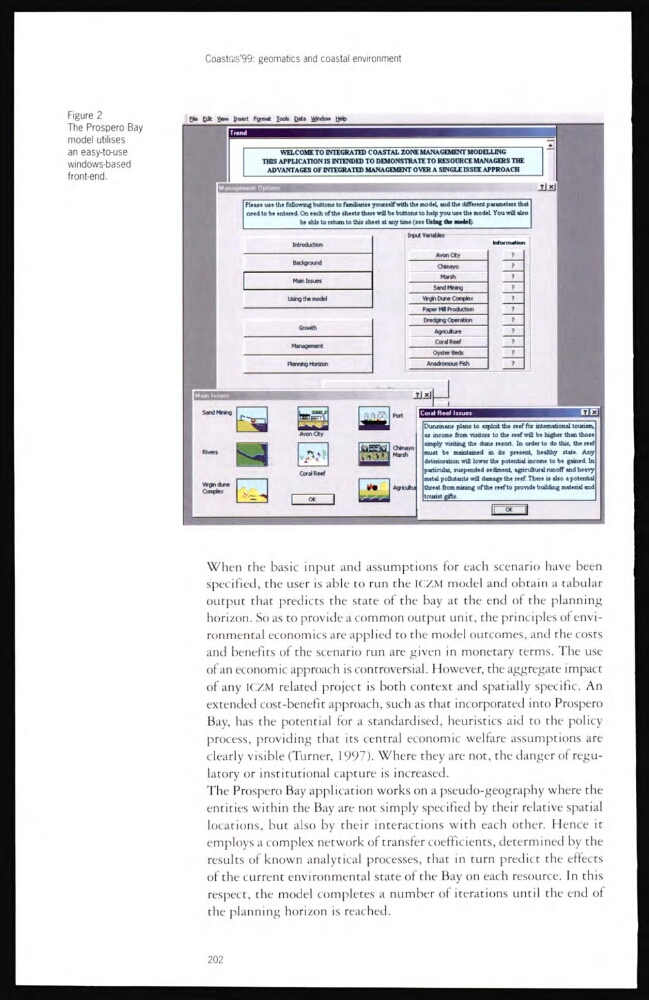
Figure 2
The Prospero Bay
model utilises
an easy-to-use
windows-based
front-end.
When the basic input and assumptions for each scenario have been
specified, the user is able to run the ICZM model and obtain a tabular
output that predicts the state of the bay at the end of the planning
horizon. So as to provide a common output unit, the principles of environmental economics are applied to the model outcomes, and the costs
and benefits of the scenario run are given in monetary terms. The use
of an economic approach is controversial. However, the aggregate impact
of any ICZM related project is both context and spatially specific. An
extended cost-benefit approach, such as that incorporated into Prospero
Bay, has the potential for a standardised, heuristics aid to the policy
process, providing that its central economic welfare assumptions are
clearly visible (Turner, 1997). Where they are not, the danger of regulatory or institutional capture is increased.
The Prospero Bay application works on a pseudo-geography where the
entities within the Bay are not simply specified by their relative spatial
locations, but also by their interactions with each other. Hence it
employs a complex network of transfer coefficients, determined by the
results of known analytical processes, that in turn predict the effects
of the current environmental state of the Bay on each resource. In this
respect, the model completes a number of iterations until the end of
the planning horizon is reached.
202
Figure 2
The Prospero Bay
model utilises
an easy-to-use
windows-based
front-end.
When the basic input and assumptions for each scenario have been
specified, the user is able to run the ICZM model and obtain a tabular
output that predicts the state of the bay at the end of the planning
horizon. So as to provide a common output unit, the principles of environmental economics are applied to the model outcomes, and the costs
and benefits of the scenario run are given in monetary terms. The use
of an economic approach is controversial. However, the aggregate impact
of any ICZM related project is both context and spatially specific. An
extended cost-benefit approach, such as that incorporated into Prospero
Bay, has the potential for a standardised, heuristics aid to the policy
process, providing that its central economic welfare assumptions are
clearly visible (Turner, 1997). Where they are not, the danger of regulatory or institutional capture is increased.
The Prospero Bay application works on a pseudo-geography where the
entities within the Bay are not simply specified by their relative spatial
locations, but also by their interactions with each other. Hence it
employs a complex network of transfer coefficients, determined by the
results of known analytical processes, that in turn predict the effects
of the current environmental state of the Bay on each resource. In this
respect, the model completes a number of iterations until the end of
the planning horizon is reached.
202