

System design and organization, access to data
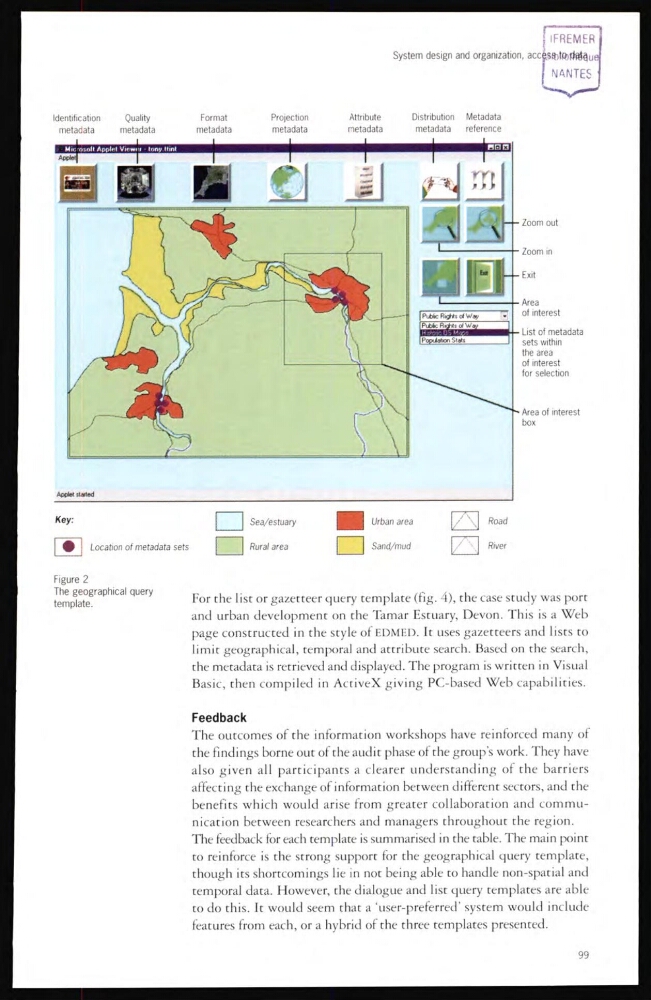
Figure 2
The geographical query
template.
For the list or gazetteer query template (fig. 4), the case study was port
and urban development on the Tamar Estuary, Devon. This is a Web
page constructed in the style of EDMED. It uses gazetteers and lists to
limit geographical, temporal and attribute search. Based on the search,
the metadata is retrieved and displayed. The program is written in Visual
Basic, then compiled in ActiveX giving PC-based Web capabilities.
Feedback
The outcomes of the information workshops have reinforced many of
the findings borne out of the audit phase of the group’s work. They have
also given all participants a clearer understanding of the barriers
affecting the exchange of information between different sectors, and the
benefits which would arise from greater collaboration and communication between researchers and managers throughout the region.
The feedback for each template is summarised in the table. The main point
to reinforce is the strong support for the geographical query template,
though its shortcomings lie in not being able to handle non-spatial and
temporal data. However, the dialogue and list query templates are able
to do this. It would seem that a 'user-preferred’ system would include
features from each, or a hybrid of the three templates presented.
99
Figure 2
The geographical query
template.
For the list or gazetteer query template (fig. 4), the case study was port
and urban development on the Tamar Estuary, Devon. This is a Web
page constructed in the style of EDMED. It uses gazetteers and lists to
limit geographical, temporal and attribute search. Based on the search,
the metadata is retrieved and displayed. The program is written in Visual
Basic, then compiled in ActiveX giving PC-based Web capabilities.
Feedback
The outcomes of the information workshops have reinforced many of
the findings borne out of the audit phase of the group’s work. They have
also given all participants a clearer understanding of the barriers
affecting the exchange of information between different sectors, and the
benefits which would arise from greater collaboration and communication between researchers and managers throughout the region.
The feedback for each template is summarised in the table. The main point
to reinforce is the strong support for the geographical query template,
though its shortcomings lie in not being able to handle non-spatial and
temporal data. However, the dialogue and list query templates are able
to do this. It would seem that a 'user-preferred’ system would include
features from each, or a hybrid of the three templates presented.
99