

4. CHEMORECEPTION
81
11. ANATOMY OF CHEMICAL SENSE ORGANS
A. Olfactory Organ
Extreme variations are found in the morphology of the peripheral
olfactory organs depending largely on the degree of development of the
olfactory system. In the sharks and rays where the chemical senses are
highly important ecologically, the paired olfactory pits or sacs are usually
situated at varying distances from the oral opening on the ventral side of
the snout. The opening of each pit is divided into two parts by a fold of
skin: anterior inlet and posterior outlet; in some instances the latter leads
to the mouth. As the fish swims through the water and as it takes water
into the mouth to breathe, a current passes through the olfactory sacs.
Thus, in the sharks and rays, the olfactory organs are influenced directly
by the respiratory current.
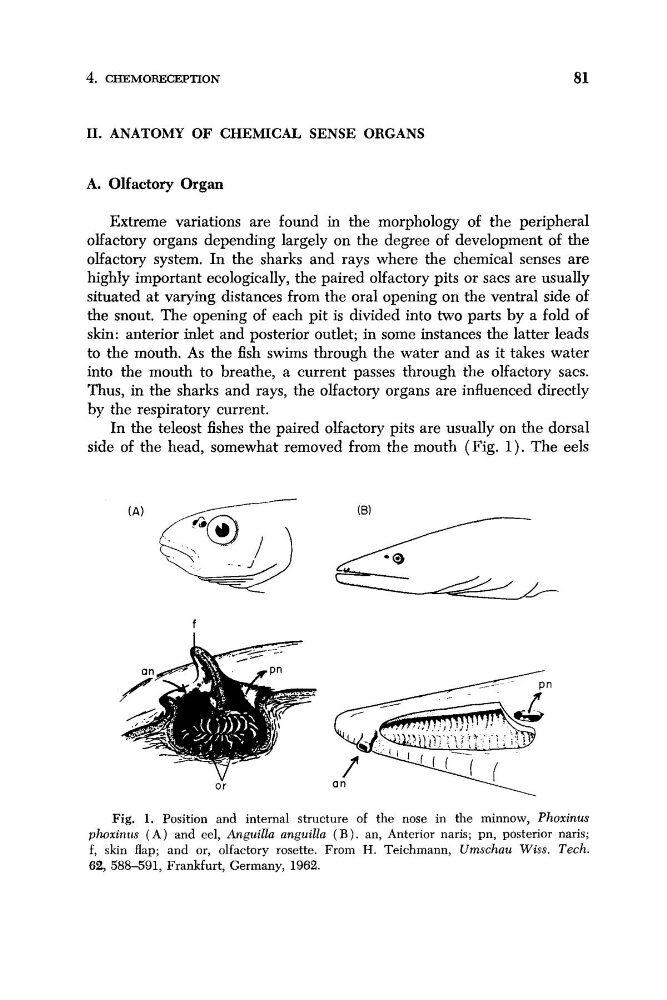
In the teleost fishes the paired olfactory pits are usually on the dorsal
side of the head, somewhat removed from the mouth (Fig. 1). The eels
f
or
o n
Fig. 1. Position and internal structure of the nose in the minnow, Phoxin~s
phoxinzis ( A ) and eel, AnguiZZu anguillu ( B ) . an, Anterior naris; pn, posterior naris;
f, skin flap; and or, olfactory rosette. From H. Teichmann, Umschau Wiss. Tech.
62, 588-591, Frankfurt, Germany, 1962.
81
11. ANATOMY OF CHEMICAL SENSE ORGANS
A. Olfactory Organ
Extreme variations are found in the morphology of the peripheral
olfactory organs depending largely on the degree of development of the
olfactory system. In the sharks and rays where the chemical senses are
highly important ecologically, the paired olfactory pits or sacs are usually
situated at varying distances from the oral opening on the ventral side of
the snout. The opening of each pit is divided into two parts by a fold of
skin: anterior inlet and posterior outlet; in some instances the latter leads
to the mouth. As the fish swims through the water and as it takes water
into the mouth to breathe, a current passes through the olfactory sacs.
Thus, in the sharks and rays, the olfactory organs are influenced directly
by the respiratory current.
In the teleost fishes the paired olfactory pits are usually on the dorsal
side of the head, somewhat removed from the mouth (Fig. 1). The eels
f
or
o n
Fig. 1. Position and internal structure of the nose in the minnow, Phoxin~s
phoxinzis ( A ) and eel, AnguiZZu anguillu ( B ) . an, Anterior naris; pn, posterior naris;
f, skin flap; and or, olfactory rosette. From H. Teichmann, Umschau Wiss. Tech.
62, 588-591, Frankfurt, Germany, 1962.