

72
DAVID INGLE
Group I
Group 2
Group 3
Group 4
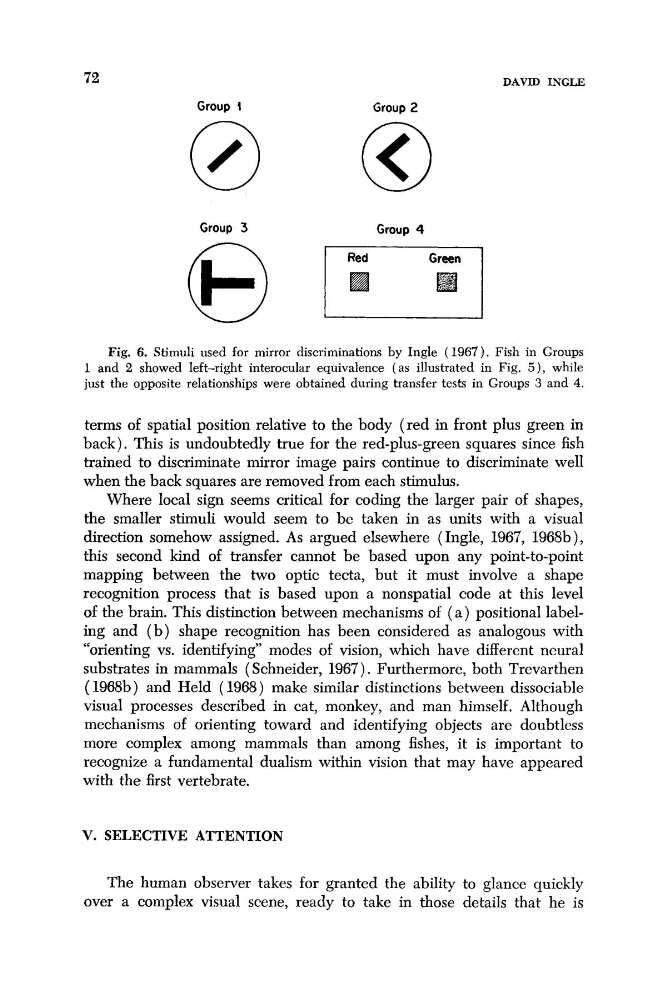
Fig. 6. Stimuli used for mirror discriminations by Ingle ( 1967). Fish in Groups
1 and 2 showed left-right interocular equivalence (as illustrated in Fig. 5), while
just the opposite relationships were obtained during transfer tests in Groups 3 and 4.
terms of spatial position relative to the body (red in front plus green in
back). This is undoubtedly true for the red-plus-green squares since fish
trained to discriminate mirror image pairs continue to discriminate well
when the back squares are removed from each stimulus.
Where local sign seems critical for coding the larger pair of shapes,
the smaller stimuli would seem to be taken in as units with a visual
direction somehow assigned. As argued elsewhere ( Ingle, 1967, 1968b ) ,
this second kind of transfer cannot be based upon any point-to-point
mapping between the two optic tecta, but it must involve a shape
recognition process that is based upon a nonspatial code at this level
of the brain. This distinction between mechanisms of ( a ) positional labeling and ( b ) shape recognition has been considered as analogous with
“orienting vs. identifying” modes of vision, which have different neural
substrates in mammals ( Schneider, 1967). Furthermore, both Trevarthen
(196813) and Held (1968) make similar distinctions between dissociable
visual processes described in cat, monkey, and man himself. Although
mechanisms of orienting toward and identifying objects are doubtless
more complex among mammals than among fishes, it is important to
recognize a fundamental dualism within vision that may have appeared
with the first vertebrate.
V. SELECTIVE ATTENTION
The human observer takes for granted the ability to glance quickly
over a complex visual scene, ready to take in those details that he is
DAVID INGLE
Group I
Group 2
Group 3
Group 4
Fig. 6. Stimuli used for mirror discriminations by Ingle ( 1967). Fish in Groups
1 and 2 showed left-right interocular equivalence (as illustrated in Fig. 5), while
just the opposite relationships were obtained during transfer tests in Groups 3 and 4.
terms of spatial position relative to the body (red in front plus green in
back). This is undoubtedly true for the red-plus-green squares since fish
trained to discriminate mirror image pairs continue to discriminate well
when the back squares are removed from each stimulus.
Where local sign seems critical for coding the larger pair of shapes,
the smaller stimuli would seem to be taken in as units with a visual
direction somehow assigned. As argued elsewhere ( Ingle, 1967, 1968b ) ,
this second kind of transfer cannot be based upon any point-to-point
mapping between the two optic tecta, but it must involve a shape
recognition process that is based upon a nonspatial code at this level
of the brain. This distinction between mechanisms of ( a ) positional labeling and ( b ) shape recognition has been considered as analogous with
“orienting vs. identifying” modes of vision, which have different neural
substrates in mammals ( Schneider, 1967). Furthermore, both Trevarthen
(196813) and Held (1968) make similar distinctions between dissociable
visual processes described in cat, monkey, and man himself. Although
mechanisms of orienting toward and identifying objects are doubtless
more complex among mammals than among fishes, it is important to
recognize a fundamental dualism within vision that may have appeared
with the first vertebrate.
V. SELECTIVE ATTENTION
The human observer takes for granted the ability to glance quickly
over a complex visual scene, ready to take in those details that he is