

64
DAVID INGLE
I
I
Temporal bias
I
Nasal bias
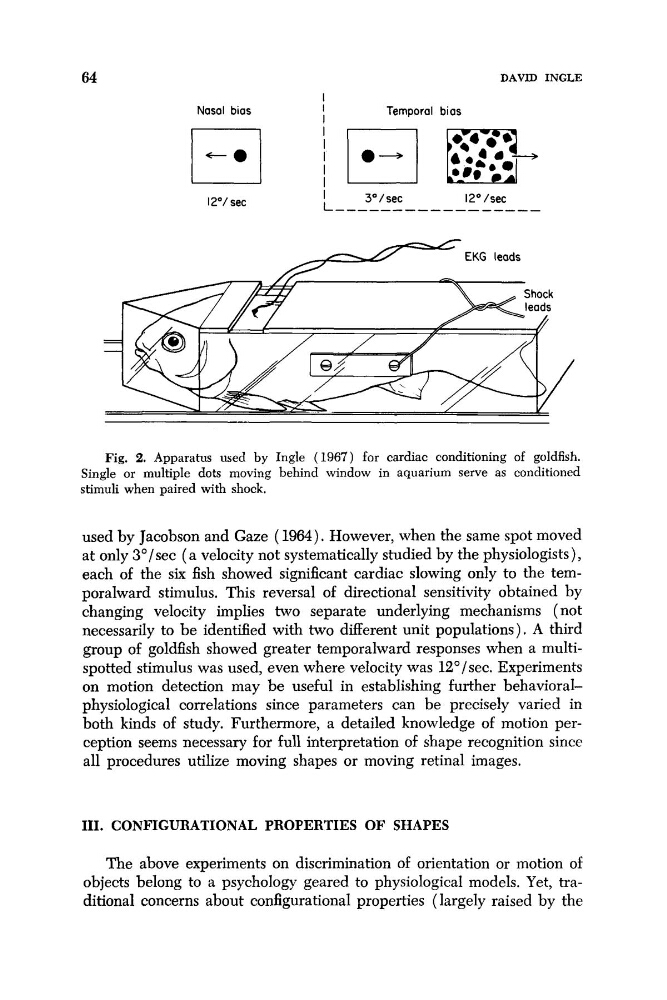
Fig. 2. Apparatus used by Ingle (1967) for cardiac conditioning of goldfish.
Single or multiple dots moving behind window in aquarium serve as conditioned
stimuli when paired with shock.
used by Jacobson and Gaze ( 1964). However, when the same spot moved
at only 3"/sec ( a velocity not systematically studied by the physiologists),
each of the six fish showed significant cardiac slowing only to the temporalward stimulus. This reversal of directional sensitivity obtained by
changing velocity implies two separate underlying mechanisms (not
necessarily to be identified with two different unit populations). A third
group of goldfish showed greater temporalward responses when a multispotted stimulus was used, even where velocity was 12"/sec. Experiments
on motion detection may be useful in establishing further behavioralphysiological correlations since parameters can be precisely varied in
both kinds of study. Furthermore, a detailed knowledge of motion perception seems necessary for full interpretation of shape recognition sincc
all procedures utilize moving shapes or moving retinal images.
111. CONFIGURATIONAL PROPERTIES OF SHAPES
The above experiments on discrimination of orientation or motion of
objects belong to a psychology geared to physiological models. Yet, traditional concerns about configurational properties ( largely raised by the
DAVID INGLE
I
I
Temporal bias
I
Nasal bias
Fig. 2. Apparatus used by Ingle (1967) for cardiac conditioning of goldfish.
Single or multiple dots moving behind window in aquarium serve as conditioned
stimuli when paired with shock.
used by Jacobson and Gaze ( 1964). However, when the same spot moved
at only 3"/sec ( a velocity not systematically studied by the physiologists),
each of the six fish showed significant cardiac slowing only to the temporalward stimulus. This reversal of directional sensitivity obtained by
changing velocity implies two separate underlying mechanisms (not
necessarily to be identified with two different unit populations). A third
group of goldfish showed greater temporalward responses when a multispotted stimulus was used, even where velocity was 12"/sec. Experiments
on motion detection may be useful in establishing further behavioralphysiological correlations since parameters can be precisely varied in
both kinds of study. Furthermore, a detailed knowledge of motion perception seems necessary for full interpretation of shape recognition sincc
all procedures utilize moving shapes or moving retinal images.
111. CONFIGURATIONAL PROPERTIES OF SHAPES
The above experiments on discrimination of orientation or motion of
objects belong to a psychology geared to physiological models. Yet, traditional concerns about configurational properties ( largely raised by the