

62
DAVID XNGLE
7
- .......
I 1
I '
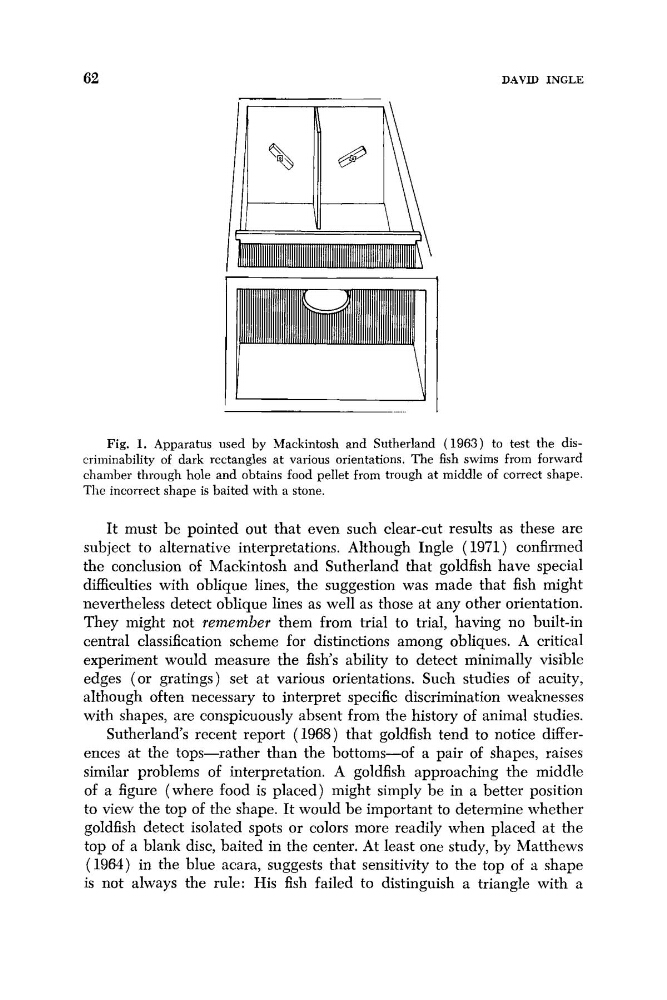
Fig. 1. Apparatus used by Mackintosh and Sutherland (1963) to test the discriininability of dark rectangles at various orientations. The fish swims from forward
chamber through hole and obtains food pellet from trough at middle of correct shape.
The incorrect shape is baited with a stone.
It must be pointed out that even such clear-cut results as these are
subject to alternative interpretations. Although Ingle ( 1971 ) confirmed
the conclusion of Mackintosh and Sutherland that goldfish have special
difficulties with oblique lines, the suggestion was made that fish might
nevertheless detect oblique lines as well as those at any other orientation.
They might not remember them from trial to trial, having no built-in
central classification scheme for distinctions among obliques. A critical
experiment would measure the fish's ability to detect minimally visible
edges (or gratings) set at various orientations. Such studies of acuity,
although often necessary to interpret specific discrimination weaknesses
with shapes, are conspicuously absent from the history of animal studies.
Sutherland's recent report ( 1968) that goldfish tend to notice differences at the tops-rather than the bottoms-of a pair of shapes, raises
similar problems of interpretation. A goldfish approaching the middle
of a figure (where food is placed) might simply be in a better position
to view the top of the shape. It would be important to determine whether
goldfish detect isolated spots or colors more readily when placed at the
top of a blank disc, baited in the center. At least one study, by Matthews
(1964) in the blue acara, suggests that sensitivity to the top of a shape
is not always the rule: His fish failed to distinguish a triangle with a
DAVID XNGLE
7
- .......
I 1
I '
Fig. 1. Apparatus used by Mackintosh and Sutherland (1963) to test the discriininability of dark rectangles at various orientations. The fish swims from forward
chamber through hole and obtains food pellet from trough at middle of correct shape.
The incorrect shape is baited with a stone.
It must be pointed out that even such clear-cut results as these are
subject to alternative interpretations. Although Ingle ( 1971 ) confirmed
the conclusion of Mackintosh and Sutherland that goldfish have special
difficulties with oblique lines, the suggestion was made that fish might
nevertheless detect oblique lines as well as those at any other orientation.
They might not remember them from trial to trial, having no built-in
central classification scheme for distinctions among obliques. A critical
experiment would measure the fish's ability to detect minimally visible
edges (or gratings) set at various orientations. Such studies of acuity,
although often necessary to interpret specific discrimination weaknesses
with shapes, are conspicuously absent from the history of animal studies.
Sutherland's recent report ( 1968) that goldfish tend to notice differences at the tops-rather than the bottoms-of a pair of shapes, raises
similar problems of interpretation. A goldfish approaching the middle
of a figure (where food is placed) might simply be in a better position
to view the top of the shape. It would be important to determine whether
goldfish detect isolated spots or colors more readily when placed at the
top of a blank disc, baited in the center. At least one study, by Matthews
(1964) in the blue acara, suggests that sensitivity to the top of a shape
is not always the rule: His fish failed to distinguish a triangle with a