

52
T. TOMITA
be extended to other fish species. Results from these entirely different
approaches were substantially the same in differentiating three pigments,
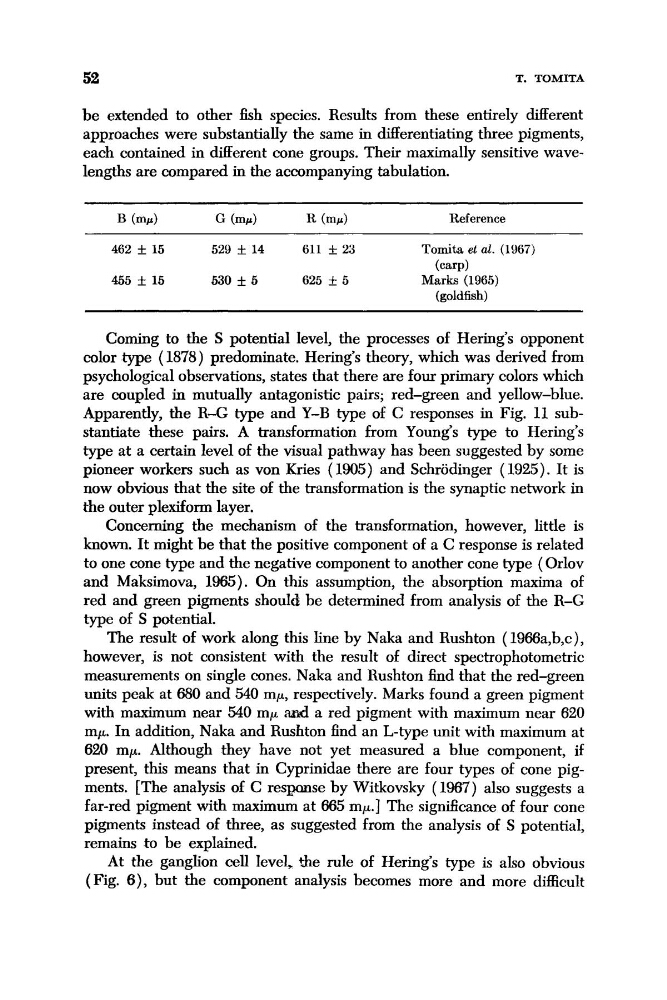
each contained in different cone groups. Their maximally sensitive wavelengths are compared in the accompanying tabulation.
462 f 15
529 rt 14
611 k 23
Tomita et al. (1967)
455 f 15
530 f 5
625 f 5
Marks (1965)
(carp)
(goldfish)
Coming to the S potential level, the processes of Hering’s opponent
color type (1878) predominate. Hering’s theory, which was derived from
psychological observations, states that there are four primary colors which
are coupled in mutually antagonistic pairs; red-green and yellow-blue.
Apparently, the R-G type and Y-B type of C responses in Fig. 11 substantiate these pairs. A transformation from Young’s type to Hering’s
type at a certain level of the visual pathway has been suggested by some
pioneer workers such as von Kries ( 1905) and Schrodinger ( 1925). It is
now obvious that the site of the transformation is the synaptic network in
the outer plexiform layer.
Concerning the mechanism of the transformation, however, little is
known. It might be that the positive component of a C response is related
to one cone type and the negative component to another cone type (Orlov
and Maksimova, 1965). On this assumption, the absorption maxima of
red and green pigments should be determined from analysis of the R-G
type of S potential.
The result of work along this line by Naka and Rushton ( 1966a,b,c),
however, is not consistent with the result of direct spectrophotometric
measurements on single cones. Naka and Rushton find that the red-green
units peak at 680 and 540 mp, respectively. Marks found a green pigment
with maximum near 540 mp a d a red pigment with maximum near 620
mp. In addition, Naka and Rushton find an L-type unit with maximum at
620 mp. Although they have not yet measured a blue component, if
present, this means that in Cyprinidae there are four types of cone pigments. [The analysis of C respase by Witkovsky (1967) also suggests a
far-red pigment with maximum at 665 mp.] The significance of four cone
pigments instead of three, as suggested from the analysis of S potential,
remains to be explained.
At the ganglion cell level, the rule of Hering’s type is also obvious
(Fig. 6), but the component analysis becomes more and more difficult
T. TOMITA
be extended to other fish species. Results from these entirely different
approaches were substantially the same in differentiating three pigments,
each contained in different cone groups. Their maximally sensitive wavelengths are compared in the accompanying tabulation.
462 f 15
529 rt 14
611 k 23
Tomita et al. (1967)
455 f 15
530 f 5
625 f 5
Marks (1965)
(carp)
(goldfish)
Coming to the S potential level, the processes of Hering’s opponent
color type (1878) predominate. Hering’s theory, which was derived from
psychological observations, states that there are four primary colors which
are coupled in mutually antagonistic pairs; red-green and yellow-blue.
Apparently, the R-G type and Y-B type of C responses in Fig. 11 substantiate these pairs. A transformation from Young’s type to Hering’s
type at a certain level of the visual pathway has been suggested by some
pioneer workers such as von Kries ( 1905) and Schrodinger ( 1925). It is
now obvious that the site of the transformation is the synaptic network in
the outer plexiform layer.
Concerning the mechanism of the transformation, however, little is
known. It might be that the positive component of a C response is related
to one cone type and the negative component to another cone type (Orlov
and Maksimova, 1965). On this assumption, the absorption maxima of
red and green pigments should be determined from analysis of the R-G
type of S potential.
The result of work along this line by Naka and Rushton ( 1966a,b,c),
however, is not consistent with the result of direct spectrophotometric
measurements on single cones. Naka and Rushton find that the red-green
units peak at 680 and 540 mp, respectively. Marks found a green pigment
with maximum near 540 mp a d a red pigment with maximum near 620
mp. In addition, Naka and Rushton find an L-type unit with maximum at
620 mp. Although they have not yet measured a blue component, if
present, this means that in Cyprinidae there are four types of cone pigments. [The analysis of C respase by Witkovsky (1967) also suggests a
far-red pigment with maximum at 665 mp.] The significance of four cone
pigments instead of three, as suggested from the analysis of S potential,
remains to be explained.
At the ganglion cell level, the rule of Hering’s type is also obvious
(Fig. 6), but the component analysis becomes more and more difficult