

564
M. V. L. BENNETT
A final question that has been raised by the evolution of electrosensory systems is their absence in invertebrates and aquatic amphibia
(Grundfest and Bennett, 1961). There are too few of the latter to make
their difference from the fishes significant, and perhaps also too few
invertebrates of sufficient size to make an electrosensory system useful.
The cutaneous receptors of invertebrates are generally peripherally
located neurons without separate receptor cells, and receptors of this
kind may not well adapt to an electroreceptive function.
VII. IMPLICATIONS FOR RECEPTOR FUNCTION IN GENERAL
The electroreceptor can be looked upon as a model of a secondary
receptor, that is, one where the primary transduction is done by a
receptor cell which then transmits synaptically to an afferent fiber.
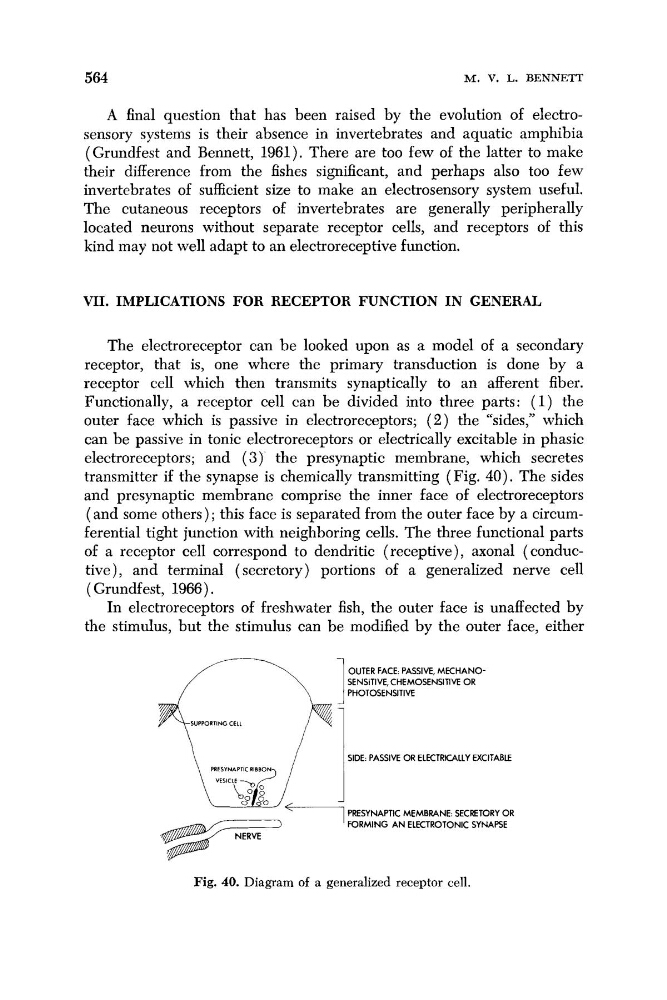
Functionally, a receptor cell can be divided into three parts: (1) the
outer face which is passive in electroreceptors; ( 2 ) the "sides," which
can be passive in tonic electroreceptors or electrically excitable in phasic
electroreceptors; and ( 3 ) the presynaptic membrane, which secretes
transmitter if the synapse is chemically transmitting (Fig. 40). The sides
and presynaptic membrane comprise the inner face of electroreceptors
(and some others); this face is separated from the outer face by a circumferential tight junction with neighboring cells. The three functional parts
of a receptor cell correspond to dendritic (receptive), axonal (conductive), and terminal (secretory) portions of a generalized nerve cell
( Grundfest, 1966).
In electroreceptors of freshwater fish, the outer face is unaffected by
the stimulus, but the stimulus can be modified by the outer face, either
OUTER FACE: PASSIVE, M K H A N O -
SENSITIVE, CHEMOSENSITIVE OR
PHOTOSENSITIVE
SUPPORTING C f l l
T PI
SIDE: PASSIVE OR ELKTRKALLY EXCITABLE
PRESYNAPTIC MEMBRANE: SECETORY OR
FORMING A N ELKTROTONIC SYNAPSE
Fig. 40. Diagram of a generalized receptor cell.
M. V. L. BENNETT
A final question that has been raised by the evolution of electrosensory systems is their absence in invertebrates and aquatic amphibia
(Grundfest and Bennett, 1961). There are too few of the latter to make
their difference from the fishes significant, and perhaps also too few
invertebrates of sufficient size to make an electrosensory system useful.
The cutaneous receptors of invertebrates are generally peripherally
located neurons without separate receptor cells, and receptors of this
kind may not well adapt to an electroreceptive function.
VII. IMPLICATIONS FOR RECEPTOR FUNCTION IN GENERAL
The electroreceptor can be looked upon as a model of a secondary
receptor, that is, one where the primary transduction is done by a
receptor cell which then transmits synaptically to an afferent fiber.
Functionally, a receptor cell can be divided into three parts: (1) the
outer face which is passive in electroreceptors; ( 2 ) the "sides," which
can be passive in tonic electroreceptors or electrically excitable in phasic
electroreceptors; and ( 3 ) the presynaptic membrane, which secretes
transmitter if the synapse is chemically transmitting (Fig. 40). The sides
and presynaptic membrane comprise the inner face of electroreceptors
(and some others); this face is separated from the outer face by a circumferential tight junction with neighboring cells. The three functional parts
of a receptor cell correspond to dendritic (receptive), axonal (conductive), and terminal (secretory) portions of a generalized nerve cell
( Grundfest, 1966).
In electroreceptors of freshwater fish, the outer face is unaffected by
the stimulus, but the stimulus can be modified by the outer face, either
OUTER FACE: PASSIVE, M K H A N O -
SENSITIVE, CHEMOSENSITIVE OR
PHOTOSENSITIVE
SUPPORTING C f l l
T PI
SIDE: PASSIVE OR ELKTRKALLY EXCITABLE
PRESYNAPTIC MEMBRANE: SECETORY OR
FORMING A N ELKTROTONIC SYNAPSE
Fig. 40. Diagram of a generalized receptor cell.