

556
M. V. L. BENNETT
0.5 sec
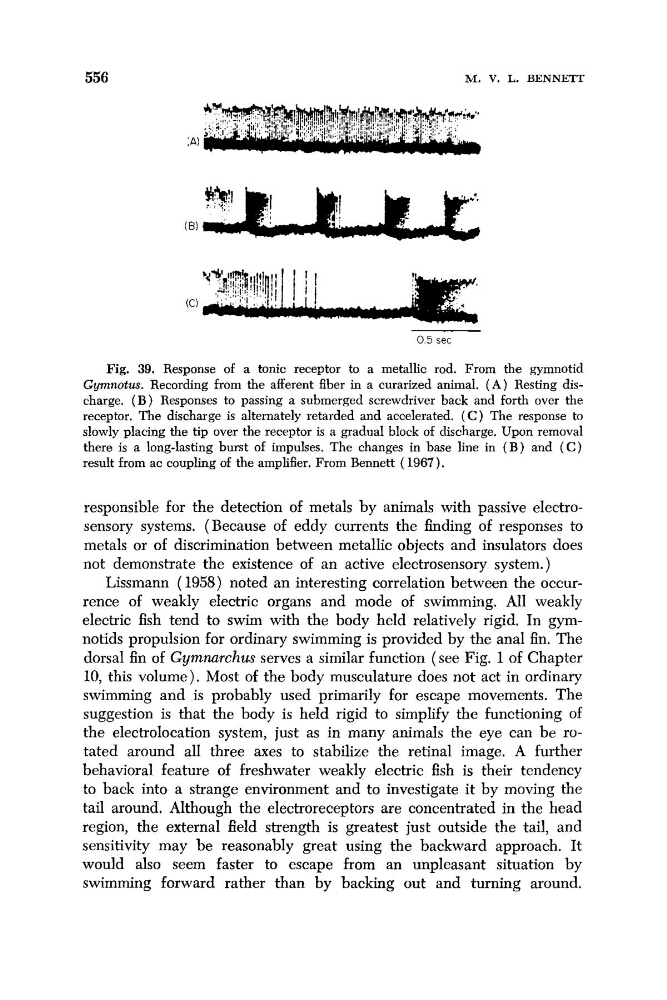
Fig. 39. Response of a tonic receptor to a metallic rod. From the gymnotid
Gymnotus. Recording from the afferent fiber in a curarized animal. ( A ) Resting discharge. ( B ) Responses to passing a submerged screwdriver back and forth over the
receptor. The discharge is alternately retarded and accelerated. ( C ) The response to
slowly placing the tip over the receptor is a gradual block of discharge. Upon removal
there is a long-lasting burst of impulses. The changes in base line in ( B ) and ( C )
result from ac coupling of the amplifier. From Bennett ( 1967).
responsible for the detection of metals by animals with passive electrosensory systems. (Because of eddy currents the finding of responses to
metals or of discrimination between metallic objects and insulators does
not demonstrate the existence of an active electrosensory system. )
Lissmann (1958) noted an interesting correlation between the occurrence of weakly electric organs and mode of swimming. All weakly
electric fish tend to swim with the body held relatively rigid. In gymnotids propulsion for ordinary swimming is provided by the anal fin. The
dorsal fin of Gymnarchus serves a similar function (see Fig. 1 of Chapter
10, this volume). Most of the body musculature does not act in ordinary
swimming and is probably used primarily for escape movements. The
suggestion is that the body is held rigid to simplify the functioning of
the electrolocation system, just as in many animals the eye can be rotated around all three axes to stabilize the retinal image. A further
behavioral feature of freshwater weakly electric fish is their tendency
to back into a strange environment and to investigate it by moving the
tail around. Although the electroreceptors are concentrated in the head
region, the external field strength is greatest just outside the tail, and
sensitivity may be reasonably great using the backward approach. It
would also seem faster to escape from an unpleasant situation by
swimming forward rather than by backing out and turning around.
M. V. L. BENNETT
0.5 sec
Fig. 39. Response of a tonic receptor to a metallic rod. From the gymnotid
Gymnotus. Recording from the afferent fiber in a curarized animal. ( A ) Resting discharge. ( B ) Responses to passing a submerged screwdriver back and forth over the
receptor. The discharge is alternately retarded and accelerated. ( C ) The response to
slowly placing the tip over the receptor is a gradual block of discharge. Upon removal
there is a long-lasting burst of impulses. The changes in base line in ( B ) and ( C )
result from ac coupling of the amplifier. From Bennett ( 1967).
responsible for the detection of metals by animals with passive electrosensory systems. (Because of eddy currents the finding of responses to
metals or of discrimination between metallic objects and insulators does
not demonstrate the existence of an active electrosensory system. )
Lissmann (1958) noted an interesting correlation between the occurrence of weakly electric organs and mode of swimming. All weakly
electric fish tend to swim with the body held relatively rigid. In gymnotids propulsion for ordinary swimming is provided by the anal fin. The
dorsal fin of Gymnarchus serves a similar function (see Fig. 1 of Chapter
10, this volume). Most of the body musculature does not act in ordinary
swimming and is probably used primarily for escape movements. The
suggestion is that the body is held rigid to simplify the functioning of
the electrolocation system, just as in many animals the eye can be rotated around all three axes to stabilize the retinal image. A further
behavioral feature of freshwater weakly electric fish is their tendency
to back into a strange environment and to investigate it by moving the
tail around. Although the electroreceptors are concentrated in the head
region, the external field strength is greatest just outside the tail, and
sensitivity may be reasonably great using the backward approach. It
would also seem faster to escape from an unpleasant situation by
swimming forward rather than by backing out and turning around.