

11. ELECTRORECEPTION
549
Distance (cm)
I
Dorsal
Ventral
O
Head-tail stimulation
0 ..
0
0
..
. 00 .
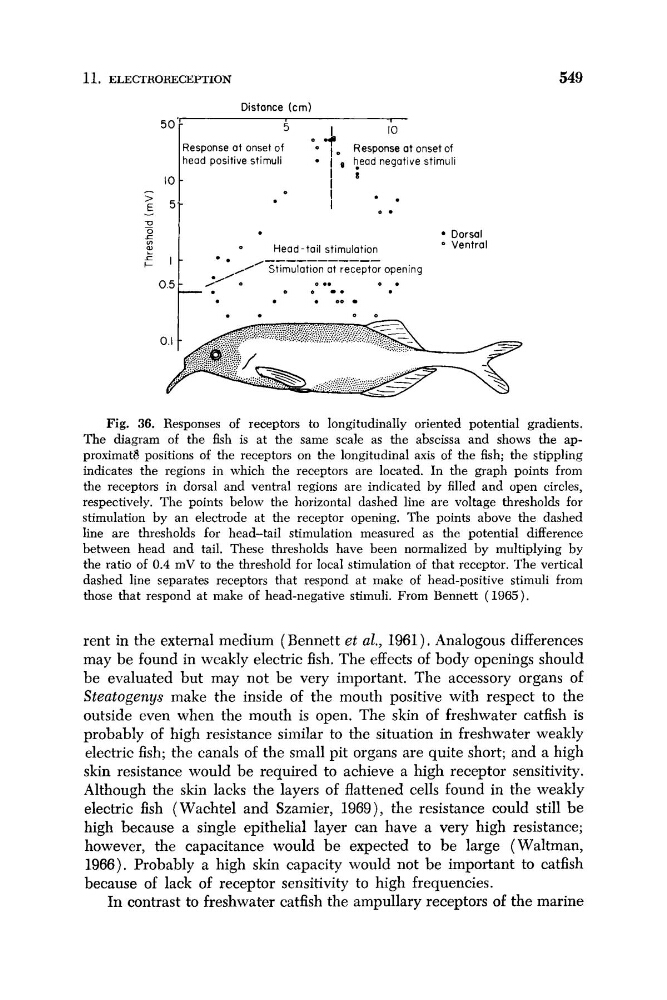
Fig. 36. Responses of receptors to longitudinally oriented potential gradients.
The diagram of the fish is at the same scale as the abscissa and shows the approximat6 positions of the receptors on the longitudinal axis of the fish; the stippling
indicates the regions in which the receptors are located. In the graph points from
the receptors in dorsal and ventral regions are indicated by filled and open circles,
respectively. The points below the horizontal dashed line are voltage thresholds for
stimulation by an electrode at the receptor opening. The points above the dashed
line are thresholds for head-tail stimulation measured as the potential difference
between head and tail. These thresholds have been normalized by multiplying by
the ratio of 0.4 mV to the threshold for local stimulation of that receptor. The vertical
dashed line separates receptors that respond at make of head-positive stimuli from
those that respond at make of head-negative stimuli. From Bennett (1965).
rent in the external medium (Bennett et al., 1961). Analogous differences
may be found in weakly electric fish. The effects of body openings should
be evaluated but may not be very important. The accessory organs of
Steatogenys make the inside of the mouth positive with respect to the
outside even when the mouth is open. The skin of freshwater catfish is
probably of high resistance similar to the situation in freshwater weakly
electric fish; the canals of the small pit organs are quite short; and a high
skin resistance would be required to achieve a high receptor sensitivity.
Although the skin lacks the layers of flattened cells found in the weakly
electric fish (Wachtel and Szamier, 1969), the resistance could still be
high because a single epithelial layer can have a very high resistance;
however, the capacitance would be expected to be large (Waltman,
1966). Probably a high skin capacity would not be important to catfish
because of lack of receptor sensitivity to high frequencies.
In contrast to freshwater catfish the ampullary receptors of the marine
549
Distance (cm)
I
Dorsal
Ventral
O
Head-tail stimulation
0 ..
0
0
..
. 00 .
Fig. 36. Responses of receptors to longitudinally oriented potential gradients.
The diagram of the fish is at the same scale as the abscissa and shows the approximat6 positions of the receptors on the longitudinal axis of the fish; the stippling
indicates the regions in which the receptors are located. In the graph points from
the receptors in dorsal and ventral regions are indicated by filled and open circles,
respectively. The points below the horizontal dashed line are voltage thresholds for
stimulation by an electrode at the receptor opening. The points above the dashed
line are thresholds for head-tail stimulation measured as the potential difference
between head and tail. These thresholds have been normalized by multiplying by
the ratio of 0.4 mV to the threshold for local stimulation of that receptor. The vertical
dashed line separates receptors that respond at make of head-positive stimuli from
those that respond at make of head-negative stimuli. From Bennett (1965).
rent in the external medium (Bennett et al., 1961). Analogous differences
may be found in weakly electric fish. The effects of body openings should
be evaluated but may not be very important. The accessory organs of
Steatogenys make the inside of the mouth positive with respect to the
outside even when the mouth is open. The skin of freshwater catfish is
probably of high resistance similar to the situation in freshwater weakly
electric fish; the canals of the small pit organs are quite short; and a high
skin resistance would be required to achieve a high receptor sensitivity.
Although the skin lacks the layers of flattened cells found in the weakly
electric fish (Wachtel and Szamier, 1969), the resistance could still be
high because a single epithelial layer can have a very high resistance;
however, the capacitance would be expected to be large (Waltman,
1966). Probably a high skin capacity would not be important to catfish
because of lack of receptor sensitivity to high frequencies.
In contrast to freshwater catfish the ampullary receptors of the marine