

11. ELECTRORECEPTION
529
-
L
(C) dL (
G
)
+ -
7
----.-- -
-
-
L__
0 -
I H ) n n i $
!
I
f-4
- -
-+---4-;g
. -
a
w
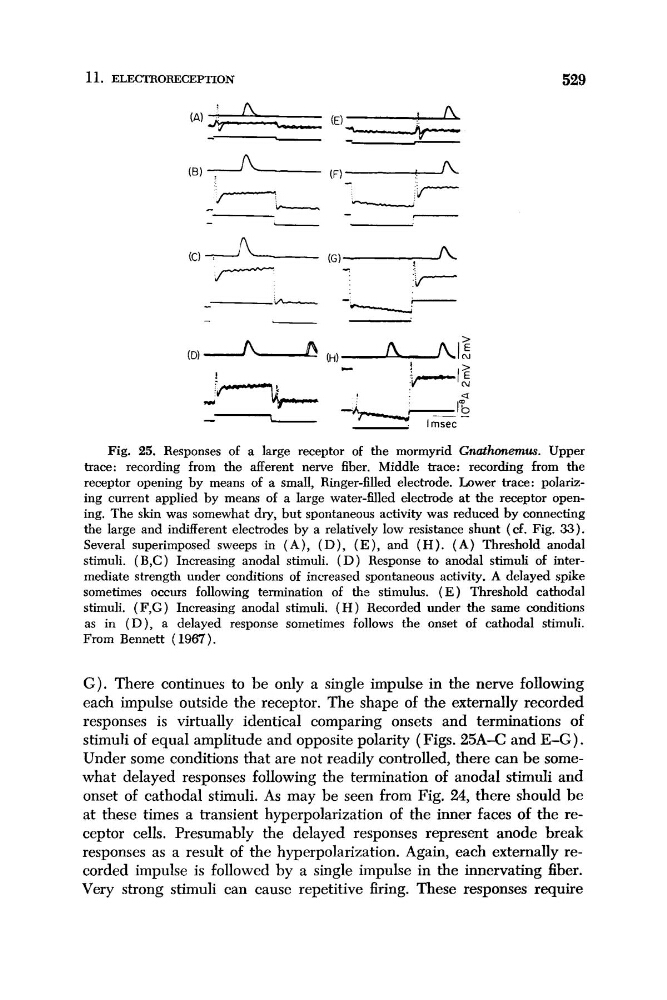
Fig. 25. Responses of a large receptor of the mormyrid Gnathonemas. Upper
trace: recording from the afferent nerve fiber. Middle trace: recording from the
receptor opening by means of a small, Ringer-filled electrode. Lower trace: polarizing current applied by means of a large water-filled electrode at the receptor opening. The skin was somewhat dry, but spontaneous activity was reduced by connecting
the large and indifferent electrodes by a relatively low resistance shunt (cf. Fig. 33).
Several superimposed sweeps in ( A ) , ( D ) , ( E ) , and ( H ) . ( A ) Threshold anodal
stimuli. (B,C) Increasing anodal stimuli. ( D ) Response to anodal stimuli of intermediate strength under conditions of increased spontaneous activity. A delayed spike
sometimes occurs following termination of the stimulus. ( E ) Threshold cathodal
stimuli. (F,G) Increasing anodal stimuli. ( H ) Recorded under the same conditions
as in ( D ) , a delayed response sometimes follows the onset of cathodal stimuli.
From Bennett (1967).
G). There continues to be only a single impulse in the nerve following
each impulse outside the receptor. The shape of the externally recorded
responses is virtually identical comparing onsets and terminations of
stimuli of equal amplitude and opposite polarity (Figs. 25A-C and E-G) .
Under some conditions that are not readily controlled, there can be somewhat delayed responses following the termination of anodal stimuli and
onset of cathodal stimuli. As may be seen from Fig. 24, there should be
at these times a transient hyperpolarization of the inner faces of the receptor cells. Presumably the delayed responses represent anode break
responses as a result of the hyperpolarization. Again, each externally recorded impulse is followed by a single impulse in the innervating fiber.
Very strong stimuli can cause repetitive firing. These responses require
529
-
L
(C) dL (
G
)
+ -
7
----.-- -
-
-
L__
0 -
I H ) n n i $
!
I
f-4
- -
-+---4-;g
. -
a
w
Fig. 25. Responses of a large receptor of the mormyrid Gnathonemas. Upper
trace: recording from the afferent nerve fiber. Middle trace: recording from the
receptor opening by means of a small, Ringer-filled electrode. Lower trace: polarizing current applied by means of a large water-filled electrode at the receptor opening. The skin was somewhat dry, but spontaneous activity was reduced by connecting
the large and indifferent electrodes by a relatively low resistance shunt (cf. Fig. 33).
Several superimposed sweeps in ( A ) , ( D ) , ( E ) , and ( H ) . ( A ) Threshold anodal
stimuli. (B,C) Increasing anodal stimuli. ( D ) Response to anodal stimuli of intermediate strength under conditions of increased spontaneous activity. A delayed spike
sometimes occurs following termination of the stimulus. ( E ) Threshold cathodal
stimuli. (F,G) Increasing anodal stimuli. ( H ) Recorded under the same conditions
as in ( D ) , a delayed response sometimes follows the onset of cathodal stimuli.
From Bennett (1967).
G). There continues to be only a single impulse in the nerve following
each impulse outside the receptor. The shape of the externally recorded
responses is virtually identical comparing onsets and terminations of
stimuli of equal amplitude and opposite polarity (Figs. 25A-C and E-G) .
Under some conditions that are not readily controlled, there can be somewhat delayed responses following the termination of anodal stimuli and
onset of cathodal stimuli. As may be seen from Fig. 24, there should be
at these times a transient hyperpolarization of the inner faces of the receptor cells. Presumably the delayed responses represent anode break
responses as a result of the hyperpolarization. Again, each externally recorded impulse is followed by a single impulse in the innervating fiber.
Very strong stimuli can cause repetitive firing. These responses require