

10. ELECTRIC ORGANS
451
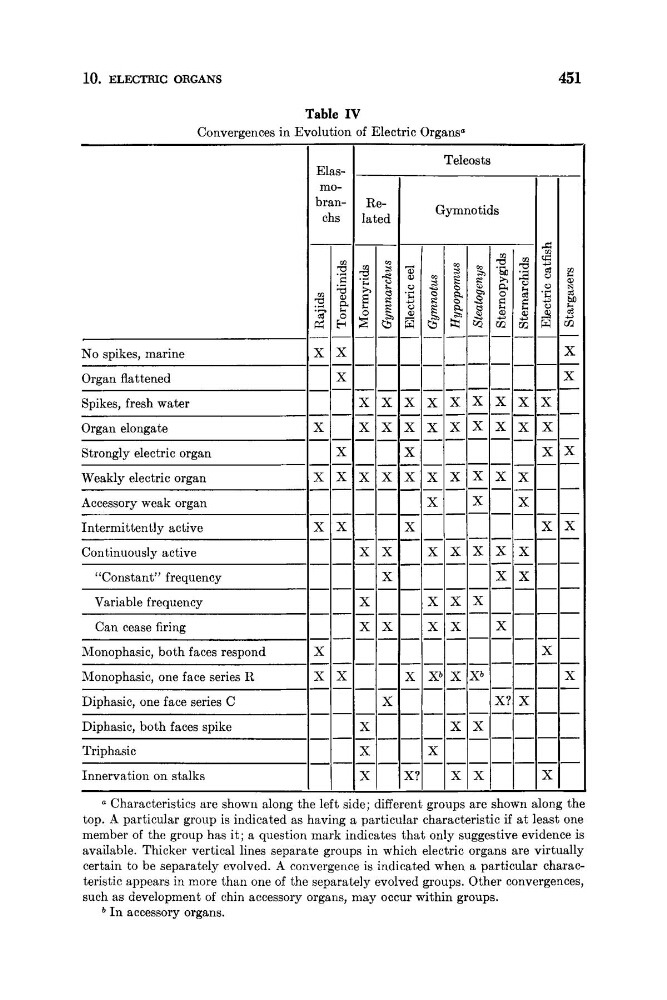
Table IV
Convergences in Evolution of Electric Organsa
No spikes, marine
Organ flattened
Spikes, fresh water
Organ elongate
Strongly electric organ
Weakly electric organ
Accessory weak organ
Intermittently active
Continuously active
“Constant” frequency
Variable frequency
Can cease firing
Monophasic, both faces respond
Monophasic, one face series R
Diphasic, one face series C
Diphasic, both faces spike
Triphasic
Innervation on stalks
Teleos ts
Gymno tids
- 1 - 1 -
x x
x x
-X
-
a Characteristics are shown along the left side; different groups are shown along the
top. A particular group is indicated as having a particular characteristic if a t least one
member of the group has it; a question mark indicates that only suggestive evidence is
available. Thicker vertical lines separate groups in which electric organs are virtually
certain to be separately evolved. A convergence is indicated when a particular characteristic appears in more than one of the separately evolved groups. Other convergences,
such as development of chin accessory organs, may occur within groups.
I n accessory organs.
451
Table IV
Convergences in Evolution of Electric Organsa
No spikes, marine
Organ flattened
Spikes, fresh water
Organ elongate
Strongly electric organ
Weakly electric organ
Accessory weak organ
Intermittently active
Continuously active
“Constant” frequency
Variable frequency
Can cease firing
Monophasic, both faces respond
Monophasic, one face series R
Diphasic, one face series C
Diphasic, both faces spike
Triphasic
Innervation on stalks
Teleos ts
Gymno tids
- 1 - 1 -
x x
x x
-X
-
a Characteristics are shown along the left side; different groups are shown along the
top. A particular group is indicated as having a particular characteristic if a t least one
member of the group has it; a question mark indicates that only suggestive evidence is
available. Thicker vertical lines separate groups in which electric organs are virtually
certain to be separately evolved. A convergence is indicated when a particular characteristic appears in more than one of the separately evolved groups. Other convergences,
such as development of chin accessory organs, may occur within groups.
I n accessory organs.