

10. ELECTRIC ORGANS
437
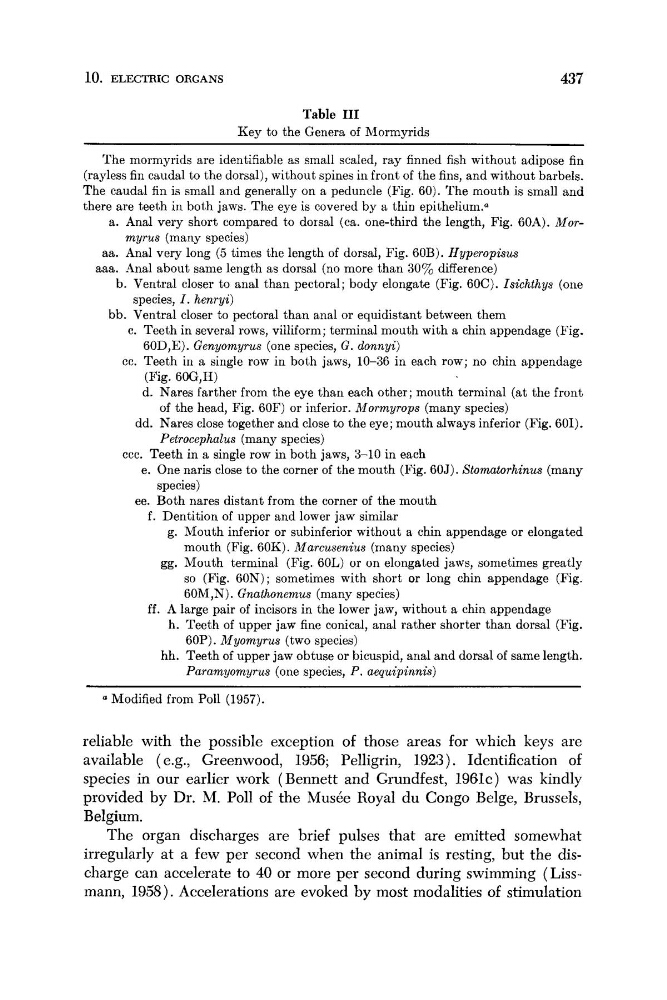
Table I11
Key to the Genera of Mormyrids
The mormyrids are identifiable as small scaled, ray finned fish without adipose fin
(rayless fin caudal to the dorsal), without spines in front of the fins, and without barbels.
The caudal fin is small and generally on a peduncle (Fig. 60). The mouth is small and
there are teeth in both jaws. The eye is covered by a thin epithe1ium.a
a. Anal very short compared to dorsal (ca. one-third the length, Fig. 60A). Mormyrus (many species)
aa. Anal very long (5 times the length of dorsal, Fig. 60B). Hyperopisus
aaa. Anal about same length as dorsal (no more than 30% difference)
b. Ventral closer to anal than pectoral; body elongate (Fig. 60C). Zsichthys (one
species, Z. henryi)
bb. Ventral closer to pectoral than anal or equidistant between them
c. Teeth in several rows, villiform; terminal mouth with a chin appendage (Fig.
6OD,E). Genyomyrus (one species, G. donnyi)
cc. Teeth in a single row in both jaws, 10-36 in each row; no chin appendage
(Fig. 60G,H)
d. Nares farther from the eye than each other; mouth terminal (at the front
dd. Nares close together and close to the eye; mouth always inferior (Fig. 601).
of the head, Fig. 60F) or inferior. Mormyrops (many species)
Petrocephalus (many species)
ccc. Teeth in a single row in both jaws, 3-10 in each
e. One naris close to the corner of the mouth (Fig. 60J). Stomatorhinus (many
species)
ee. Both nares distant from the corner of the mouth
f. Dentition of upper and lower jaw similar
g. Mouth inferior or subinferior without a chin appendage or elongated
mouth (Fig. 60K). Marcusenius (many species)
gg. Mouth terminal (Fig. 60L) or on elongated jaws, sometimes greatly
so (Fig. 60N); sometimes with short or long chin appendage (Fig.
60M,N). Gnathonemus (many species)
ff. A large pair of incisors in the lower jaw, without a chin appendage
h. Teeth of upper jaw fine conical, anal rather shorter than dorsal (Fig.
hh. Teeth of upper jaw obtuse or bicuspid, anal and dorsal of same length.
60P). Myomyrus (two species)
Paramyomyrus (one species, P . aequipinnis)
Modified from Poll (1957).
reliable with the possible exception of those areas for which keys are
available ( e.g., Greenwood, 1956; Pelligrin, 1923). Identification of
species in our earlier work (Bennett and Grundfest, 1961c) was kindly
provided by Dr. M. Poll of the Muske Royal du Congo Belge, Brussels,
Belgium.
The organ discharges are brief pulses that are emitted somewhat
irregularly at a few per second when the animal is resting, but the discharge can accelerate to 40 or more per second during swimming (Lissmann, 1958). Accelerations are evoked by most modalities of stimulation
437
Table I11
Key to the Genera of Mormyrids
The mormyrids are identifiable as small scaled, ray finned fish without adipose fin
(rayless fin caudal to the dorsal), without spines in front of the fins, and without barbels.
The caudal fin is small and generally on a peduncle (Fig. 60). The mouth is small and
there are teeth in both jaws. The eye is covered by a thin epithe1ium.a
a. Anal very short compared to dorsal (ca. one-third the length, Fig. 60A). Mormyrus (many species)
aa. Anal very long (5 times the length of dorsal, Fig. 60B). Hyperopisus
aaa. Anal about same length as dorsal (no more than 30% difference)
b. Ventral closer to anal than pectoral; body elongate (Fig. 60C). Zsichthys (one
species, Z. henryi)
bb. Ventral closer to pectoral than anal or equidistant between them
c. Teeth in several rows, villiform; terminal mouth with a chin appendage (Fig.
6OD,E). Genyomyrus (one species, G. donnyi)
cc. Teeth in a single row in both jaws, 10-36 in each row; no chin appendage
(Fig. 60G,H)
d. Nares farther from the eye than each other; mouth terminal (at the front
dd. Nares close together and close to the eye; mouth always inferior (Fig. 601).
of the head, Fig. 60F) or inferior. Mormyrops (many species)
Petrocephalus (many species)
ccc. Teeth in a single row in both jaws, 3-10 in each
e. One naris close to the corner of the mouth (Fig. 60J). Stomatorhinus (many
species)
ee. Both nares distant from the corner of the mouth
f. Dentition of upper and lower jaw similar
g. Mouth inferior or subinferior without a chin appendage or elongated
mouth (Fig. 60K). Marcusenius (many species)
gg. Mouth terminal (Fig. 60L) or on elongated jaws, sometimes greatly
so (Fig. 60N); sometimes with short or long chin appendage (Fig.
60M,N). Gnathonemus (many species)
ff. A large pair of incisors in the lower jaw, without a chin appendage
h. Teeth of upper jaw fine conical, anal rather shorter than dorsal (Fig.
hh. Teeth of upper jaw obtuse or bicuspid, anal and dorsal of same length.
60P). Myomyrus (two species)
Paramyomyrus (one species, P . aequipinnis)
Modified from Poll (1957).
reliable with the possible exception of those areas for which keys are
available ( e.g., Greenwood, 1956; Pelligrin, 1923). Identification of
species in our earlier work (Bennett and Grundfest, 1961c) was kindly
provided by Dr. M. Poll of the Muske Royal du Congo Belge, Brussels,
Belgium.
The organ discharges are brief pulses that are emitted somewhat
irregularly at a few per second when the animal is resting, but the discharge can accelerate to 40 or more per second during swimming (Lissmann, 1958). Accelerations are evoked by most modalities of stimulation