

10. ELECTRIC ORGANS
393
I msec
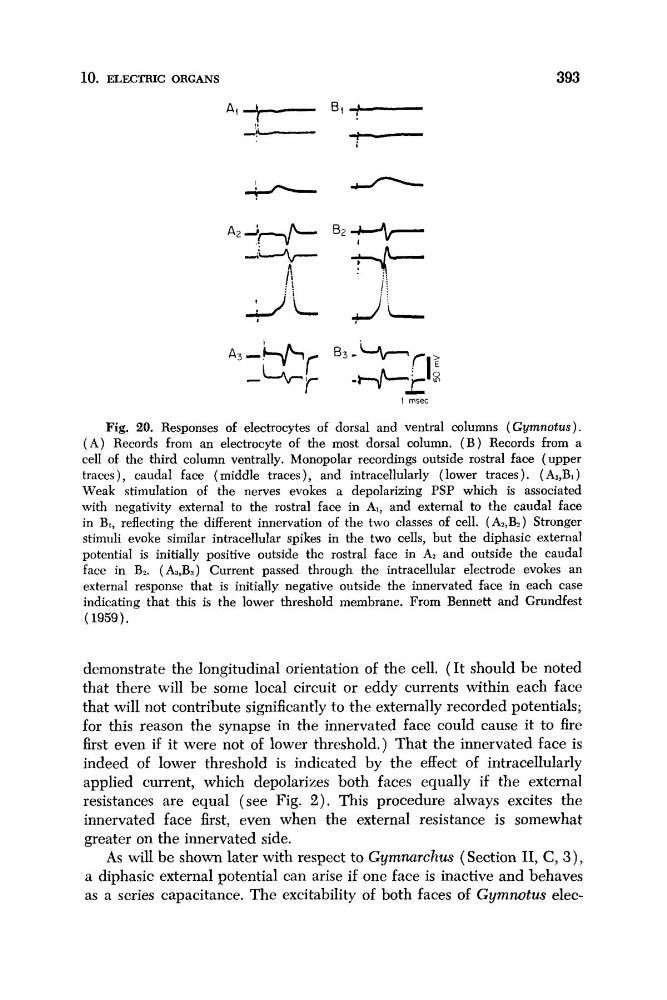
Fig. 20. Responses of electrocytes of dorsal and ventral columns (Gymnotus).
( A ) Records from an electrocyte of the most dorsal column. ( B ) Records from a
cell of the third column ventrally. Monopolar recordings outside rostral face (upper
traces ) , caudal face ( middle traces ) , and intracellularly ( lower traces ) . ( AI,Bl )
Weak stimulation of the nerves evokes a depolarizing PSP which is associated
with negativity external to the rostral face in A,, and external to the caudal face
in B,, reflecting the different innervation of the two classes of cell. (A,,B2) Stronger
stimuli evoke similar intracellular spikes in the two cells, but the diphasic external
potential is initially positive outside the rostral face in A, and outside the caudal
face in Bz. (AI,BS) Current passed through the intracellular electrode evokes an
external response that is initially negative outside the innervated face in each case
indicating that this is the lower threshold membrane. From Bennett and Grundfest
( 1959).
demonstrate the longitudinal orientation of the cell. ( I t should be noted
that there will be some local circuit or eddy currents within each face
that will not contribute significantly to the externally recorded potentials;
for this reason the synapse in the innervated face could cause it to fire
first even if it were not of lower threshold.) That the innervated face is
indeed of lower threshold is indicated by the effect of intracellularly
applied current, which depolarizes both faces equally if the external
resistances are equal (see Fig. 2). This procedure always excites the
innervated face first, even when the external resistance is somewhat
greater on the innervated side.
As will be shown later with respect to Gymnarchus (Section 11, C, 3 ) ,
a diphasic external potential can arise if one face is inactive and behaves
as a series capacitance. The excitability of both faces of Gymnotus elec-
393
I msec
Fig. 20. Responses of electrocytes of dorsal and ventral columns (Gymnotus).
( A ) Records from an electrocyte of the most dorsal column. ( B ) Records from a
cell of the third column ventrally. Monopolar recordings outside rostral face (upper
traces ) , caudal face ( middle traces ) , and intracellularly ( lower traces ) . ( AI,Bl )
Weak stimulation of the nerves evokes a depolarizing PSP which is associated
with negativity external to the rostral face in A,, and external to the caudal face
in B,, reflecting the different innervation of the two classes of cell. (A,,B2) Stronger
stimuli evoke similar intracellular spikes in the two cells, but the diphasic external
potential is initially positive outside the rostral face in A, and outside the caudal
face in Bz. (AI,BS) Current passed through the intracellular electrode evokes an
external response that is initially negative outside the innervated face in each case
indicating that this is the lower threshold membrane. From Bennett and Grundfest
( 1959).
demonstrate the longitudinal orientation of the cell. ( I t should be noted
that there will be some local circuit or eddy currents within each face
that will not contribute significantly to the externally recorded potentials;
for this reason the synapse in the innervated face could cause it to fire
first even if it were not of lower threshold.) That the innervated face is
indeed of lower threshold is indicated by the effect of intracellularly
applied current, which depolarizes both faces equally if the external
resistances are equal (see Fig. 2). This procedure always excites the
innervated face first, even when the external resistance is somewhat
greater on the innervated side.
As will be shown later with respect to Gymnarchus (Section 11, C, 3 ) ,
a diphasic external potential can arise if one face is inactive and behaves
as a series capacitance. The excitability of both faces of Gymnotus elec-