

388
M. V. L. BENNETT
papilli and an extensive network of small canaliculi that greatly increase
the surface area compared to the area that a simple planar membrane
would have (Fig. 17, see also Mathewson et al., 1961).
The properties of eel electrocytes are only slightly more complex
than those of electrocytes of the stargazer and Torpedo. The innervated
face responds to depolarization by generating a spike that overshoots
the resting potential by about 50 mV. The uninnervated face is of very
low resistance and does not become excited. The responses of a single
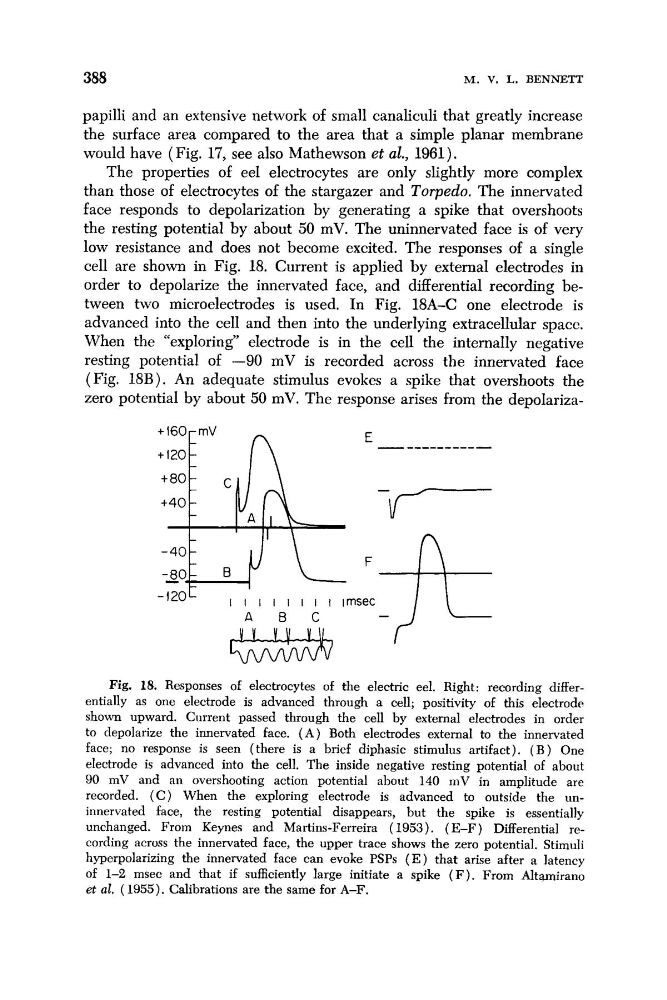
cell are shown in Fig. 18. Current is applied by external electrodes in
order to depolarize the innervated face, and differential recording between two microelectrodes is used. In Fig. 18A-C one electrode is
advanced into the cell and then into the underlying extracellular space.
When the “exploring” electrode is in the cell the internally negative
resting potential of -90 mV is recorded across the innervated face
(Fig. 18B). An adequate stimulus evokes a spike that overshoots the
zero potential by about 50 mV. The response arises from the depolarizaFig. 18. Responses of electrocytes of the electric eel. Right: recording differentially as one electrode is advanced through a cell; positivity of this electrode
shown upward. Current passed through the cell by external electrodes in order
to depolarize the innervated face. ( A ) Both electrodes external to the innervated
face; no response is seen (there is a brief diphasic stimulus artifact). ( B ) One
electrode is advanced into the cell. The inside negative resting potential of about
90 mV and an overshooting action potential about 140 mV in amplitude are
recorded. ( C ) When the exploring electrode is advanced to outside the uninnervated face, the resting potential disappears, but the spike is essentially
unchanged. From Keynes and Martins-Ferreira ( 1953). (E-F) Differential recording across the innervated face, the upper trace shows the zero potential. Stimuli
hyperpolarizing the innervated face can evoke PSPs ( E ) that arise after a latency
of 1-2 msec and that if sufficiently large initiate a spike ( F ) . From Altqmirano
et al. ( 1955). Calibrations are the same for A-F.
M. V. L. BENNETT
papilli and an extensive network of small canaliculi that greatly increase
the surface area compared to the area that a simple planar membrane
would have (Fig. 17, see also Mathewson et al., 1961).
The properties of eel electrocytes are only slightly more complex
than those of electrocytes of the stargazer and Torpedo. The innervated
face responds to depolarization by generating a spike that overshoots
the resting potential by about 50 mV. The uninnervated face is of very
low resistance and does not become excited. The responses of a single
cell are shown in Fig. 18. Current is applied by external electrodes in
order to depolarize the innervated face, and differential recording between two microelectrodes is used. In Fig. 18A-C one electrode is
advanced into the cell and then into the underlying extracellular space.
When the “exploring” electrode is in the cell the internally negative
resting potential of -90 mV is recorded across the innervated face
(Fig. 18B). An adequate stimulus evokes a spike that overshoots the
zero potential by about 50 mV. The response arises from the depolarizaFig. 18. Responses of electrocytes of the electric eel. Right: recording differentially as one electrode is advanced through a cell; positivity of this electrode
shown upward. Current passed through the cell by external electrodes in order
to depolarize the innervated face. ( A ) Both electrodes external to the innervated
face; no response is seen (there is a brief diphasic stimulus artifact). ( B ) One
electrode is advanced into the cell. The inside negative resting potential of about
90 mV and an overshooting action potential about 140 mV in amplitude are
recorded. ( C ) When the exploring electrode is advanced to outside the uninnervated face, the resting potential disappears, but the spike is essentially
unchanged. From Keynes and Martins-Ferreira ( 1953). (E-F) Differential recording across the innervated face, the upper trace shows the zero potential. Stimuli
hyperpolarizing the innervated face can evoke PSPs ( E ) that arise after a latency
of 1-2 msec and that if sufficiently large initiate a spike ( F ) . From Altqmirano
et al. ( 1955). Calibrations are the same for A-F.