

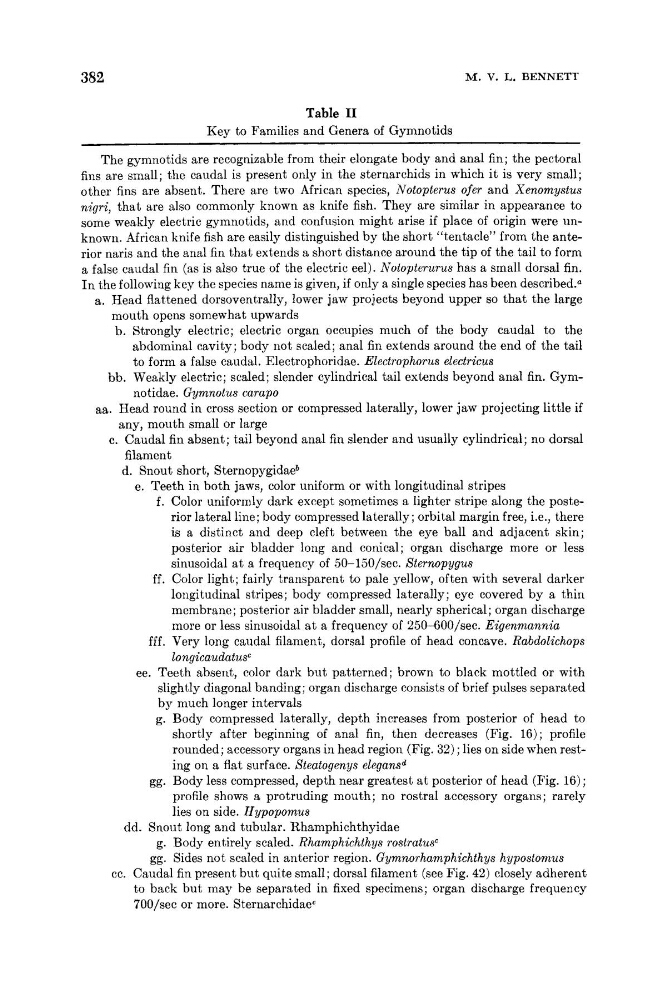
382
Table I1
Key to Families and Genera of Gymnotids
M. V. L. BENNETT
The gymnotids are recognizable from their elongate body and anal fin; the pectoral
fills are small; the caudal is present only in the sternarchids in which it is very small;
other fins are absent. There are two African species, Notopterus ofcr and Xenomystus
nigri, that are also commonly known as knife fish. They are similar in appearance to
Some weakly electric gymnotids, and confusion might arise if place of origin were unknown. African knife fish are easily distinguished by the short “tentacle” from the anterior naris and the anal fin that extends a short distance around the tip of the tail to form
a false caudal fin (as is also true of the electric eel). Notoptcrurus has a small dorsal fin.
I n the following key the species name is given, if only a single species has been described.a
a. Head flattened dorsoventrally, lower jaw projects beyond upper so that the large
mouth opens somewhat upwards
b. Strongly electric; electric organ occupies much of the body caudal to the
abdominal cavity; body not scaled; anal fin extends around the end of the tail
to form a false caudal. Electrophoridae. Electrophorus elcctricus
bb. Weakly electric; scaled; slender cylindrical tail extends beyond anal fin. Gymnotidae. Gymnotus carapo
%a. Head round in cross section or compressed laterally, lower jaw projecting little if
c. Caudal fin absent; tail beyond anal fin slender and usually cylindrical; no dorsal
any, mouth small or large
filament
d. Snout short, Sternopygidae6
e. Teeth in both jaws, color uniform or with longitudinal stripes
f. Color uniformly dark except sometimes a lighter stripe along the posterior lateral line; body compressed laterally; orbital margin free, i.e., there
is a distinct and deep cleft between the eye ball and adjacent skin;
posterior air bladder long and conical; organ discharge more or less
sinusoidal a t a frequency of 50-150/sec. Sternopygus
ff. Color light; fairly transparent to pale yellow, often with several darker
longitudinal stripes; body compressed laterally; eye covered by a thin
membrane; posterior air bladder small, nearly spherical; organ discharge
more or less sinusoidal a t a frequency of 250-600/sec. Eigcnmannia
fff. Very long caudal filament, dorsal profile of head concave. Rabdolichops
longicaudatusc
ee. Teeth absent, color dark but patterned; brown to black mottled or with
slightly diagonal banding; organ discharge consists of brief pulses separated
by much longer intervals
g. Body compressed laterally, depth increases from posterior of head to
shortly after beginning of anal fin, then decreases (Fig. 16); profile
rounded; accessory organs in head region (Fig. 32) ; lies on side when resting on a flat surface. Steatogenys elegansd
gg. Body less compressed, depth near greatest a t posterior of head (Fig. 16);
profile shows a protruding mouth; no rostra1 accessory organs; rarely
lies on side. Hypopomus
dd. Snout long and tubular. Rhamphichthyidae
g. Body entirely scaled. Rhamphichthys rostratusC
gg. Sides not scaled in anterior region. Gymnorhamphichthys hypostomus
cc. Caudal fin present but quite small; dorsal filament (see Fig. 42) closely adherent
to back but may be separated in fixed specimens; organ discharge frequency
700/sec or more. Sternarchidaee
Table I1
Key to Families and Genera of Gymnotids
M. V. L. BENNETT
The gymnotids are recognizable from their elongate body and anal fin; the pectoral
fills are small; the caudal is present only in the sternarchids in which it is very small;
other fins are absent. There are two African species, Notopterus ofcr and Xenomystus
nigri, that are also commonly known as knife fish. They are similar in appearance to
Some weakly electric gymnotids, and confusion might arise if place of origin were unknown. African knife fish are easily distinguished by the short “tentacle” from the anterior naris and the anal fin that extends a short distance around the tip of the tail to form
a false caudal fin (as is also true of the electric eel). Notoptcrurus has a small dorsal fin.
I n the following key the species name is given, if only a single species has been described.a
a. Head flattened dorsoventrally, lower jaw projects beyond upper so that the large
mouth opens somewhat upwards
b. Strongly electric; electric organ occupies much of the body caudal to the
abdominal cavity; body not scaled; anal fin extends around the end of the tail
to form a false caudal. Electrophoridae. Electrophorus elcctricus
bb. Weakly electric; scaled; slender cylindrical tail extends beyond anal fin. Gymnotidae. Gymnotus carapo
%a. Head round in cross section or compressed laterally, lower jaw projecting little if
c. Caudal fin absent; tail beyond anal fin slender and usually cylindrical; no dorsal
any, mouth small or large
filament
d. Snout short, Sternopygidae6
e. Teeth in both jaws, color uniform or with longitudinal stripes
f. Color uniformly dark except sometimes a lighter stripe along the posterior lateral line; body compressed laterally; orbital margin free, i.e., there
is a distinct and deep cleft between the eye ball and adjacent skin;
posterior air bladder long and conical; organ discharge more or less
sinusoidal a t a frequency of 50-150/sec. Sternopygus
ff. Color light; fairly transparent to pale yellow, often with several darker
longitudinal stripes; body compressed laterally; eye covered by a thin
membrane; posterior air bladder small, nearly spherical; organ discharge
more or less sinusoidal a t a frequency of 250-600/sec. Eigcnmannia
fff. Very long caudal filament, dorsal profile of head concave. Rabdolichops
longicaudatusc
ee. Teeth absent, color dark but patterned; brown to black mottled or with
slightly diagonal banding; organ discharge consists of brief pulses separated
by much longer intervals
g. Body compressed laterally, depth increases from posterior of head to
shortly after beginning of anal fin, then decreases (Fig. 16); profile
rounded; accessory organs in head region (Fig. 32) ; lies on side when resting on a flat surface. Steatogenys elegansd
gg. Body less compressed, depth near greatest a t posterior of head (Fig. 16);
profile shows a protruding mouth; no rostra1 accessory organs; rarely
lies on side. Hypopomus
dd. Snout long and tubular. Rhamphichthyidae
g. Body entirely scaled. Rhamphichthys rostratusC
gg. Sides not scaled in anterior region. Gymnorhamphichthys hypostomus
cc. Caudal fin present but quite small; dorsal filament (see Fig. 42) closely adherent
to back but may be separated in fixed specimens; organ discharge frequency
700/sec or more. Sternarchidaee