

1. VISUAL PIGMENTS
21
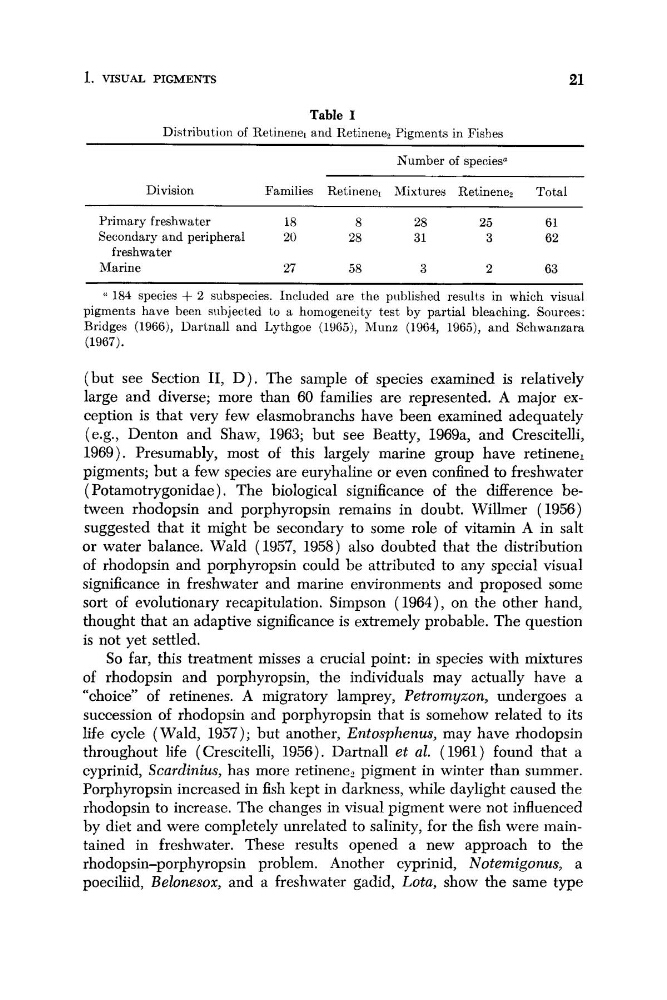
Table I
Distribution of Retinenel and Retinenel Pigments in Fishes
Number of species”
Division
Families Retinenel Mixtures Retinenea
Total
Primary freshwater
18
8
28
25
61
Secondary and peripheral
20
28
31
3
62
Marine
27
58
3
2
63
freshwater
(L 184 species + 2 subspecies. Included are the published results in which visual
pigments have been subjected to a homogeneity test by partial bleaching. Sources:
Bridges (1966), Dartnall and Lythgoe (1965), Munz (1964, 1965), and Schwanzara
(1967).
(but see Section 11, D ) . The sample of species examined is relatively
large and diverse; more than 60 families are represented. A major exception is that very few elasmobranchs have been examined adequately
(e.g., Denton and Shaw, 1963; but see Beatty, 1969a, and Crescitelli,
1969). Presumably, most of this largely marine group have retinenel
pigments; but a few species are euryhaline or even confined to freshwater
( Potamotrygonidae) . The biological significance of the difference between rhodopsin and porphyropsin remains in doubt. Willmer (1956)
suggested that it might be secondary to some role of vitamin A in salt
or water balance. Wald (1957, 1958) also doubted that the distribution
of rhodopsin and porphyropsin could be attributed to any special visual
significance in freshwater and marine environments and proposed some
sort of evolutionary recapitulation. Simpson ( 1964), on the other hand,
thought that an adaptive significance is extremely probable. The question
is not yet settled.
So far, this treatment misses a crucial point: in species with mixtures
of rhodopsin and porphyropsin, the individuals may actually have a
“choice” of retinenes. A migratory lamprey, Petromyxon, undergoes a
succession of rhodopsin and porphyropsin that is somehow related to its
life cycle ( Wald, 1957); but another, Entosphenus, may have rhodopsin
throughout life (Crescitelli, 1956). Dartnall et al. (1961) found that a
cyprinid, Scardinius, has more retinene2 pigment in winter than summer.
Porphyropsin increased in fish kept in darkness, while daylight caused the
rhodopsin to increase. The changes in visual pigment were not influenced
by diet and were completely unrelated to salinity, for the fish were maintained in freshwater. These results opened a new approach to the
rhodopsin-porphyropsin problem. Another cyprinid, Notemigonus, a
poeciliid, Belonesox, and a freshwater gadid, Lota, show the same type
21
Table I
Distribution of Retinenel and Retinenel Pigments in Fishes
Number of species”
Division
Families Retinenel Mixtures Retinenea
Total
Primary freshwater
18
8
28
25
61
Secondary and peripheral
20
28
31
3
62
Marine
27
58
3
2
63
freshwater
(L 184 species + 2 subspecies. Included are the published results in which visual
pigments have been subjected to a homogeneity test by partial bleaching. Sources:
Bridges (1966), Dartnall and Lythgoe (1965), Munz (1964, 1965), and Schwanzara
(1967).
(but see Section 11, D ) . The sample of species examined is relatively
large and diverse; more than 60 families are represented. A major exception is that very few elasmobranchs have been examined adequately
(e.g., Denton and Shaw, 1963; but see Beatty, 1969a, and Crescitelli,
1969). Presumably, most of this largely marine group have retinenel
pigments; but a few species are euryhaline or even confined to freshwater
( Potamotrygonidae) . The biological significance of the difference between rhodopsin and porphyropsin remains in doubt. Willmer (1956)
suggested that it might be secondary to some role of vitamin A in salt
or water balance. Wald (1957, 1958) also doubted that the distribution
of rhodopsin and porphyropsin could be attributed to any special visual
significance in freshwater and marine environments and proposed some
sort of evolutionary recapitulation. Simpson ( 1964), on the other hand,
thought that an adaptive significance is extremely probable. The question
is not yet settled.
So far, this treatment misses a crucial point: in species with mixtures
of rhodopsin and porphyropsin, the individuals may actually have a
“choice” of retinenes. A migratory lamprey, Petromyxon, undergoes a
succession of rhodopsin and porphyropsin that is somehow related to its
life cycle ( Wald, 1957); but another, Entosphenus, may have rhodopsin
throughout life (Crescitelli, 1956). Dartnall et al. (1961) found that a
cyprinid, Scardinius, has more retinene2 pigment in winter than summer.
Porphyropsin increased in fish kept in darkness, while daylight caused the
rhodopsin to increase. The changes in visual pigment were not influenced
by diet and were completely unrelated to salinity, for the fish were maintained in freshwater. These results opened a new approach to the
rhodopsin-porphyropsin problem. Another cyprinid, Notemigonus, a
poeciliid, Belonesox, and a freshwater gadid, Lota, show the same type